Saturday, 16 March 2024

July 1941

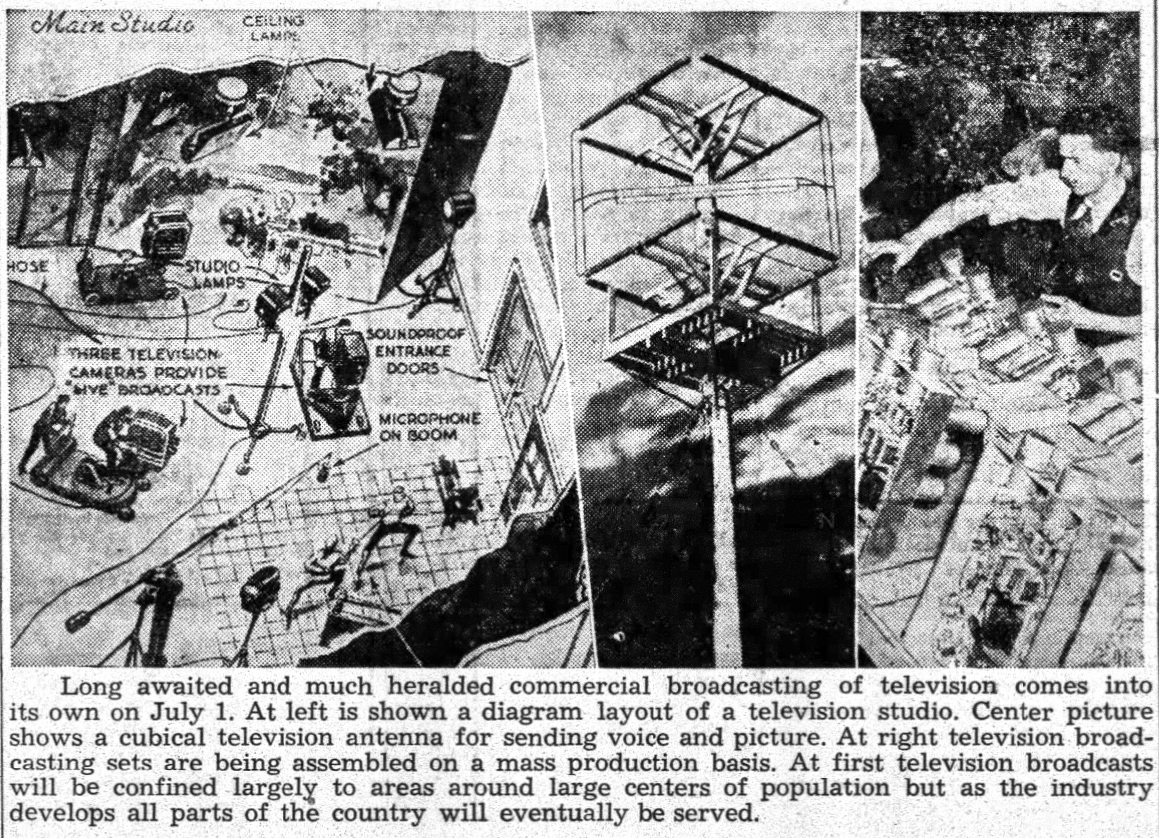
July 1, 1941 was one of most significant days in entertainment history.

It’s the day commercials were allowed on American television.

Money drives the television machine. It’s responsible for just about everything you see on the home screen (even educational television needs grants to put programming on the air). And, today, you don’t get streams in your home for nothing. Legally, anyway.

July 1, 1941 was when it all began.

There were still only a handful of stations on the air. Even then, the FCC had approved DuMont’s picture standards, which meant TV sets had trouble picking up signals from NBC and, especially, CBS. That was in New York. Los Angeles and Chicago had stations broadcasting, with Philadelphia and Schenectady in stages of development. Even DuMont wasn’t ready to air regular programming.

Chatter abounded about commercial television when it debuted. We posted about it here. There are lots of newspaper stories to pick from, so we’ve tried to restrict ourselves.

The schedules below for New York television in July 1941 come from the Herald Tribune and the Times. There was no programming on Sunday. DuMont was only running unspecified tests.

If you're wondering, the little girl named Ann Francis seen on the storybook show later grew up to be Anne Francis.

Tuesday, July 1, 1941
WNBT (NBC), New York, Channel 1 (55.75mc, video 51.25mc)
1:30—Test pattern.
2:30—Baseball: Phillies vs. Dodgers at Ebbets Field.
6:45 to 7:00—News with Lowell Thomas.
8:00—Test pattern.
9:00—U.S.O. Program: Thomas E. Dewey, Mrs. Winthrop Aldrich, others; Uncle Jim’s Question Bee; Musical Revue: “Bottlenecks of 1941”; “Truth or Consequences” with Ralph Edwards.
WCBW (CBS), New York, Channel 2 (65.75mc, video 61.25mc)
2:00—Test pattern.
2:30—Dancing lessons.
3:15 to 3:30—Children’s story.
7:30—Test pattern.
8:00—News.
8:15—Joan Edwards, songs.
8:30—Metropolitan Museum of Art: Speaker, Francis Henry Tyalor.
9:00 to 9:30—Bob Edge interviews Paul Schreiber, Yankee pitcher; Mrs. Gwendolyn Bloomingdale.
W2XWV (DuMont), New York, Channel 4
12 to 6 p.m.—Tests and selected films.

As of last Tuesday (July 1), it was legal to have advertising sponsorship of television programs in America. Because it was legal NBC solicited its radio advertisers to try the new medium and three sponsors accepted. Thus NBC had some commercials to start off commercial television. This was Tuesday. On Wednesday and thereafter NBC television schedules were about where they have been since 1939 — filling in time. Mixed into the premiere night of commercial television was a Soldier Show (reviewed below) and ceremonies in celebration of the successful culmination of the recent $11,000,000 fund drive for the United Service Organizations which will hereafter operate canteens, etc., at or near our Army camps. The ceremonies televised the faces of such personages as Thomas E. Dewey, Walter Hoving, Admiral Andrews, Col. Lord, Mrs. Winthrop Aldrich and Mrs. Ogden L. Mills. There was nothing to say about the ceremonies except that the two ladies had a startled where-am-I look when they got the cue to talk and the scripts of all the speakers were written in that, dull, logrolling monotone characteristic of organization officers congratulating each other.
More detailed comment on commercial television's first night follows:
UNCLE JIM'S QUESTION BEE
With Bill Slater, Edith Spencer, Dan Seymour
Audience Participation
SPRY (Levers)
Once-Only, July 1, 1941
WNBT (NBC), New York
(Ruthrauff & Ryan)
Uncle Jim's (Bill Slater) Question Bee, one of the innumerable audience participation programs on the radio and neither worse nor better, entertainment-wise, than its contemporaries, was fortified by another sponsored personality of the same sponsor, Aunt Jenny (Edith Spencer), for this one-time experiment by Ruthrauff & Ryan in television production. Uncle Jim's was able to call itself the first advertising-sponsored television quiz program in history. It was first by about one hour, Ralph Edwards' Truth and Consequences' being a later offering of the premiere evening.
Probably typical of television's booking difficulties, the guests who had been announced, Lionel Stander and Gloria Stuart, did not show up. Instead Allen Prescott, an experienced radio program emcee, and an artist's model chosen apparently at the last minute for her photogenic features rather than any probable ability to help along a quiz, were substituted. There was also an 'outsider' couple.
The effect of television upon an audience participation show may be said to be twofold: (1) the contestants acquire a visual 'personality,' offsetting the fact they seldom seem to have any microphone personality unless they're plants; and (2) the child-like nature of quizzes is made doubly evident. It might be fair to deduce that television would enhance the appeal of this sort of thing to those already interested and drive away everybody else. But television does have an 'eavesdropping' quality like a party-line telephone and homo sapiens usually dote upon listening in on other people's conversations. So there you have a confused picture, a politician's yes-but-on-the-other-hand-no kind of report. Which is probably the story of television as of its 'commercial' beginning, July 1; 1941.
It was pretty artificial and self-conscious striving when the whole group gathered around Aunt Jenny's table where a Spry-made chocolate layer cake was cut. Uncle Jim, announcer Dan Seymour, the artist's model, Allen Prescott and the visiting couple all awkwardly nibbled at the cake as Aunt Jenny, without a hint of self-consciousness, kept taking bows for her prowess as a cook.
Aunt Jenny (Edith Spencer) is okay for television. This is not surprising as she was undoubtedly picked in the first place because she shows up in magazine layouts as the perfect prototype of the kitchen-proud American homekeeper. As a case of typecasting the advertising world has in Aunt Jenny out-Hollywooded Hollywood. Not only does this actress look (wearing specs), dress (bungalow aprons, etc.) and appear (affable, energetic, workman-like) like the incarnate copywriter's concept of all American toilers-over-hot-stoves, but she is able to read lines 100% in character. She's a clinical study in beautiful-food-selling hokum.
But Aunt Jenny, the next time she cuts a chocolate layer cake over television, will have to remember not to lick the cake-knife with her mouth and then offer to cut her guests another, slice with the same knife.
The program was panned on and off commercially by a closeup of Dan Seymour, a mite silly-feeling, holding a can of the shortening grease made by Levers. Seymour televises attractively as does Uncle Jim.

LOWELL THOMAS
Newscast
15 Mins.
SUNOCO
Once only, July 1
WNBT (NBC), New York
(Roche, Williams, Cunningham)
The regular Sunoco newscast at 6:45 P.M. was doubled for television. In other words, while he was giving his digest of the news tickers, Thomas was also under the fire of the iconoscope. Television presented a picture of him broadcasting.
Added for television fore and aft were closeups of cans of Sunoco oil. There is nothing very glamorous about these cans or about men reading either news digests or commercials from scripts. But the value of news to television as to radio—and other media— cannot be questioned. It is a standard commodity of human interest.
Thomas has appeared before the tele cameras before and was at home. He 'photographs' okay, mustache and eyebrows and abundant hair framing a clear picture for black and white.

'TRUTH OR CONSEQUENCES'
With Ralph Edwards
IVORY SOAP
Once Only, July 1, 1941
WNBT (NBC), New York (Compton)
This was a second question-asking program in an evening of dullish, slow-paced, unedited, time-ignoring telecasts. By the time the Ralph Edwards session began along about 10:30 p.m. the viewers must have been pretty blah from it all. (It was a beastly hot night to make it worse and 525-line television doesn't get ideal results on 441-line sets.)
There were the same kind of camera closeups of Ivory Soap as of Sunoco and Spry containers earlier. There was a staged bit of hoke about what beautiful hands one gal has and vice versa on another gal. And the reason?
It was pretty hard to believe that the contestants were not paid stooges. This radio program is a broadcast version of the old parlor game of forfeits. The horseplay unquestionably is responsible for the program's high radio popularity rating.
Television was able to offer all who were mechanically equipped to see the strange spectacle of an adult citizen told to perform a hula-hula dance. The production staff wrapped him in a grass skirt and he carried through with that willingness to play the fool which sometimes passes as being a good sport It makes a very unpretty picture — If anybody cares — of American citizenship in 1941. But there were more and more incredible consequences to come. There was, for example, another fat gent who was told he was a child. He was to prepare to bawl while seated on the lap of a middle-aged woman, ostensibly a complete stranger to him. The instructions were the cue for the prop boys to rush a length of cloth between the fat gent's legs and tie him up in a diaper. All good clean radio fun, but it helped to begin television under commercial sponsorship on a pretty low level.
May destiny preserve this nation from the terrible example of smart-alekism which, with the aid of television if ever organized nationally, this kind of drunk-while-sober behavior represents! Land. (Variety, July 9)

'JACK AND THE BEANSTALK'
With Lydia Ferera, Ann Francis, John Rupe
Story with Cartoons
Afternoon, 3:25 WCBW (CBS) New York
Here is an imaginative experiment. Using the two television cameras on mobile dollies, the story of 'Jack and the Beanstalk' was begun as a serial. Lydia Perera is the story-teller; Ann Francis the blonde daughter who kneels down by mommy's chair. John Rupe is the animator who draws to suit the narrative as the story unfolds. It was a pleasant, nostalgic reminder in simple — beautifully simple — terms and it provided a first rate sample of fluid, unfettered approach to the production problems of television.
It was amusing and significant how often the cartooning of Rupe, as executed before the viewer's eyes, drew warm chuckles. The iconoscopes trained on and off mother, mother and daughter, child, the expanding panel of cartoons. Especially amusing was Rupe's suggestion of what his home and mother looked like to Jack in the beanstalk once he had climbed up to the land of make-believe.
Phillip Booth both writes and directs this series, and an intelligent job he does in both. Land. (Variety, July 9)

NBC's latest decision is to make available 15 hours or more per week for commercial television, starting July 1. It states that it has several accounts lined up for television broadcasting.
RCA-NBC television got started yesterday (Tuesday) in New York under the new dispensation from the Federal Communications Commission which permits advertising sponsorship. It's pretty vague who of the 2,000-odd owners or television receivers can tune in the programs at this date because of the needed conversion from 441 line images to 525 lines.
However, NBC has three first-time sponsors with which to start. General Mills sponsored the Brooklyn Dodgers baseball newscasting in the name of Sun Oil, At 9:15 the Uncle Jim's Question Bee was presented for Spry with Gloria Stuart and Lionel Stander as special personalities along with 'Aunt Jenny,' which same sponsor. Lever Brothers, has on CBS.


NEW YORK, July 5.—NBC commercial television bowed in Tuesday [1] with Bulova Time Signals, Lowell Thomas airing the news for Sun Oil Company, Uncle Jim’s Question Bee for Lever Bros., and Ralph Edwards’ Truth or Consequences for Procter & Gamble. With the exception of Thomas, who aired at 6:45 p.m., and the first Bulova Times Signal at 2:30 p.m., the remaining commercials were telecast between 9 and 11 p.m., together with a few sustaining features which included talks on the United Service Organization Campaign and a soldier-boy revue, Bottlenecks of 1941, thrown together by the draftees at Fort Monmouth, N. J.
Emerging from this television melange was one completely sock tele show. Truth or Consequences. Truth or Consequences has already proven itself good stage fare, having successfully played theaters, therefore its success on tele might have been expected. Its action was in the nut groove, having much of the element of spontaneity, and Edwards paced the show as if he had been doing television for years, showing no hesitancy or doubt as to the propriety or execution of show’s screwball antics. Commercials on this session were rather good, best of them occurring at the beginning of the program and showing two women—one of them with “dishpan hands” and the other with comparatively lovely appendages owing to the use of Ivory Soap.
Uncle Jim’s Question Bee, airing for Spry, did not come thru so successfully: rather it limped along, hitting a spontaneous level only occasionally. Players occasionally assumed a wooden quality that threatens to be the bane of many would-be tele performers and programs. Commercial plugs were experimentally interesting, but on occasion foolish and boring. Announcer Don Seymour, for instance, would sometimes appear holding a can of Spry. This type of plug lacks all ingenuity, and the expression on Seymour’s face seemed to indicate this fact. A better commercial had Aunt Jenny displaying the texture of Spry and giving out with an appropriate spiel. A more elaborate but boring commercial showed the cast eating a cake baked with Spry. This was much too long and showed the players gorging themselves while maintaining fixed, grinning facial expressions.
The USO program, which opened the evening telecast, was an average piece of business presenting a number of speakers. Thomas E. Dewey led the session and proved very telegenic.
Bottlenecks of 1941, the soldier boys’ musical comedy, had a few bright moments, undoubtedly gave the soldiers and their families some thrills, but displayed the to-be-expected amateurish faults. (Paul Ackerman, Billboard, July 12)


'BOTTLENECKS OF 1941'
Soldier Show
WNBT (NBC), New York
This may have been funny to the soldiers, and it may have had some punch and zip in an auditorium. But before the NBC television cameras it was unbearably dull. Every item was dragged out nearly everything was in slow tempo. The humor was too local, too special for more than an occasional half-smile's-worth via sky-pictures.
Fort Monmouth Signal Corps Replacement Training Centre wrote, directed and performed the various skits, songs, etc. Although billed as 'excerpts' the suspicion was inevitably aroused that nobody at NBC exercised any of the ruthless cutting that might have made this a passable filler on the novelty value. One-third its rambling running length would have been more suitable. But then, of course, everybody couldn't have been seen or heard or gotten any of those pointless 'credits' which army morale or free show courtesy seems to demand. (Variety, July 23)


NBC, fully licensed to carry advertising-sponsored television programs, went on the air last Tuesday, July 1, in New York with three sample commercial programs (see reviews this issue), but CBS, not yet fully commercially licensed and lacking an audience because Channel 2 is not provided for on existing receivers, has merely stepped up its program experimentation. After viewing the NBC commercials and the CBS experimentals these showmanship observations seem justified:
1. The commercials will be a headache, especially under the non-fluid tape-measured, narrow space production methods of NBC.
2. The experimental at Columbia seem to have a basically more promising approach to programming in terms of showmanship.
The difference, invidious or not, between NBC and CBS television production seems to be that NBC is formal and CBS is informal, highly so. NBC skypictures give the impression that the engineer runs the works. CBS already suggests that CBS runs the engineers. This is the difference between treating telelvision [sic] as a science only and treating it as an art exploiting a science.
The informality at CBS, which occupies huge auditorium-like quarters in Grand Central Terminal, is exemplified in numerous small ways, but especially in the general attitude, which represents conscious company policy. For example, one iconoscope has taken a picture of its mate rolling into position for the next shot, a close-up. Vaudevillians who put on their acts are allowed to ad lib and there is a take-it-easy quality in everything. The results are psychologically beneficial. True, CBS has not yet televized anything requiring actors to memorize lines, or stick to a set dramatic plot. Here, perhaps, is where the comparison is unfair to NBC, which has faced these hardships with time, money, staff and other limitations.
CBS' Contribution
CBS greatest production contribution to television after this informality technique (or escape-from-technique?) is the bank of hanging flourescent lights which form a shell above the floor. These, plus mercury vapors developed by General Electric, provide a big and ample throw of light over a large area in which the dollies can freely move and the actors are not roasted as under ordinary lighting. (NBC has also made considerable progress in improved lighting.)
The control panel at CBS makes a provocative spectacle of the modus operandi of television. There are several images of what the iconoscopes are giving to the transmitter (Chrysler tower three blocks away) and the directing crew wear head phones. Left to right looking outward down at the lighted floor there is (1) a girl secretary keeping the log for the FCC, (2) audio engineer with headphones (Dick Fay) who communicates with the microphone boon-operator, etc., (3) assistant director Carl Beyer, (4) Director Worthington Minor, (5) switch Bernie Brink, who controls the traffic of the mobile cameras operated by Messrs, Bretz and Benedick, and (6) the shader, Albert Harcher, who checks the light.
Exec Heads
In and about the production floor are the executive heads of CBS television, Adrian Murphy, Peter Goldmark, Leonard Hole, Gilbert Seldes. And as a final touch of informality there is Dick Coogan who is roving master of ceremonies. He may pop into the picture at any time to comment, kibitz with the performers, make suggestions, So far as most of the items that CBS puts out are concerned, the rehearsal and the performance are merged, co-existing, improvised and synchronized.
These comments should not be taken to imply that CBS has a new revolutionary technique, but simply to report that it has something and its fresh perspective, purposely freed of other company tradition, may be an excellent, invigorating influence on all television. This seems true — the basic approach is showmanly, not engineering. (Robert J. Landry, Variety, July 9)


FCC Applications, July 1
NEW. NBC, Washington-CP commercial television station Channel No. 2 FM (formerly W3XNB).
NEW, Philco Radio & Television Corp., Philadelphia-CP new commercial television station to operate on Channel No. 3 FM emission (formerly W3XE).


Wednesday, July 2, 1941
WNBT (NBC), New York, Channel 1
1:30—Test pattern.
2:30—Eastern Clay Court Tennis Championships at Jackson Heights.
8:00—Test pattern.
9:00—Film: “Death from a Distance” (1935) with Russell Hopton, Lola Lane.
WCBW (CBS), New York, Channel 2
2:00—Test pattern.
2:30—News
2:45—Table Talks. Helen Sioussat interviews Mrs. Fay Gillis Wells, Quincy Howe and Clark Eichelberger.
3:15—Children’s story.
7:30—Test pattern.
8:00—News.
8:15—Joan Edwards, songs.
8:30—Quiz.
W2XWV (DuMont), New York, Channel 4
12 to 6 p.m.—Tests and selected films.

Thursday, July 3, 1941
WNBT (NBC), New York, Channel 1
1:30—Test pattern.
2:30—Eastern Clay Court Tennis Championships, Jackson Heights.
8:00—Test pattern.
9:00—Variety Show with Julien Bryan’s Pictures of Russia.
WCBW (CBS), New York, Channel 2
2:00—Test pattern.
2:30—News.
2:45—Metropolitan Museum of Art.
3:15—Children’s story.
7:30—Test pattern.
8:00—News
8:15—Bob Edge, Sports.
8:30—Country dance and Swedish Folk Dance Society.
W2XWV (DuMont), New York, Channel 4
12 to 6 p.m.—Tests and selected films.

FCC Applications: July 3
NEW, General Electric Co., New Scotland, N. Y.-CP new commercial television station formerly W2XB Channel No. 3 and special emission FM.


Friday, July 4, 1941
WNBT (NBC), New York, Channel 1
1:30—Test pattern.
2:30—Eastern Clay Court Tennis Championships, Jackson Heights.
8:00—Test pattern.
9:00—Film short subjects; spelling bee.
WCBW (CBS), New York, Channel 2
2:00—Test pattern.
2:30—News.
2:45—Metropolitan Museum of Art.
3:15—Children’s story.
7:30—Test pattern.
8:00—News.
8:15—Clifford Reed, Office of Emergency Management.
8:30—Test Pattern.
9:00—Sports with Bob Edge.
W2XWV (DuMont), New York, Channel 4
12 to 6 p.m.—Tests and selected films.

Saturday, July 5, 1941
WNBT (NBC), New York, Channel 1
1:30—Test pattern.
2:30—Eastern Clay Court Tennis Championships, Jackson Heights.
WCBW (CBS), New York, Channel 2
2:30 to 4:30—Test pattern.
W2XWV (DuMont), New York, Channel 4
12 to 6 p.m.—Tests and selected films.

Monday, July 7, 1941
WNBT (NBC), New York, Channel 1
9:00 to 11:30—Amateur Boxing from Jamaica Arena.
WCBW (CBS), New York, Channel 2
2:00—Test pattern.
2:30—News.
2:45—Dancing lesson with Arthur Murray instructors.
3:15—Children’s story: “Jack and the Beanstalk.”
7:30—Test pattern.
8:00—News.
8:15—Joan Edwards, songs.
8:30—Variety: “Men at Work.” Goodrich and Nelson, acrobats; Libby and Betty, bicyclists; Lena Clark; Estelle and LeRoy, dancers; Fredda Gibson, songs.
W2XWV (DuMont), New York, Channel 4
12 to 6 p.m.—Tests and selected films.

Tuesday, July 8, 1941
WNBT (NBC), New York, Channel 1
1:30—Test pattern.”
2:30—Film: “Condemned to Live.”
9:00—Film: “Glider Meet at Elmira,” The Revuers, Variety Show.
10:00—News.
WCBW (CBS), New York, Channel 2
2:00—Test pattern.
2:30—News.
2:45—Unscheduled (station aired "Boys in the Back Room").
3:15—Children’s story.
7:30—Test pattern.
8:00—News.
8:15—Joan Edwards, songs.
8:30—Metropolitan Museum of Art.
9:00—Bob Edge Interviews.
W2XWV (DuMont), New York, Channel 4
12 to 6 p.m.—Tests and selected films.

INSIGHT into television problems was supplied by CBS last Tuesday [7] on a special half-hour visual program, The Boys in the Back-room, on WCBW, CBS television station in New York. From its new television studios in the Grand Central Bldg. CBS presented appearances by Gilbert Seldes, CBS director of television programs, along with members of the production and engineering staffs, all with a word on their special functions and problems. The Back room telecast may be repeated soon, according to CBS. (Broadcasting, July 14)

Chicago, July 8.
Various' stage names appearing at the two downtown Balaban & Katz theatres which present live talent (Chicago and State-Lake) have made appearances on the B. & K. television station, W9XBK. Among these were Pat O'Brien, Willie Shore, Gil Lamb and Blackstone the Magician.
Station set-up is in final stages of completion and when finished will carry full 15-hour-a-week schedule of television programs. A staff of eight people headed by William C. Eddy, is at the station and have been responsible for the actual building of much of the equipment.
A 200 ft. steel tower has been erected on the roof of the State-Lake Bldg., and a portable broadcasting automotive unit has been built. Two large studios and one small 'personality' studio are ready. (Variety, July 9)


Schenectady, N. Y., July 8. When work on General Electric's new television studio, claimed to be the largest of its kind in the United States, is completed within a few weeks, GE plans to enter the commercial telecasting field with the FCC minimum of 15 hours per week. Last December, the company discontinued the broadcasting of local television programs over W2XB, Schenectady, after 18 months of experimentation.
Equipment to include two cameras on movable dollies, one stationary camera, a microphone extension boom allowing complete control of position and angle of the mike from off-set, etc. A 128-foot steel tower, on which are mounted relay antennas to carry the programs to the transmitting station in the Helderbergs, is near a rear corner of the structure. To protect the antennas from the elements, they are enclosed by a wooden box which can be electrically heated. (Variety, July 9)


Wednesday, July 9, 1941
WNBT (NBC), New York, Channel 1
1:30—Test pattern.
2:30—Film: “Chronicles of America—Christopher Columbus.”
8:00—Test pattern.
9:00—Variety Show: “Stars of Tomorrow”; Film: “Bermuda” with Carveth Wells, commentator.
10:00—News.
WCBW (CBS), New York, Channel 2
2:00—Test pattern.
2:30—News Report.
2:45—Helen Sioussat interviews Elinore M. Herrick, Elden La Mar, Spencer Miller, Harold Bergen.
3:15—Children’s story.
7:30—Test pattern.
8:00—News.
8:15—Joan Edwards, songs.
8:30 to 9:30—Quiz program.
W2XWV (DuMont), New York, Channel 4
12 to 6 p.m.—Tests and selected films.

Thursday, July 10, 1941
WNBT (NBC), New York, Channel 1
1:30—Test pattern.
2:30—Water Circus at Astoria Pool.
8:00—Test pattern.
9:00—Film: “Easy Money.”
10:00—News.
WCBW (CBS), New York, Channel 2
2:00—Test pattern.
2:30—News.
2:45—Metropolitan Museum.
3:15 to 3:30—Children’s story.
7:30—Test pattern.
8:00—News.
8:15—Bob Edge, sports.
8:30 to 9:30—English Folk Dance and Country Dance Societies; Adrian Hull, caller.
W2XWV (DuMont), New York, Channel 4
12 to 6 p.m.—Tests and selected films.

Friday, July 11, 1941
WNBT (NBC), New York, Channel 1
2:30—Baseball: Reds vs. Dodgers at Ebbets Field.
9:00—One-act play: “Minuet” with Ned Wever and Helen Claire; and film, “We Are all Artists.”
10:00—News with Ray Forrest
WCBW (CBS), New York, Channel 2
2:00—Test Pattern.
2:30—News.
3:15 to 3:30—Children’s Story.
7:30—Test Pattern.
8:00—News.
8:15—Test Pattern.
9:00—Sports with Bob Edge.
W2XWV (DuMont), New York, Channel 4
12 to 6 p.m.—Tests and selected films.

Saturday, July 12, 1941
WNBT (NBC), New York, Channel 1
1:30—Test pattern.
2:30—Metropolitan A.A.U. Basketball, Manhattan Beach.
WCBW (CBS), New York, Channel 2
2:00 to 4:30—Test pattern.
W2XWV (DuMont) Channel 4
12 to 6 p.m.—Tests and selected films.

Monday, July 14, 1941
WNBT (NBC), New York, Channel 1
8:00—Test Pattern.
9:00—Amateur Boxing from Jamaica Arena.
WCBW (CBS), New York, Channel 2
2:00—Test pattern.
2:30—News.
2:45—Dancing lesson.
3:15—Children’s story.
7:30—Test pattern.
8:00—News.
8:15—Joan Edwards, songs.
8:30—Variety: “Men at Work.”
W2XWV (DuMont), New York, Channel 4
12 to 6 p.m.—Tests and selected films.

DANCING LESSONS
Ruth Hopkins, Frank Liebler, Phyllis Gray, Billy Lipton
30 Mins.
Afternoon, 2:45
WCBW (CBS) New York
Not yet commercially licensed, Columbia's WCBW nevertheless went to a full 15-hour weekly television schedule as of July 1. It is using the opportunity to continue program experimentation shooting with highly mobile iconoscopes. The production interest of these dancing lessons, in which quite literally two Arthur Murray instructors will teach two beginners, lies in the wide spaces, the lack of camera lines, the informality of the whole proceedings. Dick Coogan, as a sort of roving emcee, will walk across the floor every now and then and make some comment on the lessons. All easy-going, unhurried, unstiff. Similarly, a cameraman with a hand film set does his shooting in full view of the tele.
The informality loosens up and makes interesting a routine filler that could so easily be as rigid as a German train dispatcher. Land. (Variety, July 23)


BROADCASTING of original television programs over W2XB, General Electric station at Schenectady, is to be resumed with greatly increased transmitting power upon completion of the new studio building and changes in the transmitter to incorporate the new standards with a few weeks, according to Robert S. Peare, GE manager of broadcasting.
Power at the transmitting station in the Helderberg mountains, 12 miles south of Schenectady, will be increased from 3,000 to 20,000 watts for sound and eventually from 10,000 to 40,000 watts for scene transmission. Locally originated programs, discontinued last December after 18 months of experimentation, will be both live and film.
Since December GE telecasting has been confined to the relaying of NBC programs originating in New York by means of the relay and transmitting stations in the Helderbergs. These rebroadcasts were discontinued temporarily as of June 30 to permit changing the transmitting equipment to conform to the new picture and sound standards established by the FCC.
W2XB had been telecasting under an experimental license in Channel 3 and expects to apply for a commercial license in this channel. With completion of the changes, GE is planning to enter the commercial telecasting field with a minimum schedule of 15 hours weekly. GE receiving sets in the Albany, Troy and Schenectady area served by W2XB and in metropolitan areas served by other television stations will be adapted to the new standards. (Broadcasting, July 14)


SEEKING listener opinion on programs, WNBT, NBC's television station in New York, mailed a folder postcard with attached business reply card listing the station's entire schedule for the week. On the reverse of the reply card is a ballot listing each program with the request to classify as either excellent, good, fair or poor. (Broadcasting, July 14)

Tuesday, July 15, 1941
WNBT (NBC), New York, Channel 1
1:30—Test Pattern.
2:30—Swimming at Manhattan Beach.
9:00—Variety with Jack Smith, Patti Pickens and Jean Cavall, Bob Simons, others.
10:00—News with Ray Forrest.
WCBW (CBS), New York, Channel 2
2:00—Test pattern.
2:30—News
2:45—“Boys in the Back Room.”
3:15 to 3:30—Children’s story.
7:30—Test pattern.
8:00—News.
8:15—Joan Edwards, songs.
8:30—Metropolitan Museum of Art.
9:00—Bob Edge, sports.
W2XWV (DuMont), New York, Channel 4
12 to 6 p.m.—Tests and selected films

Wednesday, July 16, 1941
WNBT (NBC), New York, Channel 1
1:30—Test pattern.
2:30—Film: “Jamestown.”
3:10—Film: “Aquarium in a Wine Glass.”
3:20—Film: “An Apple a Day.”
8:00—Test Pattern.
9:00—Stars of Tomorrow.
9:30—“Words on the Wing.”
10:00—News.
WCBW (CBS), New York, Channel 2
2:00—Test pattern.
2:30—News Report.
2:45—Helen Sioussat interviews: Major George F. Eliot, Amos Pinchot, Elizabeth Blackwell, Robert K. Strauss.
3:15—Children’s story.
7:30—Test pattern.
8:00—News.
8:15—Joan Edwards, songs.
8:30 to 9:30—Quiz program.
W2XWV (DuMont), New York, Channel 4
12 to 6 p.m.—Tests and selected films.

INSTITUTIONAL telecast to act for television as the Farm & Home Hour does for longwave broadcasting will start July 17 on NBC's television station WNBT, under the Lame of Radio City Matinee. Hostess on the first program will be Vyvyenne Donner, fashion expert, and guests will include the Triolets, girl's trio, and the Four Dudes, male chorus.
Subsequent programs will be devoted to such feminine interests as beauty, fashions, child welfare, and decorating. The hour telecasts, Thursdays at 2:30 p.m., will be written and produced by Ernest Coiling, who handles television publicity for NBC. (Broadcasting, July 14)


That talented singer, Henrietta Lovelace, appeared on the first of a series of television broadcasts at Radio City Wednesday [16]. She also was one of the entertainers, along with Aida Ward and Lucille Hegeman, who was on the program. (New York Amsterdam Star-News, July 19)

COMMERCIAL television facilities were granted July 16 by the FCC to General Electric Co., Schenectady, to replace its W2XB, experimental video station of GE silent since June 30. GE at present is remodeling its present experimental transmitter in the Helderberg Hills, New Scotland, N. Y., and proposes to be ready for its commercial debut by Sept. 1. Incidental experimentation with color television is contemplated by GE.
Grant authorized use of television channel No. 3 (66,000-72,000 kc.) and will serve 3,320 square miles in the Albany-Schenectady-Troy area with some 572,000 residents. (Broadcasting, July 21)


FCC Application: July 16
NEW. Allen B. DuMont Labs., New York-CP new commercial television station on Channel No. 6.


NEW YORK (AP)—Television is back in stride again.
How far it goes depends on many National defense requirements on the radio industry will be a factor.
But in coming back it has a new status—commercial instead of experimental. It has been given a full “green light" by revised Federal Communication Commission regulations.
New York, as the present center of activity, with Los Angeles about next in line, has taken the reintroduction without much ballyhoo. Programs were resumed on a regular schedule alter nearly a year lapse taken up in settling differences over operating standards.
The NBC station, now WNBT and on the air as W2XBS since April, 1939, with public programs, was first to get a commercial license. The CBS transmitter, WCBW, under construction and experimentation for two years, started its schedule under authorization calling for a 30-day period of tests.
The Don Lee station at Los Angeles, W6XAO, which has been telecasting since 1931, experimentally and otherwise, maintains its schedule while changing over the transmitter to the new standards. At Schenectady, N.Y., the General Electric W2XB is temporarily closed down to increase power, move into new studios and make other alterations.
Image Detail Increased
Otherwise throughout the country there are nearly 20 additional stations in various stages of preparation looking to commercial licenses.
The new standards include an increase of image detail from 441 to 525 lines and the use of frequency modulation on the sound channel. These changes affect the receivers, which, while many will operate fairly well with some adjustment of need to be altered internally to get the full effect of the improved standards.
Among these are shifts in the tuning unit. For instance, CBS is on a new channel which most of the sets will not bring in until the alterations, now under way here without cost to set owners, are completed. New York has about 3,000 receivers and Los Angeles more than 500.
Despite lack of ballyhoo, there is plenty of hustle in the NBC and CBS studios. Programs run from movies, drama, dancing lessons, through vaudeville acts and in some instances the televising of regular broadcasts like that of Lowell Thomas. NBC has a number of remote pickups, mainly sports, while Don Lee also puts on numerous remotes.
The CBS outside pickup apparatus still is in preparation.
Defense Must Be Considered
Return of television comes when the radio industry is stressing every effort toward the upbuilding of defense communications. At the same time it faces curtailment of important metals for civilian use.
This situation no doubt is to have an effect on the marketing of receivers as well as transmitters and the supplying of necessary replacement parts. However, one company, RCA, has reported it expects to have a number of sets available, while another, DuMont, said it planned to become active again.
Meanwhile, both NBC and CBS, as they go ahead with public programs, are continuing research into color television, considerably advanced in the laboratory within the last year. (C.E. Butterfield column, July 16)


Thursday, July 17, 1941
WNBT (NBC), New York, Channel 1
1:30—Test pattern.
2:30—Radio City Matinee with Vyvyenne Donner, Percy Cowan, Ralph and Budd, Triolettes, others.
8:00—Test pattern.
9:00—Film: “Tumbleweeds” with William S. Hart.
10:00—News.
WCBW (CBS), New York, Channel 2
2:00—Test pattern.
2:30—News.
2:45—Metropolitan Museum of Art.
3:15 to 3:30—Children’s story.
7:30—Test pattern.
8:00—News.
8:15—Bob Edge, sports.
8:30—Country Dance, Adrian Hall, caller.
9:30—Color Television: Country Dance.
W2XWV (DuMont), New York, Channel 4
12 to 6 p.m.—Tests and selected films.

COLOR EXPERIMENT
With Country Dance Society
20 Mins.
Thursday, 9:30 p.m.
WCBW (CBS) New York
Mark the date: July 17, 1941. It probably is a television 'first.' At the conclusion of its regular black-and-white transmissions Thursday night there was a 20-minute over-the-air telecast by Columbia's mechanical disc-type color television.
It was the first viewing by outsiders not in a laboratory by coaxial cable relay. This incident was seen in the board room of CBS at 485 Madison avenue, and came from the Chrysler tower.
As just what it was called — an experiment — the offering was provocative and arresting. Color definition was quite clear and the camera revealed detail surprisingly well. It was helpful to have seen the same Country Dance Society and Ukranian costume dancers in black and white just ahead of the demonstration.
Many problems remain, of course. Whole clusters of problems, in fact, have not even been considered. But as of July 17, 1941, it is something remarkable to see and report this CBS color television developed by Peter Goldmark. Land. (Variety, July 23)


A fall millinery and fur fashion show was a feature of the first “Radio City Matinee” television program, sponsored by the National Broadcasting Co. from 2:30 to 3:30 yesterday afternoon. The event, visualized as a program of particular interest to housewives, is under the supervision of Vyvyan Donner, fashion editor of Fox Movienews [right]. The furs in the showing were provided by members of the Associated Fur Coat and Trimming Manufacturers, Inc. (Women’s Wear Daily, July 18)

Friday, July 18, 1941
WNBT (NBC), New York, Channel 1
1:30—Test pattern.
2:50—Baseball: Cardinals vs. Dodgers at Ebbets Field.
9:00—Film: “Carlsbad Caverns.”
9:10—Film: “Technique of Lucite Carving.”
9:20—Film: “Estonia.”
9:30—Harvey Harding, songs.
9:45—To be announced.
10:00—News analysis with Sam Cuff.
WCBW (CBS), New York, Channel 2
2:00—Test Pattern.
2:30—News.
2:45—Test Pattern (Times) or Film (Herald Tribune)
3:15 to 3:30—Children’s Story.
7:30—Test Pattern.
8:00—News.
8:15—Test Pattern.
9:00—Sports with Bob Edge.
W2XWV (DuMont), New York, Channel 4
12 to 6 p.m.—Tests and selected films.

FCC Application, July 18
NEW, Don Lee Broadcasting System, Hollywood--CP new commercial television station (formerly W6XAO) on Channel No. 1.


Saturday, July 19, 1941
WNBT (NBC), New York, Channel 1
2:00—Test pattern.
3:00 to 5:00—Metropolitan A.A.U. Basketball, Manhattan Beach.
WCBW (CBS), New York, Channel 2
2:00—Test pattern.
2:30-4:30—Film.
W2XWV (DuMont), New York, Channel 4
12 to 6 p.m.—Tests and selected films.

Monday, July 21, 1941
WNBT (NBC), New York, Channel 1
8:00—Test Pattern.
9:00 to 11—Amateur Boxing from Jamaica Arena.
WCBW (CBS), New York, Channel 2
2:00—Test pattern.
2:30—News.
2:45—Dancing lesson.
3:15—Children’s story.
7:30—Test pattern.
8:00—News.
8:15—Joan Edwards, songs.
8:30 to 9:30—Variety with Ray and Arthur, acrobats; Julian and Marjorie, dancers; Betty Jane Smith, tap dancer; Jack McCoy, comedian; Tamara, songs (Times) OR Drama: “`Men at Work” (Herald-Tribune)
W2XWV (DuMont), New York, Channel 4
12 to 6 p.m.—Tests and selected films.

COMMEMORATING the tenth anniversary of the inauguration of its first daily television broadcasting service, CBS on July 21 included a brief anniversary ceremony in its regular Monday evening Men at Work telecast on WCBW, New York.
Gilbert Seldes, director of CBS television programs, described the initial telecast of July 21, 1931, when James J. Walker, then Mayor of New York, Ted Husing, George Gershwin, Kate Smith and other artists crowded into a small, dark room to do their stuff on a floor space only two feet square before a battery of photoelectric cells surrounding the small opening through which their faces were televised.
E. K. Cohan, CBS director of engineering, and William Schudt, head of the transcription division of Columbia Recording Corp., CBS subsidiary, were introduced by Mr. Seldes as engineer and program director of the first CBS television program.
Contrasting television then and now, Mr. Seldes pointed out that actors no longer need weird makeup, that television studios today are large, light and air-conditioned and that the images on the receiver are now well defined, but added that this progress there are still many problems to be solved in the broadcasting of sight-and-sound programs. (Broadcasting, Aug. 4)


WITH CBS transmitting its first full-scale television program in full color last Thursday evening [17] and DuMont as well as CBS expecting to be ready for commercial operation about Aug. 1, the television picture in New York broadens day by day. The only operator to start commercial video on the July 1 opening date, NBC continues its regular 15-hour weekly visual program schedule, which includes several sponsored programs, on WNBT.
Using special apparatus developed in its own laboratories by Dr. Peter Goldmark, CBS chief television engineer, CBS wheeled in color cameras and televised a repeat performance at 9:30 p.m. of its Country Dance program, transmitted in black-and-white from 8:30-9:30 p.m. The full production was televised in color, although only a few of the special color receivers were available for spectators.
DuMont Testing
DuMont's new transmitter and studios, located at 515 Madison Ave., New York, are going through final stages of field testing, accordingto Mortimer Loewi, head of the DuMont television operations, and a commercial license is expected around Aug. 1. Although DuMont expects to begin commercial operations as early as possible, no definite word on commercial arrangements, such as sponsors and rates, has been announced by Mr. Loewi. The new "electronic view-finder" will be used on television cameras at the new studios, Mr. Loewi stated, commenting that the novel apparatus should lower the cost of visual pickup equipment. The new view-finder consists of a 5-inch cathode tube in a shadow-box attached to the side of the camera.
By looking through the eye aperture the operator sees the televised scene on the screen of the tube, just as it is picked up by receivers. In addition to automatic compensating features and the advantage to the operator of seeing the actual transmitted result, the relatively economical apparatus replaces expensive sets of glass lenses, Mr. Loewi explained. (Broadcasting, July 21)


Tuesday, July 22, 1941
WNBT (NBC), New York, Channel 1
1:30—Test Pattern.
2:30—Film: “Mother’s Sacrifice.”
2:40—Film: “Spilling the Beans.”
2:45—Film: “Truthful Tolliver.”
8:00—Test Pattern.
9:00—Zeke Manners’ Hillbillies (Herald Tribune)
9:30—Boxing (Herald Tribune) OR
9:00 to 11—Boxing from Ebbets Field. Main bout, Red Burman vs. Melio Bettina (Times).
WCBW (CBS), New York, Channel 2
2:00—Test pattern.
2:30—News
2:45—“Boys in the Back Room.”
3:15 to 3:30—Children’s story.
7:30—Test pattern.
8:00—News.
8:15—Joan Edwards, songs.
8:30—Metropolitan Museum of Art.
9:00—Sports with Bob Edge, interviews Philip Wylie, writer.
W2XWV (DuMont), New York, Channel 4
12 to 6 p.m.—Tests and selected films

Television enthusiasts will have the pleasure to view trick and accuracy fly and bait casting over the WABC [WCBW] Television next Tuesday night [22] when your columnist will have as guests of Bob Edge, Miss Doris Fischer of Mountain View, and Little Dorothy Vogel, sensational caster, daughter of Archie Vogel, local police officer. The show is slated for 9:30 p. m.
This I believe will be the first time such a program has been used in television. Bob Edge, noted sportsman and commentator, now in charge of all sports programs for WABC Television, is arranging all necessities for the broadcast. (Doc Gootenberg column, Paterson Evening News, July 18)


BECOMING the first sponsor of televised sports contests, Adam Hat Stores, New York, last Monday signed a contract with NBC to sponsor television broadcasts of boxing matches held at Ebbets Field under promotion of the Brooklyn Boxing Assn., headed by Chick Meehan, former football coach. The first televised fight under the new Adam Hat contract is scheduled for July 22, the Red Burman-Melio Bettina heavyweight match, and will be carried on WNBT, New York NBC television station, at 9:30 p.m. (EDST).
The July 22 fight also will be sponsored for regular broadcast on NBC-Blue by the company, which in addition will sponsor a series of 10 other bouts on NBC-Blue, from Shibe Park and the Philadelphia Auditorium under promotion of Herman Taylor, Philadelphia fight impresario.
Jack Fraser has been assigned to handle the commentary for the televised version of the Burman-Bettina fight, with Sam Taub and Bill Stern, NBC fight announcing team, presiding over the Blue broadcast. NBC holds exclusive broadcast and television rights to all bouts at Ebbets Field, home of the Brooklyn Dodgers, as well as exclusive broadcast rights for Taylor's Philadelphia fights. (Broadcasting, July 21)


Wednesday, July 23, 1941
WNBT (NBC), New York, Channel 1
1:30—Test pattern.
2:30—Film: “The Pilgrims.”
3:20—Film: “Monks of Mystery.”
3:25—Film: “Riviera Industries.”
8:00—Test Pattern.

9:00—Good Neighbors. 9:45—Travelogue with Julien Bryan.
10:00—News.
WCBW (CBS), New York, Channel 2
2:00—Test pattern.
2:30—News Report.
2:45—Helen Sioussat interviews Philip LaFollette, Linton Wells, Edward M. Steveson, Mrs. Harry Shackleford.
3:15 to 3:30—Children’s story.
7:30—Test pattern.
8:00—News.
8:15—Joan Edwards, songs.
8:30 to 9:30—Quiz program.
W2XWV (DuMont), New York, Channel 4
12 to 6 p.m.—Tests and selected films.

Thursday, July 24, 1941
WNBT (NBC), New York, Channel 1
1:30—Test pattern.
2:30—Variety with Christopher Morley, Chandra, Richard Kent, others.
8:00—Test Pattern.
9:00—Film: “It couldn’t Have Happened” with Reginald Denny.
WCBW (CBS), New York, Channel 2
2:00—Test Pattern.
2:30—News.
2:45—Metropolitan Museum of Art.
3:15 to 3:30—Children’s Story.
7:30—Test Pattern.
8:00—News.
8:15—Sports with Bob Edge.
8:30—Country Dance and Finnish Folk Dance Societies, Adrian Hull, caller.
W2XWV (DuMont), New York, Channel 4
12 to 6 p.m.—Tests and selected films.

Friday, July 25, 1941
WNBT (NBC), New York, Channel 1
1:30—Test pattern.
2:30 to 3:30—Wings Over America, from LaGuardia Field.
8:00—Test pattern.
9:00—Ed, Jack, Betty, roller skaters.
9:10—Civil Defncse Program.
9:20—Asta Sven, dancer.
9:30—Harvey Harding, songs.
9:45—Ireene Wicker, stories.
10:15—News Analysis, Sam Cuff
WCBW (CBS), New York, Channel 2
2:00—Test pattern.
2:30—News Reports.
2:45—Test pattern.
3:15 to 3:30—Children’s Story.
7:30—Test pattern.
8:00—News.
8:15—Test pattern.
9:00 to 10:00—Sports with Bob Edge.
W2XWV (DuMont), New York, Channel 4
12 to 6 p.m.—Tests and selected films.

Saturday, July 26, 1941
WNBT (NBC), New York, Channel 1
2:00—Test pattern.
3:00 to 5:00—Metropolitan A.A.U. Basketball, Manhattan Beach.
WCBW (CBS), New York, Channel 2
2:00—Test pattern.
2:30-4:30—Film.
W2XWV (DuMont), New York, Channel 4
12 to 6 p.m.—Tests and selected films.

Monday, July 28, 1941
WNBT (NBC), New York, Channel 1
8:00—Test Pattern.
9:00 to 11—Amateur Boxing from Jamaica Arena.
WCBW (CBS), New York, Channel 2
2:00—Test pattern.
2:30—News.
2:45—Dancing lesson.
3:15 to 3:30—Children’s story.
7:30—Test pattern.
8:00—News.
8:15—Joan Edwards, songs.
8:30 to 9:30—“Men at Work”: Variety with Sue Reed, Jack Homer, puppeteer; Hal Sherman, comic; Toy and Wing, dancers; Hildegarde Halliday, mimic.
W2XWV (DuMont), New York, Channel 4
12 to 6 p.m.—Tests and selected films.

BOTANY WORSTED MILLS, Passaic, N. J., will soon become the third advertiser on WNBT, NBC television station in New York, sponsoring a daily televised weather forecast followed by a visual presentation of one of the sponsor's products. Series, for which the starting date has not yet been determined, will be placed through Alfred J. Silberstein Inc., New York. (Broadcasting, July 28)

Tuesday, July 29, 1941
WNBT (NBC), New York, Channel 1
1:30—Test Pattern.
2:30—Soap Box Derby, Riversdale.
8:00—Test Pattern.
9:00—Summer Time Revue.
10:00—News with Ray Forrest.
WCBW (CBS), New York, Channel 2
2:00—Test pattern.
2:30—News.
2:45—“Boys in the Back Room.”
3:15 to 3:30—Children’s story.
7:30—Test pattern.
8:00—News.
8:15—Joan Edwards, songs.
8:30—Metropolitan Museum of Art.
9:00—Bob Edge interviews Caswell Adams, writer.
W2XWV (DuMont), New York, Channel 4
12 to 6 p.m.—Tests and selected films

Wednesday, July 30, 1941
WNBT (NBC), New York, Channel 1
1:30—Test pattern.
2:30—Film: “The Puritans.”
3:30—Film: “Seen in Syria.”
8:00—Test Pattern.
9:00—“Stars of Tomorrow.”
9:30—Spelling Bee
10:00—Betty Randall, songs.
10:10—News with Ray Forrest.
WCBW (CBS), New York, Channel 2
2:00—Test pattern.
2:30—News Report.
2:45—Helen Sioussat interviews.
3:15 to 3:30—Children’s story.
7:30—Test pattern.
8:00—News.
8:15—Joan Edwards, songs.
8:30 to 9:30—Visual quiz program.
W2XWV (DuMont), New York, Channel 4
12 to 6 p.m.—Tests and selected films.

FCC Applications: July 30
NEW, Zenith Radio Corp., Chicago-CP new commercial television station (formerly W9XZV) on Channel No. 1.
NEW. The Journal Co., Milwaukee-CP new commercial television station (formerly W9XMJ) on Channel No. 3.


Thursday, July 31, 1941
WNBT (NBC), New York, Channel 1
1:30—Test pattern.
2:30—Variety Show.
8:00—Test Pattern.
9:00—Julien Bryan, photographer-lecturer [photo to right].
9:40—Film: “The Ninth State” (1938).
WCBW (CBS), New York, Channel 2
2:00—Test Pattern.
2:30—News.
2:45—Metropolitan Museum of Art.
3:15 to 3:30—Children’s Story.
7:30—Test Pattern.
8:00—News.
8:15—Sports with Bob Edge.
8:30—Country Dance and Polish Folk Dance Societies, Adrian Hull, caller.
W2XWV (DuMont), New York, Channel 4
12 to 6 p.m.—Tests and selected films.

Saturday, 9 March 2024

W9XAP Chicago

“This program came to you from Chicago.”

This was a common phrase on network radio in the 1930s. It only makes sense, then, that Chicago would have a big role in television in the same period.

TV in the Windy City dated to 1928 when the Federation of Labor put W9XAA on the air, with headlines across the U.S. The station went off the air, though the license remained active. W9XAO followed, but it was silenced when the Federal Radio Commission took away the license of the radio station that went with it, WIBO, to clear a frequency for a radio station in Gary, Indiana. There was also a television station attached to WENR radio. W9XR could not be received on sets which could pick up W9XAO, and the Federal Radio Commission was asked in April 1931 to let the license expire at month's end. (A license had also been granted on May 29, 1929 to Aero Products of Chicago to operate W9XAG. It was deleted June 30, 1930).

The next television station had a big backer: the Chicago Daily News, which owned radio station WMAQ. W9XAP was first listed in the update to the Radio Service Bulletin published by the U.S. government on November 30, 1929, licensed between 2,750 and 2,850 kcs. (109.1 to 105.3 meters) at 5,000 watts (W9XAQ was licensed to the Daily News to broadcast at a different frequency).

It’s truly unfortunate the Daily News isn’t on line because it should be full of information about the station, including programming schedules. Newspapers were loath to give publicity to a rival in the same city. However, W9XAP’s licensing was news enough that wire services serving papers in the nation reported on it.

Perhaps the Daily News was the source of this story in James W. H. Weir's “DX Highlights” column in the Pittsburgh Press of March 12, 1930:

“Reports reach us that WMAQ listeners will soon be able to see the artists who put on the studio programs for the simultaneous broadcasting of television and sound has just been announced by William S. Hedges, WMAQ’s president. So far as is known, The Daily News will be the first newspaper to own and operate its own television station. Television equipment, now being completed by Western Television Corp., is expected to be ready within 60 days. Television will be broadcast over station 9WXAP [sic], construction permit for which has just been granted by the Federal Radio Commission. The wavelength will be 6,040 kilocycles.”

By July, stories appeared (especially in the New York Herald Tribune and Times that the station had been testing its signal and was on the verge of regular programming. One of the things the news stories, such as the one below from the Associated Press, pointed out was W9XAP had technology that would allow more than just someone's head to be broadcast. It could show a full body. Even more than one!

WMAQ Will Soon Start Regular Schedule of Television and Broadcast Programs
CHICAGO, Aug. 5 (AP)—New devices, not unlike the bulging eyes of a deep sea fish, but far more sensitive, have taken up quarters in the studies of WMAQ.
They are photoelectric cells, the heart of the new television equipment installed by the station.
Television programs, the first to be given on a regular schedule by a broadcast station, are to become a part of WMAQ’s features this month, according to present plans. Installation of the equipment, largely an experimental venture, has been slow as all of it had to be especially made.
Television of studio scenes will be by means of the short wave station W9XAP operating on 2,800 kilocycles. It is planned to send out image programs morning, afternoon and evening, showing the most popular radio stars as they broadcast sound on the station's regular wave of 447.5 meters.
Full length images will be possible with the apparatus, engineers explained, which is arranged to provide instantaneous closeups. Views of several persons full length also will be possible.
Improved Pickup System
Part of the success of full length transmission is attributed to the use of an improved pickup system and to a triple spiral scanner. Much flicker is eliminated thereby.
The transmitting disk, like that in the receiver for this system, operates at 900 revolutions per minute. Synchronization between receiver and transmitter is accomplished through the 80-cycle house lighting current which supplies power for the scanning disk motors.
The disk has 45 tiny holes in three 120-degree spirals, giving 15 holes per spiral.
Scenes are picked up passing a beam of light through the scanner to the object. The beam, broken up by the whirling disk, is reflected to photoelectric cells, which turns it into electrical impulses for transmission.
Persons being televised may move freely as the pickup units enable the operator to follow them with the beam.
Great Amplification
In the studios are two photo cells, 16 inches in diameter, said to be the largest made. Engineers of the Western Television company installers of the system say there to an advantage in using such large cells as opposed to the multi-cell bank.
A ring-bank of eight cells beside the announcer will pick up his image as he introduces the programs. As his image fades, those of the performers will appear.
Each pickup unit has an amplifier which builds up the feeble television impulses for transmission to a ''mixer" and thence to the main amplifier in the operating room. This amplifier boosts the signal about 1,000,000 times before it goes to the transmitter.


The big day was getting closer. Here is another story with a bit more information.

First Regular Radio Television Program Will Be Inaugurated Next Week
Chicago Plant Will Be First To Try It Out
Sound Transmission as Well as Pictures Will Be Broadcast by Station WMAQ

By ROBERT MACK
Consolidated Press Association
Washington, Aug. 23 — Talking movies of the air—the last word in the realm of present-day television—make its bow next week in Chicago when the world's newest television station ventures on its maiden ethereal cruise.
Synchronized with sound accompaniment from broadcasting station WMAQ, in Chicago, the new visual station will inaugurate its service next Wednesday. Thereafter it will maintain operations on regular schedule for the host of radio "lookers" in Chicago and its environs, as well as the sizable group of television “DX” fans here and there throughout the Nation.
Latest Equipment
The new station, bearing the call letters W9XAP, is owned by the Chicago Dally News, which also operates Station WMAQ. The very latest in television apparatus has been installed, and specially appointed studios have been devised for the visual broadcasts.
These schedules a day will be maintained following the inaugural, at which times the co-ordinate voice and picture transmission will be broadcast. Within a few months it is the plan of the station to offer a news reel of the air, synchronized with sound from WMAQ.
William S. Hedges, president of WMAQ, Inc., subsidiary of the Daily News, and also president of the National Association of Broadcasters, declares that the new visual station, embracing as it does the latest television has to offer, will be devoted to development of the visual art. Only by placing actual television on the air can the industry learn of the public reaction, he asserts, and it is the public which must be satisfied in the final analysis.
Actual Television
Actual television and not shadowgraphs or the like, will be offered, according to Mr. Hedges. The “Sanabria system" of transmission being used makes possible the scanning and transmission of full-length images, rather than mere busts. With three 16 inch photo-electric cells or "electric eyes” used for the scanning process, the apparatus is capable of picking up and transmitting through space likeness of three characters at the same time.
Television receiving sets, ranging in price from $150 to $200 are being manufactured and marketed, especially calibrated for the type of transmitter installed at the new station. In addition, component parts of televisors also are on the market, so that the mechanically inclined fan may manufacture his own set. The apparatus uses the 45 hole, 3 spiral disc.
For the inaugural, it is expected that station W9XAP will have a “looking” audience of some 5,000 in Chicago alone. About 200 stores in Chicago are collaborating in the event, and all will have television receivers in operation and on display.
Operating on the five experimental television channels In the short wave band are some two dozen visual stations. The Chicago station, the newest member of this pioneering group, is licensed for 1,000 watts power on the channel ranging from 2,750 to 2,850 kilocycles. Its consistent service area should be Chicago and about 50 miles of surrounding territory.


The big day had arrived! The Associated Press told viewers what to expect:

TELEVISION ON THE AIR TONIGHT
Station W9XAP And WMAQ Co-operate In New Sight And Sound Program
CHICAGO, Aug. 27 (AP)—The first scheduled television program from the newspaper-owned television station, W9XAP, will be on the air tonight. Both WMXAP and its parent station, WMAQ, are owned by the Daily News.
The televised program will go the air at 8 o'clock central daylight time. At the same time the images are on the air the sound portion of the act will be broadcast by WMAQ.
Bill Hay will announce the dual program. His image as well as those of Tubby Griffith, heaveweight boxer, and a sparring partner, Stanley Harris; Ken Murray, the vaudeville artist; the Whitney trio; Betty MacLean, a character actress; a saxophonist and Ed G. McDougal, president of Libby, McNeil and Libby, sponsors of the event, will be televised.
WMAQ, licensed by the federal commission, as a television experimenter, expects soon to present three television programs daily. As a check on tonight’s test, 200 television sets have been placed in Chicago and suburbs.
Although special equipment is required to pick up the images of performers, the station’s regular broadcasting studios will be used. Instead, however, of the single microphone to catch sound there are two huge photostatic cells, 16 inches in diameter, to pick up the image. Engineers of the Western Television company, installers of the station, claim they are the largest ever made.
Viewers of the WMAQ program may see full length images of several artists. An innovation in television equipment enables the station operator to shift from long shots to close-ups, exactly as is done in moving pictures.


W9XAP officially began on August 27, 1930. Here's one report:

Television Possibilities Shown To Chicago Radio Fans in Demonstration
By KENNETH HATHAWAY
Consolidated Press Association
Chicago, Aug. 28 (CPA).–Although television still is in the experimental stage, it was taken out of the laboratory Wednesday night when W9XAP, the experimental television station of The Chicago Daily News, went on the air with a half hour program of pictures synchronised with voice broadcast through Station WMAQ.
More than 300 television receivers placed in the hands of dealers throughout Chicago and its suburbs demonstrated to thousands of curious spectators that there is something to these talking pictures of the air.
Unfortunately the program did not go through as planned, due to failure of a filter condenser in the transmitter, and there was a break in the continuity as engineers placed the transmitter in service. Still, radio fans were shown the possibilities of this new addition to the air family.
Most obviously, the experiment showed, it remains for the layman to “get the hang” of his television receiver before he can be assured of good reception. The situation might be compared to the early days of radio when the owner of a crystal set would search diligently for the “hot spot" of his crystal in order that he might hear the low strains of music coming from a station miles distant. Today the owner of a television receiver must not only accurately tune his receiver so that he receives a good sharp signal, but he must watch the framing of the picture so that it is centered within the square of light made by the neon lamp that corresponds to the speaker connected to the radio voice received.
This fact was forcibly demonstrated when some of the dealers having their first receivers, found a lack of familiarity to their disadvantage. Not realising that there was station trouble when the picture first faded, they turned the dials and framing control on the receiver the result that when the station returned to the air they did not get the signal.
Subsequent to the regular program, with Bill Hay announcing, another half hour of pictures was transmitted without voice accompaniment as a further demonstration of the possibilities of television.
At this time a cartoonist worked before the microvisor to show that the lines of his drawing could be defined clearly on the receiver screens. With the first public test completed, engineers on The Daily News staff will work during the remainder of the week prior to inauguration of regular scheduled television broadcasts, to correct deficiencies found on the first night of the public program.
The demonstration has shown conclusively that the public is intensely interested in the air talkies, and those responsible for the activities of Station W9XAP are elated over results obtained.


The station had other problems, on camera and off. One was how the television camera picked up make-up. The other was how well some Chicgoans picked up the signal.

Television Picks Own Type Of Beauty
Chicago, Sept. 26. (AP).—Television hasn’t waited long to pick a type of beauty undeniably all its own.
Besides, it has frowned on the red of the lipstick and the white of the powder puff.
Assets of the young lady so fortunate as to be one of the first "television girls,”differ considerably from the generally accepted idea of beauty.
To reproduce well at the other end of the invisble broadcast television circuit the radio camera miss must have a broad face and big eyes.
Her lipstick must be green. There must be no siftings of powder on nose or face, nor the rosy hue of rouge on her cheek. Her eye must not be shaded.
Already television studio pioneers have found that special treatment must be applied. The grease paint is of a type that will best reflect light rays, and outside of the green lips the only other application is the moderate use of mascara on the eyelashes.
What the proper television makeup ultimately will be remains to be determined, but so far these are a few of the things learned by John Gihan, program director of W9XAP, the television station owned by WMAQ, The Chicago Dally News' broadcast unit.
As a particular type for television, Gihan has selected Miss Mildred Potter of The Daily News’ art staff, whose face seems to register particularly well over the air. He has found out, too, that profiles must be avoided, and that the closeups must be face to face.
Since going to the air with a reguIar schedule, W9AAP has broadcast seven times daily—four periods of "sound and sight" and three periods of television alone. The sound goes out over WMAQ, and is included in its regular program. Arrangement of television programs still is largely experimental. Gihan said that he was ready to “try everything." Girl boxers, acrobatic dancers, pantomime, puppet shows, dramatic sketches, chalk talks, and closeups, including visitors to the station, have been used.
A singing parrot was tried. The rapid movements of a xylophonist and a trap drummer made good tests, he discovered.
Because of the tieup with WMAQ, all "sound and sight" features have to be interesting enough, from the standpoint of sound alone, to satisfy the vast majority of fans who have no television receivers.
For that reason, a checkup on reception in the Chicago area, for the present, must depend upon a few "looking posts.” However, reports to the station indicate reception is good 13 miles away on the north and from 30 to 33 miles to the south of the city.
Walter Strong, publisher of The Daily News, said that he got good results on a set on his farm home in Oregon, III, more than 30 mile wests.
There's a post for television just as for sound. It's static—but without crashes and bangs. In the picture it is silent, a flashing black streak.
Lookers of W9XAP have discovered likewise that there is interference. A clash of signals has been noted in Chicago with W2XCR, Jersey City, N. J., which transmits on a wave-length close to that of W9XAP.


Accurate information about the station’s programming may appear on-line some day. At present, a search of newspapers reveals the Associated Press printed Monday through Saturday schedules of both W2XAO and W9XAP. So did a paper in Munster, Indiana from an unidentified source. The schedules were not the same. For example, here’s what the Munster Times published on Friday, Sept. 12, 1930:

9:00 to 9:30 a.m.—W9XAO.
10:00 to 10:30—W9XAO.
11:33 to 12:00 noon—W9XAP.
1:30 to 2:00—W9XAO.
4:30 to 5:00—W9XAO.
6:00 to 6:30—W9XAO.
7:30 to 7:45—W9XAO.

The Chicago Daily News published a radio directory and the 1931 edition very helpfully supplies readers with a schedule entitled “Television Broadcast in Chicago.” It’s far more elaborate than anything in papers I’ve found.

MORNING—Daily
9:00-9:30 WIBO-W9XAO Dawson’s Reading Room
10:00-10:30 WIBO-W9XAO Miss Smith’s Children’s Hour
11:33-12:00 WMAQ-W9XAP Woman’s Calendar
12:00-12:33 W9XAO Novelty Program

AFTERNOON-Daily
12:33-12:45 WMAQ-W9XAP Daily News Summaries
12:45-1:30 W8XAO [sic] Novelty Program
1:30-2:00 WIBO-W9XAO Studio Program
2:15-2:55 W9XAP Variety Program
3:00-4:30 W9XAO Novelty Program
4:30-5:00 WIBO-W9XAO Studio Program
5:00-5:30 W9AXO Novelty Program

EVENING
Monday, Wednesday and Saturday
6:30-6:45 WMAQ-W9XAP Studio Program
6:45-7:00 W9XAP Novelty Program
7:30-8:00 WIBO-W9XAO Studio Program
8:00-8:30 W9XAO Television Cartoons
8:30-9:00 W9AXO Variety Program
9:00-9:30 W9XAP Novelty Program

Tuesday
6:30-6:45 WMAQ-W9XP Studio Program
6:30-6:45 WIBO-W9XAO Variety Program
6:45-7:00 W9XAP Novelty Program
7:00-8:00 W9XAP Novelty Program
8:00-8:30 WIBO-W9XAO Studio Program
8:30-9:00 W9XAO Television Cartoons
9:00-9:30 W9XAP Variety Program

Thursday
6:30-6:45 WMAQ-W9XAP Studio Program
6:45-7:00 W9XAP Novelty Program
7:00-7:45 WIBO-W9XAO Studio Program
7:45-9:00 W9XAO Television Cartoon
9:00-9:30 W9XAP Variety Program

Friday
6:00-6:30 WIBO-W9XAO Studio Program
6:30-6:45 WMAQ-W9XAP Studio Program
6:45-7:00 W9XAP Alpha Stalson’s Handcraft
7:00-7:30 W9XAO Variety Program
7:30-7:45 WIBO-W9XAO Studio Program
7:45-9:00 W9XAO Television Cartoons
9:00-9:30 W9XAP Novelty Program

Joseph H. Udelson’s fine book “The Great Television Race” explains: “W9XAP televised a rather unimaginative schedule of regular programs consisting primarily of silent cartoons drawn before the station’s scanner [by John Mattis] or portions of WMAQ’s local radio fare. However, these programs were telecast intermittently from about noon until approximately 9:00 p.m., allowing the audience more opportunity to “look in” than most other stations. This programming was further arranged to avoid schedule conflicts with W9XAO.”

However, obsolescence doomed the station. NBC bought the Daily News’ interest in WMAQ in November 1931, and with it the television station. NBC was inventing its own electronic TV system and had no need for the swirling mechanical disc of the Sanabria system used by W9XAP. The station went off the air, though NBC held onto the license. W9XAP was granted a one-year renewal for the period of May 1, 1936 to May 1, 1937, but NBC applied to the FCC on November 21, 1936 to turn the station into a fax transmitter.

Chicago wouldn’t have television again until February 1939 when Zenith’s W9XZV signed on.

Saturday, 2 March 2024

April-June 1941

Now, a word from our sponsor...

That phrase could soon be heard as the F.C.C. finally announced at the start of May 1941 commercial television had been approved beginning July 1st.

NBC was prepared, having been broadcasting a limited schedule, but the Commission’s decision meant all television sets had to meet the new, July 1 transmission standards. NBC felt most sets could still pick up its signal for the time being. CBS didn’t have the same luck. And DuMont wasn’t exactly ready to go on the air at all.

According to a Christian Science Monitor story, the only other TV stations broadcasting experimentally were W6XAO (Don Lee) in Los Angeles, W9XZV (Zenith) in Chicago and W3XE (Philco) in Philadelphia. Besides DuMont’s W2XWV, there were 13 other stations in the process of signing on. Some never did, such as W6XHH in Los Angeles and W6XHT in San Francisco licensed to Howard Hughes. Others had to wait until after World War Two when equipment was available. Exceptions were W9XBK (WBBM-TV) in Chicago and W6XYZ (KTLA) in Los Angeles.

For an industry so anxious to run commercials to make money, few sponsors were signed up in time for July 1. NBC inked some advertisers for the day only.

NBC’s sporadic schedule for the April to June period is below. Anything that mentions test patterns is from the New York Herald Tribune; the rest is from the Daily News, where radio columnist Ben Gross was enthralled with television. Television coverage in Chicago was negligable, but there were several stories in the Tribune showing how miniscule the television audience was there. W6XAO warranted a bit of print in Los Angeles, with the number of sets in the area varying depending on the story.

Thursday, April 3, 1941
W2XBS (NBC), New York (audio, 51.25 mcs.; video, 55.75 mcs.)
7:30—Test pattern.
8:30—Film Short Subjects.

Actions of the Federal Communications Commission, April 3
NEW, CBS. Boston, granted motion change to 43.5 mc. for new television station, denied consolidation of hearing of Yankee Network, Worcester Telegram Publishing Co. and CBS for new television station and hearing continued indefinitely on Worcester application, denied intervention on application Outlet Co., Providence, new television station; WJAR, Providence, dismissed petition to intervene hearing on application of Yankee Network, Worcester Telegram Publishing Co. for television, granted enlargement issues, and on own motion consolidated hearing on application of WJAR and Yankee Network. (Broadcasting, April 7)


Saturday, April 5, 1941
1:00—Test pattern.
2:00—Army Day parade.
New York City’s biggest Army Day parade since World War days was also covered by radio yesterday [5]. WOR and the Mutual network were content to contribute a fifteen-minute word coverage by staff announcers with infrequent pickups of the bands (2:30). But the real job was done by NBC’s television cameras via W2XBS, which took the air at 2 and telecast the entire parade. In spite of the rain and resultant poor light, the images were sufficiently clear to present a real picture of the nation’s armed might. When there weren’t sufficient bands in the line of march to provide a martial music backdrop NBC provided appropriate recordings of militant music. The announcer’s commentary, the televised images, and the added melodies gave us a complete picture. And we didn’t have to stand in the rain! (Ben Gross, Daily News, Apr. 6)

Wednesday, April 9, 1941
7:30—Test pattern.
8:30—Film Short Subjects.

Friday, April 11, 1941
1:30—Test pattern.
2:30—Baseball: Dodgers vs. Yankees.
NBC on April 11 televised on W2XBS the opening game of New York's big league baseball season when the Dodgers played the Yankees at Ebbets Field, Brooklyn. The television cameras were placed in the photographers cage opposite third base instead of behind home plate as heretofore. Al Helfer, sports announcer of WOR, New York, handled the play-by-play account, assisted by Ray Forrest and Jack Fraser. (Broadcasting, Apr. 14) [Note: this would have been pre-season. No interleague play in 1941].

Sunday, April 13, 1941
11:00—Test pattern.
11:45—Vox Pop Interviews.
12:00-12:30—English Refugee Children Speaking to Parents in London (also on WEAF).

History will repeat itself, after a fashion, when the Wilshire Center Easter promenade takes place today on Wilshire Blvd. between Lafayette Park and Nordandie, along the route followed by early California generals who led their men from the tiny Pueblo de Nuestra Senora La Reina de Los Angeles to the ocean.
Scientific-minded promenaders will be attracted to the lawn of the Ambassador where the Don Lee television station [W6AXO] will set up its mobile unit for a three-hour telecast of the promenade, beginning at 12:30.
Receiving sets will be in operation in the Town House and the Wilshire Center Brown Derby. (Los Angeles Times, Apr. 13)


Monday, April 14, 1941
9:00—Amateur Boxing Bouts.

Wednesday, April 16, 1941
2:00—Test pattern.
3:00—Baseball: Dodgers vs. Giants.
The Dodgers-Giants ball game at Ebbets Field made a great television attraction yesterday (3 to 5 P. M.) [16]. NBC’s visual station, W2XBS, had its cameras trained on the proceedings and the pickup was one of the most effective I’ve seen this season from an outdoor event. (Ben Gross, Daily News, Apr. 17)

Friday, April 18, 1941
7:30—Test pattern.
8:40—Wrestling at Jamaica Arena.

Sunday, April 20, 1941
A television tower is rising in Chicago’s loop. The antenna mast for Balaban and Katz’s new television station, W9XBK, atop the State-Lake building already has reached a point some 350 feet above street level. When completed this spring it will rise over 400 feet, surmounting all but the tallest skyscrapers.
Meanwhile the station, using low power and a smaller, lower antenna system, is engaged in experimental transmissions from studios on the top floor of the State-Lake building. These are conducted by William C. Eddy, graduate of the United States Naval Academy, who is the director of television for B. & K. Mr. Eddy is a veteran in the field of television having worked for years with NBC and RCA.
Check Experimental Programs.
A dozen receivers have been placed round about Chicago for use in checking the quality of reception of these experimental programs. Starting early in May, sample transmissions will be available to the theater going public. Receivers will be scattered about the mezzanine floor of the Chicago theater.
There will be programs several times each day. These will be typical of the experimental shows that have been sent out for months. Northwestern university players have appeared from time to time and many types of amateur performers, some from the vaudeville stage, presented.
There are showings of the new fashions now and then. The other day new types of hair-dos were demonstrated.
Images 9x11 Inches.
B & K. uses the DuMont system of television with 525 lines per image. This fine line system provides images that are marked for their clarity and sharp definition. The images are about 9 by 11 inches. Looking into a receiver in the studios we watched traffic moving along Wacker drive the other day. The camera pointed out a window was focused on the Chicago river several blocks away and we watched with interest the changing view of boats and street cars and followed the outlines of the familiar skyline as a technician “panned” [from panorama] back and forth.
Auditions and rehearsals are old stuff to anyone in radio. But a television audition! That is something new and different. In ordinary radio sound is everything; in television sound becomes supplementary to sight. Mr. Eddy rates the response to sight at about 86 per cent and to sound only 14.
No Scripts Permitted.
Television auditioners, accustomed to performing in studios with a script are at a disadvantage because here no scripts are permitted. Stage performers seem to have the advantage over radio performers. As candidates for this new art take their position midst dazzling lights double chins, awkward gestures and mannerisms are emphasized.
A scene may open with a distant effect, then the camera moves in for a closeup. Shifts may then be made from a performer’s face to his hands.
One is impressed with the fact that the art of television, since it is still experimental, is so fluid and plastic. There is much of the trial and error technique about it. (Larry Wolters, Chi Trib, Apr. 20)


Monday, April 21, 1941
9:00—Boxing Matches.

CBS plans to begin regular field testing of its television transmitter in New York about June 1, according to Adrian Murphy, CBS Executive director of television. Emphasis will be put on transmission of pictures in full color, he said, but it has not yet been decided whether black-and-white images should be dropped completely.
The chief problem, he explained, is not at the transmitter end but one of reception. Several manufacturers have expressed considerable interest in making color receivers and work is progressing towards putting them into production although none are being produced at this time. There is no doubt about their eventual production, Mr. Murphy stated, but it is doubtful whether color receivers will be available by June 1. (Broadcasting, April 21)


Tuesday, April 22, 1941
Actions of the Federal Communications Commission, April 22
NEW, Journal Co., Milwaukee—Granted CP television station 300-812 mc television [W9XMJ]. (Broadcasting, Apr. 28)


Wednesday, April 23, 1941
2:30—Test pattern.
3:30—College Baseball—Fordham vs. St. John’s University.

Thursday, April 24, 1941
Actions of the Federal Communications Commission, April 24
NEW, Midland Broadcasting Co., Kansas City—CP television dismissed at applicant's request. (Broadcasting, Apr. 28)


WASHINGTON, April 24—The Federal Communications Commission’s ban against commercial television broadcasting will be lifted in two or three weeks, it was stated today at the commission.
Officials said that marked technical improvements had made the extension of permission for commercial broadcasting possible. Thus, in a comparatively short time a broadcaster speaking from the television screen may frankly say he is advertising a tooth powder, cigarettes, automobiles or floor wax.
Two achievements are primarily responsible for the decision. Heretofore the commission has been dissatisfied with the synchronization “pulse” from the television transmitter to the receiving set. Further, the “scanning lines” had been limited, so that, officials say, it was not possible to transmit images of a suitable size and clarity. But now, it is stated, these difficulties appear to have been overcome.
In one instance the synchronization apparatus has been altered to allow the reproduction of television scenes in a proper fashion, and the establishment of a long wanted “lock-and-key” relationship between transmitter and receiver. In the other the “scanning lines” have been increased from 441 to 525.
Now, officials say, the progress of television will be up to the radio industry, which heretofore has asserted its inability to do much In the way of expansion without the transmission lines. [orphan partial paragraph follows]
substantial backing of commercial advertisers. Television transmission is obviously expensive and advertisers are expected to furnish much of the money necessary to establish the broadcast stations and the [partial paragraph ends]
How far television manufacturers will go is not known at the commission’s offices, where officials assert they were surprised that the large companies did not show more anxiety last month to proceed with commercial broadcasting. Hearings were held late in March, but, according to the commission officers, the broadcast systems displayed no special enthusiasm to start. (NY Times, Apr. 25)


Friday, April 25, 1941
7:30—Test pattern.
8:30—Wrestling at Jamaica Arena.

Saturday, April 26, 1941
HOLLYWOOD, April 25 (AP)—Television scenes of home games of the Hollywood coast league baseball team will be broadcast by Thomas S. Lee’s television station, W6XAO, starting Saturday [26]. Sunday’s doubleheader with the Los Angeles Angels, as well as the Saturday game, will be handled and the broadcasts may continue for the season on week-ends when the Stars are playing here.
Harry R. Lubcke, W6XAO television director, said semi-wide angle and telephoto lens cameras will be spotted on the ball field and follow continuous action of the games from start to finish. Images will be short-waved to the base transmitter on top of Mount Lee, then fed on the regular channel to the estimated 500 home television receivers in the Los Angeles area.


Sunday, April 27, 1941
Charles E. Wilson, president of General Electric Co., announced yesterday [27] that company resources normally used in research and development of radio and television receivers and electronic tubes will be devoted largely to electronic apparatus for defense needs. In the statement Mr, Wilson said that an offer to do such defense work had been made to Col. Frank Knox, Secretary of the Navy, and other naval officials, and had been accepted. He added that the company’s action will not affect the commercial radio receiver models for 1941-’42, but will mean standardization on tower models And a minimum of changes during the defense period. (Herald Tribune, Apr. 28)

Monday, April 28, 1941
9:00—Amateur Boxing.

Tuesday, April 29, 1941
All available sports in Southern California will be covered this Summer and Fall by the television cameras of KHJ-W6XAO in an experimental program lined up by Tommy Lee and his television experts to test new developments in equipment and technique.
In addition to completed plans to televise the Saturday and Sunday home games of the Hollywood Stars at Gilmore Field, and the Monday and Friday boxing at the American Legion Stadium, the Lee organization s lining up coverage of the Hollywood Park racing this Summer and the college football games this Fall from the Colesium.
With the advantages of the new transmitter for W6XAO on Mt. Lee the Mutual affiliates are using two cameras, one with wide-angle, the other with telephoto lens, and are securing reports from some 500 owners of receivers in this area on entertainment qualities of the experimental coverage. (Hollywood Reporter, Apr. 29)


Wednesday, April 30, 1941
3:00—Baseball: Brooklyn vs. Cincinnati.
The baseball game between the Cincinnati Reds and the Brooklyn Dodgers had an added element of interest yesterday. Not only was the contest broadcast by Red Barber over WOR at 3, but NBC’s sight and sound television cameras picked up the action from Ebbets Field. Reception and coverage were better than during previous telecasts. (Ben Gross, Daily News, May 1)

Thursday, May 1, 1941
9:00—Defense Bond Program.
When Liberty Bonds were launched on a war-torn world, there were neither radio nor television to aid their sale. But last night [1], both were used to acquaint our people with the merits of the new Defense Bonds. Six NBC commentators—Lowell Thomas, John W. Vandercook and Don Goddard, in New York; and H. V. Kaltenborn, Baukhage and Earl Godwin, in Washington—engaged in a long distance forum concerning the benefits of investing in Uncle Sam’s securities. WJZ aired the proceedings at 9 and, at the same time, NBC’s picture station, W2XBS, telecast the assembly of the first mentioned group of communicators in Radio City. (Ben Gross, Daily News, May 2)

Color television achieved by a three-color revolving disc superimposed upon an electronic tube was demonstrated last Thursday (1) by RCA-NBC engineers. First to the management of the companies, and later to the daily, trade and scientific press, the demonstration was carried through on four receivers, two black and white and two color, set up in the board room of NBC at Radio City.
The program came down by coaxial cable from the regular television studios. Live models were used. Fabrics, fruit, shoes, packages of cigarettes were shown to draw the differences between color and black and white. O. B. Hanson, NBC’s chief engineer, presided.
Demonstration, lasting about 20 minutes, seemed obviously pointed as the RCA-NBC answer to Columbia which created a big stir some months ago when unveiling the mechanical system worked out by its Peter Goldmark. Only one or two passing references to ‘our friends down the street’ were made. Not by anything that was said, but rather by what was not said and the behaviour of the demonstrators, RCA-NBC seemed to imply:
‘Well here it is—mechanical, revolving disc color television. We think its pretty good. We think it’s as good as Columbia’s. But our hearts still belong to Daddy Electronics.’
Resolution on the projection-type screen suffered from lack of light intensity. Engineer explained afterwards a makeshift tube had to be substituted for one that burned out ‘at the last minute due to the perversity of laboratory equipment when demonstrations are planned for outsiders.’ On the smaller, front view set the colors were brighter and the image sharper. It was another omen of the progress of television itself that both the color, which was tentatively good, and the black and white which was excellent, were tossed off as just a little something the engineers ran up on their gadgets. Land. (Variety, May 7)


Friday, May 2, 1941
7:30—Test pattern.
8:30—Wrestling at Jamaica Arena.

WASHINGTON, May 2.—The nation-wide commercial debut of television has been act for July 1, the Federal Communications Commission announced today in a statement permitting the sale of broadcasts to sponsors.
Held up for more than a year because of the variety of receivers and transmission systems, commercial television has thus been given a green light, following the adoption of standards proposed by the National Television System Committee at a hearing on March 20.
Frequency modulation is required for the sound accompanying the pictures.
The standards which have been agreed to, in substance, “represent, with but few exceptions, the undivided engineering opinion of the industry,” the commission observed in its report, “and satisfy the requirement for advancing television to a high level of efficiency within present known developments.”
According to the commission’s view expressed today the delay to obtain standardization has been justified by the development of standards which alleviate the problem of different receivers being required to “key” into varying competing transmission systems.
If there had been an attempt to set standards when the industry was sharply divided, the commission held, the state of art would have been frozen to the then unsatisfactory level of performance.” Under the new dispensatlon, the industry can take advantage of outstanding improvements in synchronizing signals.
The standards fix the line and the frequencies at 525 and 30, respectively. The 525 lines provide far greater detail in the pictures transmitted than the 441 lines advocated a year ago.
In addition to frequency modulation being required for the sound accompaniment, other developments, such as color television, will have six months of practical tests, at the conclusion of which further changes may be considered.
On the basis of the March hearing, the commission has fixed fifteen hours a week as a reasonable minimum for program service and has increased the number of channels in the present commercial television band, whereas seven lower channels are in the present television band, the commission making the eleven upper channels likewise available.
The commission is adhering to its previous ruling, which precludes more than three television stations being under the same control. (Herald Tribune)


The National Association of Broadcasters estimated that 7,000 television receivers are in the hands of the American public, with the New York City metropolitan area having almost 5,000 of the total.
Pending a fixing of a commercialization date the stations already on the air have been operating on an experimental basis. Regular scheduled broadcasts have been conducted in Boston, New York, Philadelphia, Chicago, and Los Angeles, with various other stations operating at irregular hours....
Radio experts last night [2] estimated that there are only about 50 television receivers in Illinois at present—most of them in Chicago, where experimental broadcasts have been conducted for some time. Experimental stations have been operated by Zenith Radio corporation and by Balaban and Katz corporation.
Television chain programs may not become a reality for five years, experts said. The short range of effective transmission would require the construction of relay transmitters at intermediate points between the broadcasting stations of a chain. A television transmitter of medium power would cost about $100,000, against $40,000 for a comparable radio transmitter, the experts estimated. They placed the price of a “fair” television receiver for the home at $300 to $400. (Chicago Tribune/AP, May 3)


Tuesday, May 6, 1941
7:30—Test pattern.
8:30—Soccer games at Madison Square Garden.

Wednesday, May 7, 1941
Actions of the Federal Communications Commission, May 7
W1XG, Boston—Denied 30 day extension television authority. (Broadcasting, May 12)


Thursday, May 8, 1941
2:00—Test pattern.
2:55—Baseball: Dodgers vs. Cardinals at Ebbets Field.
Television had it over radio yesterday [8] in the wooing of those sensitive Dodgers fans. Although WOR, because of commercial commitments, was forced to discontinue airing the Brooklyn-St. Louis game at the tenth inning, NBC’s television station, W2XBS, remained on the job until the bitter end. (Ben Gross, Daily News, May 9)

Friday, May 9, 1941
Television on a large screen was shown to the public for the first time last night [9] by the R. C. A. Manufacturing Company at the New Yorker Theater, 254 West Fifty-fourth Street, About 1,200 spectators saw a two—hour show featuring the fight for tile middleweight championship between Ken Overlin and Billy Soose at Madison Square Garden which Soose won on the judges’ decision.
The most frequent comment heard as the show progressed was: “It’s just like the movies.” The screen was 15 by 20 feet. The pictures were clear for the most part, although at times it appeared that enlargement detracted something from sharpness. The audience applauded and cheered their favorites during the fight. This added to the illusion of being at the ringside.
Other parts of the program included a news broadcast, a visit to the home of the “Parker Family,” a round-table discussion on the possibilities of theater television, the singing of the national anthem by Miss Lucy Monroe, and James A. Farley, former Postmaster General, being interviewed by Lowell Thomas at a National Broadcasting Company television studio.
The complete television show reached the New Yorker Theater from Radio City via a balanced telephone wire, a special wire for carrying television signals. The fight signals were relayed from Radio City after having been sent there by telephone from Madison Square Garden, the show could have been given simultaneously in many other theaters in New York and as far as Philadelphia, R. C. A. engineers said. It was estimated that the cost of equipping a theater for large-screen television would be between $25,000 and $30,000. (Herald Tribune, May 10)


Actions of the Federal Communications Commission, May 9
W2XWV, New York [DuMont], granted license new television station 78-84 mc 1 kw aural and visual, experimentally. (Broadcasting, May 19)


Saturday, May 10, 1941
First major football games to be televised and the first to be broadcast by short wave in Spanish for the benefit of South and Central American listeners—these are two of the records that were set by games of the University of Pennsylvania at Franklin Field.
The television broadcasts are through station W3XE of the Philco Corporation. From the cameras on special scaffolds, the signals are transmitted over co-axial cables to nearby Convention Hall, on the roof of which is a special relay transmitter several months ago in televising the Republican Convention In the same building. This sends the signals to the W3XE transmitter in North Philadelphia.
The Spanish short wave broadcasts are through the Columbia short wave station. (Bergen Evening Record, May 10)


Sunday, May 11, 1941
12:30—Test pattern.
1:30—British Refugee Children Speak to Parents in London.
Yesterday’s celebration of Mothers’ Day added poignance to the two-way conversations between refugee children here and their parents in Great Britain (WJZ-1:30). Not that there was any great evidence in the youngsters’ voices, but the televised images (W2XBS-1:30) showed the emotions they were experiencing. One little boy fingered a carnation as he told his mother in England the significance of the day in America. Another little girl bit her lips to hold back her tears. Of course some of them considered it a great lark, a sort of extended vacation. The parents, almost unanimously, accused their offsprings of having lost their English accents. But neither group seemed to mind that. (Ben Gross, Daily News, May 12)

Wednesday, May 14, 1941
Patrick Michael Cunning starts production today on television subjects for studios in the east which go commercial July 1. Cunning is using a new “non-grain telescene” film with which he has been experimenting six months. (Hollywood Reporter)

Friday, May 16, 1941
8:30—Wrestling at Jamaica Arena.

Saturday, May 17, 1941
2:30—Races From Belmont.

Monday, May 19, 1941
9:00—Amateur Boxing Bouts.

Tuesday, May 20, 1941
The Rialto, N. Y., operated by Arthur Mayer, will become the first theatre in this country to offer television. A deal was closed yesterday morning (Tues.) [20] by Mayer with Scophony Television, Ltd., of London, for the immediate installation of one of their large-screen receivers.
Televised programs, as available, will become part of each week’s show at the Rialto, in support of first-run features. House plays secondary films on first run, plus shorts and newsreels. It seats 750. In obtaining all televised programs, the Rialto will get a minimum of 45 hours of this type of entertainment since each of the three transmitting companies, RCA, CBS and Dumont, must provide a minimum of 15 hours weekly when they start operating July 1, date of receiving license.
Scophony television established itself for commercial theatre presentation in England some time back, with shows given for over a year in the Odeon and Monsiegneur theatres, London. They have been abandoned because of the war. Arthur Levey, a director of Scophony and also well known in the film Industry, represented the television company in the deal with Mayer. (Variety, May 21)


Wednesday, May 21, 1941
1:15—Test Pattern.
2:15—Races: Acorn Handicap from Belmont.

Friday, May 23, 1941
Owners or home television sets will find at least two, and possibly three, companies ready to begin television on a commercial basis on July 1, giving fifteen hours each of program material, broadcasters said yesterday [23].
Officials of the Columbia Broadcasting System and the Allen B. Du Mont Laboratories, Inc., said they expected to be ready for commercial television on July 1. At the National Broadcasting Company it was said that nothing definite on commercial television had been decided yet, although the company would continue its experimental programs if it did not switch to a commercial basis.
The Federal Communications Commission announced recently that commercial television could go ahead on July 1. This followed adoption of a set of standards designed to make all television sets receive all telecasts within their range.
Four primary changes will need to be made in virtually all the old television sets to insure satisfactory reception under the new standards. The number of old sets in the metropolitan area is estimated to be 3,500 to 4,000. The cost of adjusting a set, one broadcaster said, would be about $20 or $25, but there is a chance that some manufacturers will do the job free if the set is brought to the factory.
Company May Adjust Sets
Mr. Du Mont said he was considering adjusting old sets by his company at little or no cost to the owner. At the executive offices of the Radio Corporation of America, it was said that the R. C. A. Manufacturing Company was considering doing the same with its old sets.
The old sets will have to be adjusted to receive sound in frequency modulation (FM). Most of the sets, however, were designed for high frequency and so will get FM, although probably not in first-class manner unless they are fixed. Adjustments must be made so the set can receive the improved 525-line definition of pictures instead of the old 441-line.
Synchronizing circuits of receivers must also be adjusted, and the sets will need new tuning circuits to pick up television programs from C. B. S., which is on channel No. 2, relinquished by the Army. Only a few sets were designed to pick up signals from this channel.
Production of 500 by July 1
Mr. Du Mont said he expected to have 500 new sets by July 1. These will cost from $300 to $600, with the screens 8 by 10 Inches Lo 12 by 10 inches. R. C. A., parent company of N. B. C., has no immediate plans for making new sets. The corporation still has many old ones on hand. Philco Radio and Television Corporation, which has manufactured experimental sets, said it was prepared to go ahead with home sets when the demand warranted. These and other firms in radio and television reported trouble in getting materials because of defense priorities.
WOR and Metropolitan Television, Inc., a subsidiary of Bloomingdale Bros., Inc., and Abraham & Straus, Inc., department stores, have permits to build television stations, but the slowness in getting materials because of priorities Is retarding construction.
Ira A. Hirschmann, vice-president of Bloomingdale’s and Metropolitan Television, said that difficulties in getting equipment made it impossible to hazard a guess as to when television programs would be coming from studios in the two stores. (Herald Tribune, May 24)


Demonstration of television reception of wrestling matches at American Legion stadium, Los Angeles, will be held tomorrow evening [23] from 8:30 to 10:30 o'clock at Russell Hillen Radio shop, 465 N. Main street, with the public invited.
Reception will be over a set made by Kenneth Middleton, 805 S. Garey avenue, service man at Hillen's who has been experimenting with television for about four years. During the course of his experimentation, Middleton has received a number of complimentary letters from Harry R. Lubcke of Don Lee Broadcasting company, director of television. Lubcke was much interested in Middleton's reception of programs at this distance of 30 miles, inasmuch as 20 miles was considered the farthest that such programs could be sent over W6XAO, which has been the only sending station to date.
However, beginning July 1, when television will become commercialized, several stations will begin to broadcast and programs will be greatly improved because of commercialization.
To date, activities in this field have been entirely experimental, and tomorrow evening’s demonstration at Hillen’s will show results of such experimentation.
Baseball games on Saturday and Sunday afternoons In Los Angeles will be televised for the rest of the season, according to Hillen’s. (Pomona Progress Bulletin, May 22)


Actions of the FCC, May 23
W6XAO, Hollywood—Granted license new television station 50-56 mc 1 kw visual, 150 w aural. (Broadcasting, May 26)

Saturday, May 24, 1941
1:00—Test pattern.
2:20—Baseball: Dodgers vs. Phillies at Ebbets Field.

Sunday, May 25, 1941
Plans to televise paintings, prints and other art objects at the Metropolitan Museum of Art have been completed by the Columbia Broadcasting System, it was announced yesterday [25]. The television, in colors, is to begin soon after July 1 on an experimental basis.
Television offers an opportunity to educate the public taste to fine art just as radio broadcasts of operas and symphonies have developed taste for music, according to Francis Henry Taylor, director of the Metropolitan, who developed the plan with Gilbert Seldes, Columbia’s director of television. Mr. Taylor said he believed the experiments would be particularly valuable to schools.
The telecasts are expected to start with color slides which the Metropolitan has made of some 250,000 items in its collection. Use of the slides is necessary because the network does not expect to obtain mobile television equipment until after Aug. 1. The Federal Communications Commission has authorized the beginning of commercial television programs July 1. (Herald Tribune, May 26)


Score two more world firsts for Los Angeles—the first motor car on a production set in a television station and the first building built exclusively for television broadcasting.
The car is a 1941 Pontiac torpedo eight sedan. The building is the new $200,000 Don Lee television station W6XAO, located atop Mt. Lee in Hollywood.
In a noncommercial experiment, the Pontiac was driven onto a television set in the huge studio and photographed in a scene of charming Maxine Gray’s new production, “California Melodies,” now in preparation.
PICK-UPS RELAYED
Built on Mt. Lee at a 1700-foot elevation, the Don Lee television station is topped by a steel tower rising 300 feet in the air. The station is being used now in relaying remote pick-ups of boxing matches, baseball games and other events, but very shortly regular productions will be “squirted” from the station, according to Harry R. Lubcke, electronics wizard of Hollywood.
In being the first car on a television set in the world’s first exclusive television station, the Pontiac became a pioneer in science and art, in the opinion of Maxine Gray, beautiful singing television star.
“Who knows,” she said, “what the future of television will be?
“And what about the automobile of the future?
“There’s enough power in the air to run all the motor cars in the world at 1 per cent of the present cost and some day some smart electronics engineer will find a way to take this power out of the air and put it to work in motor transportation, like Harry R. Lubcke is taking it out of the air to relay scenes from the tele-camera to an outdoor antenna which freely tosses them to the airlanes in all directions with no wires to span the distance from studio to homes with teleceiver sets.” (Los Angeles Times, May 25)


Monday, May 26, 1941
9:00—Amateur Boxing Bouts.

Wednesday, May 28, 1941
2:15—Races from Belmont.

Saturday, May 31, 1941
2:00—4A Track and Field Meet.

Monday, June 2, 1941
9:00—Amateur Boxing Bouts.

New York.—Seven large theatre circuits have already made offers to RCA for installation of large screen television in their theatres, according to an official of the Radio Corp. No contracts have been signed yet, but RCA is continuing demonstrations and tests in the New Yorker theatre, telecasting complete ball games and other sports and civic events. (Hollywood Reporter, June 2)

Wednesday, June 4, 1941
2:15—Races from Belmont.

Tommy Lee got around a city ordinance neatly when he installed a swimming pool on the grounds of his new television plant in the hills overlooking Hollywood. City fathers ruled he must have a watershed to fight fires, if necessary. Pool will be made to do double duty, to serve also as a site for swimming events to be televised over W6XAO. (Variety, June 4)

Saturday, June 7, 1941
2:20—Baseball: Dodgers vs. Reds at Ebbets Field.

Wednesday, June 11, 1941
7:45—Test Pattern.
8:45—Baseball: Dodgers vs. Pirates at Ebbets Field.
The first night baseball game ever telecast was presented to lookers-in of NBC’s visual station, W2XBS, with the televising of the Dodgers-Pirates battle at Ebbets Field last night (8:45). This presentation proved beyond a doubt that outdoor night events are subjects for television. The images on my office receiver were neither so bright nor so clear-cut as those seen during daytime tele casts. But they were far brighter and clearer than I had believed possible. (Ben Gross, Daily News, June 12)

Saturday, June 14, 1941
1:00—Test pattern.
2:00—Metropolitan A. A. U. Track and Field Meet, Randalls Island.

Monday, June 16, 1941
9:00—Amateur Boxing Bouts.

The National Broadcasting Company announced yesterday [16] that it has filed applications with the Federal Communications Commission for commercial television stations to be operated in New York, Washington and Philadelphia under rules issued by the F. C. C. last May 3.
The New York station, W2XBS, in the Empire State Building, has been broadcasting experimentally since June, 1936, and, if the F. C. C. approves, it will be ready to operate on a commercial basis July 1. A minimum weekly schedule is expected to provide for broadcasts between 2 and 11 p. m. for at least six days each week.
Recognizing the contributions which the first purchasers of television receiving sets have made toward its development, the R. C. A. Manufacturing Company has announced that it will adjust without cost to the owners all R. C. A. television sets in the New York area to conform with the new standards.
N. B. C has asked the F. C. C. for an extension of time to complete television station W3XNB in Washington. The station is expected to begin testing next November and be ready for commercial service March 1, 1942. A location has been selected for the Philadelphia station, and application has been filed with the F. C. C. for approval of the site. (NY Herald Tribune, June 17)


Thursday, June 19, 1941
1:00—Test pattern.
3:30—“Learn to Swim,” from Astoria Pool.

Saturday, June 21, 1941
1:00—Test pattern.
2:15—Races—“The Tremont” from Belmont.

Monday, June 23, 1941
New York.—With start of commercial television only ten days off, the outlook here is gloomy for any large scale telecasting, important programming, or extensive marketing of sets in the near future, a survey shows. NBC was reported ready to announce its schedule of programs last week but failed to do so for some unexplained reason. CBS over the weekend announced a weak and tentative schedule but even if it was an important announcement it would not matter as only a few television receivers in this area can pick up signals on channel two to which CBS is assigned.
CBS announced an operating schedule under construction comprised of one hour transmission starting 2:30 p.m. Mondays through Fridays, from 2 to 4 on Saturdays and evening transmissions from 8 to 9:30 Mondays through Thursdays, and 8 to 10 on Fridays. There has yet to be an announcement of a sponsored show and none of the advertisers can use Columbia because of the few sets able to receive it. The CBS announcement also noted continuing difficulties in securing trained personel, equipment and replacement parts. Paramount’s Dumont Television Company has been busy interviewing tap dancers, vocalists and vaudeville actors but its transmitter is still not completed and may not be ready to go on the air July 1.
Dumont officials insist, however, they will be ready by August 1. The fourth television station in this area, permit for which was granted to Bloomingdale’s department store, has not even started on construction plans as yet. (Hollywood Reporter, June 23)


Actions of the FCC, June 23
NEW, Columbia Broadcasting System Inc., New York—CP new television station Channel No. 1 FM emission.
W1XG, Boston—Amend modification of license and application CP to request commercial television station, change transmitter location, add aural channel. (Broadcasting, June 30)


Wednesday, June 25, 1941
Paramount is making rapid preparations for opening a television station atop one of the Hollywood hills. Two telecamera ‘chains,’ as the photographic units are called, are en route here. Edward C. Buddy, five years in charge of Paramount newsreel operations in Europe, has arrived to take charge of the station, which will be one link of the network. Television Products, Inc., will be the name of the sight-sound firm, a subsidiary of Paramount. Local station is expected to be operating within three to six months of the July 1 date when television goes commercial. (Hollywood Reporter, June 25)

Thursday, June 26, 1941
With commercialized television transmission becoming effective July 1, Allen B. DuMont Laboratories, Inc., is resuming production of television receivers. Additional factory space has been acquired outside the company-owned factory building which is already busy with cathode-ray tube and instrument production as well as national defense contracts. The additional plant space was acquired “to meet the anticipated demand for television receivers.
retails prices on the company’s television receivers have been advanced on the average about 10% due to increased material and labor costs. New price range on the DuMont television line runs from $325 for the table model to $575 for a combination radio and phonograph television set. (Wall Street Journal, June 26)


Conversion of the approximately 2,000 RCA television receivers in the New York metropolitan area is beginning immediately, RCA Mfg. Co. said last Thursday [26], adding that in addition to modernizing the receivers already in the field it is also revamping several hundred sets in stock at its Camden factory, which will be made available for sale to the public as rapidly as possible. To speed the adjustment of sets in the field, the company has established ten television service depots throughout the metropolitan district, and expects to complete the job within six weeks. Until the adjustments have been made, owners of RCA sets will be able to receive telecasts with "a fair degree of satisfaction" it was said. Alterations necessary were described as: (1) Deletion of the 44-50 mc. channel and addition of the new 60-66 mc. channel, now assigned to CBS; (2) modifications in receiver circuits to permit synchronization of 525-line images instead of the 441-line pictures previously transmitted; (3) conversion of the sound channel to accommodate the new requirements of FM sound transmission. (Broadcasting, June 30)

Friday, June 27, 1941
The Columbia Broadcasting System announced yesterday [27] that it had received authorization from the Federal Communications Commission to conduct television program tests for at least thirty days starting next Tuesday, the day television goes on a commercial basis. C. B. S. said it expects to receive a commercial license after completing the tests.
C. B. S. plans to start test transmissions with a news broadcast at 2:30 p. m. Tuesday. The Du Mont Laboratories, Inc., which is also awaiting a commercial license from the Federal Communications Commission, expects to be ready to go on the air by Tuesday.
The National Broadcasting Company already has a commercial license and begins its new service with a telecast of the baseball game between the Brooklyn Dodgers and the Philadelphia Phillies at 2:20 p. m. Tuesday at Ebbets Field, Brooklyn. N. B. C. will use the call letters WNBT in place or the old experimental letters W2XBS. (Herald Tribune, June 28)


Sunday, June 29, 1941
NBC, which, as already announced, inaugurates its commercial television on Tuesday, has issued a rate card. The prices for time range from $60 per hour, for weekday afternoon shows, to $120 per hour for evening broadcasts on weekdays. There is no Sunday night schedule. In addition to time charges, sponsors must also pay for the use of the studios, from $75 to $150 an hour, plus costs for talent, musicians, sound effects men, music and script rights, costumes and properties. (Ben Gross, Daily News, June 29)

Monday, June 30, 1941
8:00—Test pattern.
9:00—Amateur Boxing from Jamaica Arena.

FOUR national advertisers—Bulova Watch Co., Lever Bros. Co., Procter & Gamble Co., and Sun Oil Co.—will share in the inauguration of commercial television July 1. by purchasing time on NBC's New York video transmitter, WNBT. Each advertiser will utilize his television time for a sight-and-sound version of his current advertising by sound broadcasting.
Bulova will sponsor two time announcements, one to be made at the beginning of the Dodgers-Phillies baseball game that will provide WNBT's opening afternoon program, the other at the end of the evening telecast. Lever Bros. will present a televersion of Uncle Jim's Question Bee, advertising Spry; Sun Oil will televise its regular Lowell Thomas news period; then from 9 on, the USO show, an Army program with Ft. Monmouth talent; P & G's Truth or Consequences. All contracts are for July 1 only....
Service spots, for televised programs of news, weather and time are priced at $8 per minute nighttime and $4 per minute daytime. (Broadcasting, June 30)


DON LEE BROADCASTING SYSTEM, Hollywood, after several weeks of negotiation, has signed a contract with Local 40, IBEW, covering about 45 technicians of KHJ KFRC KGB KDB, and television station W6XAO. Retroactive to June 1, the contract provides wage increases of from $25 to $70 per month. Pact calls for closed shop, full seniority rights, the right of review in case of discharge from service, full compensation for loss of time should discharge be unjustifiable.
Contract further provides for two-weeks' vacation with full pay, sick leave, overtime pay, double time for national holidays and other improved working conditions. (Broadcasting, June 30)