Showing posts with label W9XG. Show all posts

Saturday, 3 January 2026

March 1933

Everything is up to date in Kansas City, went the old saying, and it was certainly true in one aspect in March 1933.

W2XAB, the CBS TV station in New York, had suddenly halted its broadcasts in February. With that, the main experimental television transmissions were coming from the Midwest.

The big station seems to have been W9XAL. It was owned by the Kansas City Journal-Post, which also owned KMBC radio. The paper’s Sunday broadcasting page columnist was a chap named John Cameron Swayze (right), who did a six-day-a-week noon newscast that went to the air on both stations. Other radio shows were simulcast. One was a variety show hosted by Emil Chaquette. He was a well-known local bandleader. Swayze profiled him in the paper’s March 5, 1933 edition, including this tale:

The scene was the studios of television station W9XAL. One of the officials was watching the picture produced by the evening television jubilee program. Suddenly he looked at his watch. "I thought that cartoonist was supposed to finish at 8 o'clock," he remarked.
A student spoke up: "Pardon me, sir, but the cartoonist has finished, the jubilee program is on now." He looked at the picture in the receiving set. "That's our program' director's picture you see."
The official started, then looked closer.
It was Emile!


I wonder if the watch was a Timex.

By month's end, Chaquette's show was off the air. An evening interview programme was added.

Also on W9XAL with Ted Malone was singer/announcer Hugh Studebaker, who left for Chicago in 1933 and was part of the supporting company on Fibber McGee and Molly. While he doesn’t talk about television, he does talk about working with Malone in an interview with chronicler Chuck Schaden.


W9XAK at Kansas State College in Manhattan began its programming this month. Other stations were on the air, including W9XK at the University of Iowa, W9YH at the University of Illinois and Purdue University’s W9XG, judging by a story about someone who had built a TV set (not included in this post). Their broadcasts were not for mass entertainment. Elsewhere, W6XAO was still broadcasting limited programming from Los Angeles.

Here are some items for the month, with W9XAL getting the focus. There is an unusual entry about a television show from the National Radio Broadcasting Company in Los Angeles. The next day, the Pasadena Star-News declared “Visual and audible reception of the program were excellent.” I cannot find the company in the 1933 or 1934 City Directories, nor any of the company's principals, and the only TV station license in Los Angeles was held by the Don Lee Broadcasting System.

Wednesday, March 1, 1933
W9XAL, Kansas City
12:00—Journal-Post News Flashes, with John Cameron Swayze, KMBC.
12:15—Tex Owens, KMBC.
4:30—Between the Bookends with Ted Malone and Hugh Studebaker, KMBC.
8:00—Emile Chaquette with Rose Nutter and Rhythm Sweeties.

FIRST TELEVISION SET.
The first television radio set to reach this city is now in operation. The set is in the possession of Wade Patrick, pioneer radio dealer of Brookfield [Missouri].
In a broadcast last night [1] the stations of Iowa City, Iowa, and Kansas City, featuring singers, were seen and heard. Television in a commercial sense is still in its infancy, but the set shows what the "hand writing on the wall" for the future of radio will be. The set has seven tubes, and a receiving panel in the top part of the cabinet, which transmits the pictures.
Wade, who was the first to develop the radio business in Brookfield, is still holding to his prestige by being the first with television. (Brookfield Argus, Mar. 1)


W3BBD Known to Hundreds of Operators in All Parts of the World—Owner Also Experiments Successfully With Television
The brilliant flashes of a blue tube and the insane acrobatics of a half dozen dials are the only visible signs to inform the novice that a powerful short wave radio station is operating with the skilled hand of one with years’ of experience at the key.
The station is W3BBD, owned and operated by Conard M. Gilbert, 206 Harding avenue, Collingswood. . .who is 27. . .
Gilbert recently built and operated a television outfit, and succeeded in receiving several pictures from Washington via that channel. However, the pictures were almost illegible, and Gilbert gave up the set until such time as method of sending shall be improved. (Post-Courier, Camden, N.J.)


Thursday, March 2, 1933
W9XAL, Kansas City
10:00 a.m.—Uncle Ezra’s Ramblings, KMBC.
12:00—Journal-Post News Flashes with John Cameron Swayze, KMBC.
12:15—Tex Owens, KMBC.
4:30—Between the Bookends with Ted Malone and Hugh Studebaker, KMBC.
8:00—Emile Chaquette with Judy Conrad and Leo Bates, WLBF.

Sound-Sight Program Will Be Open to the Public Friday Over Stations WSUI, W9XK
First public demonstration of a sound-sight program broadcast over radio station WSUI and television station W9XK at the University of Iowa will he made Friday evening [3] at 6:15 o'clock in the chemistry building corridor.
The program will be under the direction of Prof. E. B. Kurtz, head of the electrical engineering department and "father" of the university television elation, first one operating at an American university. The demonstration will precede Professor Kurtz' Baconian lecture at 7 o'clock on "Problems in Television."
A regular WSUI feature will be sent out over the television and radio microphones in the electrical engineering building studios. The program will he received in sound-sight in the corridor of the chemistry building, where visitors will pats on their way to the auditorium for the lecture.
Professor Kurtz in his lecture will explain the fundamental processes of television used in the local station, W9XK. The talk will be illustrated by stereopticon slides showing the principle of operation, as well as pictures of the equipment used. After describing the method of operation involved in transmitting and receiving, he will discuss and explain the important problems that must be solved in order to transmit pictures of larger area and finer texture.
Professor Kurtz has been head of the department of electrical engineering for the last four years. He received his bachelor's degree in 1917 at Wisconsin, and holds the degrees of M.S. in electrical engineering from Union college, Schenectady, N. Y., and E.E. and Ph.D., from Iowa State college at Ames. He was head of the electrical engineering and acting dean of engineering at Oklahoma A. and M. college before coming to Iowa. Sound-sight demonstrations for several faculty groups have been given recently, with Friday night's program the first that has been opened to the public. (Iowa City Press-Citizen)


Mechanism Being Built at K. S. C. Will have Only One Other Equal
A scanning disc which will have but one equal in the United States is now under construction in the college television laboratory by L. C. Paslay and H. H. Higginbottom. The disc is one of the most important parts of the television set and must be constructed with extreme accuracy, said Mr. Paslay. It must be balanced so that it can run smoothly at 1,200 revolutions per minute. This part would take but a short time in comparison with arranging the holes through which the light must be filtered. (Manhattan, Kan. Journal)


Marceline News— Marceline [Missouri] has been well represented on radio programs within the last week. Friday afternoon, Lawrence Patrick, son of Dr. and Mrs. P. L. Patrick, sang from station KMBC, Kansas City. He appeared on the television experimental program. (The Bulletin, Linneus, Mo., Mar. 2)

Friday, March 3, 1933
W9XAL, Kansas City
12:00—Journal-Post News Flashes with John Cameron Swayze, KMBC.
12:15—Tex Owens, KMBC.
4:30—Ted Malone and Hugh Studebaker, KMBC.
8:00—Emile Chaquette with Rev. Earl A. Blackman, Youth’s Forum, and Four Molton Bros., WLBF.
9:00—Ed Cochrane’s Sports Chat, KMBC.

Kurtz Demonstrates Sight-Sound Program Over W9XK and WSUI
Demonstration and explanation of sound-sight broadcasts as sent out by radio station WSUI and television station W9XK at the University of Iowa was given to about 1,000 persons Friday evening [3] at the chemistry auditorium. It was the first public demonstration of television, with Prof. E. B. Kurtz, head of the electrical engineering department, explaining the operation in his Baconian lecture which followed the broadcast.
The reception was made in the corridor of the chemistry building from 6:45 to 7 o'clock, with the large crowd permitted only a short view and then moved on to make room for others. In his lecture, Professor Kurtz explained the process of changing the light waves reflected from the subject to be broadcast into electric current through a photoelectric cell, transmitted to the receiver, and changed back by the "glow lamp" to the image seen on the screen. (Iowa City Press-Citizen, Mar. 4)


Saturday, March 4, 1933
W9XAL, Kansas City
12:00—Journal-Post News Flashes with John Cameron Swayze, KMBC.
12:15—Tex Owens, Texas Ranger, KMBC.
6:30—Kansas City Bar Association, James M. Johnson, speaker, KMBC.
8:00—Emile Chaquette with Judy Conrad and Bill and Mary, WLBF.

W9YH, University of Chicago
11:00 to 11:15 a.m.—Television program.

Combined Pictures, Sound Will Be Broadcast Today in First Program Over WILL, W9YH
Combined pictures and sound will be broadcast today by the University on its first publicly announced television program via station W9YH, located in the radio laboratories of the department of electrical engineering, Electrical Engineering laboratory, and the University's radio station, WILL. The program will go on the air from 11 a. m. until 11:15.
F. J. Darke, Jr. '33 and D. E Chapman, graduate student, both of them majors in electrical engineering, are operators of the television set. They have been working on it since last September. Prof. Hugh A. Brown of the department of electrical engineering has acted as their technical adviser.
Last Saturday [Feb. 25] the first program —an experimental program — was broadcast. Today will begin regular Saturday broadcasts with the exception of March 11 and 17, when a conflict on WILL'S program will make television broadcast via that station impossible at 11 a. m.
Ukelele selections and singing by E. J. Emery '35 and a four-minute talk on the history of television by Darke will make up the program which will be broadcast. Darke will be the announcer.
The subjects to be broadcast will stand in the television booth in the radio laboratory with the pictures being sent out directly from W9YH while a wire will carry the sound over to WILL where it will be broadcast. W9YH operates on a frequency of 1884 kilocycles and WILL on 890 kilocycles. W9YH has a 500-watt transmitter, and sends out 45 hole, three spiral, 900 revolutions-per-minute television signals. (Daily Illini)


Monday, March 6, 1933
W9XAL, Kansas City
11:50—Journal-Post News Flashes with John Cameron Swayze, KMBC.
12:15—Tex Owens, KMBC.
4:30—Between the Bookends, with Ted Malone and Hugh Studebaker, KMBC.
8:00—Emile Chaquette with Gladys Schnorf, pianist, WLBF.

GLADYS SCHNORF ON TELEVISION JUBILEE
Gladys Schnorf, Kansas City pianist will again be featured on the Television Jubilee program, Monday night [6] at 8 o'clock over television station W9XAL.
Her numbers will be "The Fountain" by Provaznik and "The Legend" by Albeniz.
Other artists that have a prominent part in the program during the week are Emile Chaquette, Judy Conrad, Don Watson, Gaylord Bentley. Doris Bicknell, Kitty Evers, Rose Mary Dougherty, Bill and Mary and the Four Milton Brothers. (Kansas City Journal, Mar. 5, 1933)


Masons To See Demonstration Of Television
Pictures Of Dancer, Chief Will Be Broadcast

Pictures transmitted by television will be shown at the stated meeting of Pasadena Masonic Lodge, No. 272, tomorrow night at the Masonic Temple. It will be the first television demonstration held in Pasadena.
Dance Program
Collenette, former Pavlowa dance artist, and one of her ballets will appear on the program, and the Venetian Trio, composed of Robert Olson, piano; Hamilton Lawrence, violin; and Winslow Adams, 'cello,' will play. This year marks the golden anniversary of Pasadena Lodge, the oldest Masonic group in the city and the program is one of a series to mark the fiftieth anniversary.
The television demonstration will tie up a Los Angeles broadcasting station one hour and involve the services of nearly fifty persons. Collenette and Police Chief Charles H. Kelley, the latter a past master of Pasadena Lodge, will be televised from the National Radio Broadcasting studio. Collenette, following her appearance on the dance program, will be taken with Chief Kelley to the television studio by a police escort.
Two Numbers Planned
The Collenette ballet will appear in two numbers, "The Awakening" and a comedy feature. There will also be solo and duet dances. Those to appear are Dorothy Dean, Joanne Turner, Ida Lee, Inetta Buell, Anne Abbott, Phyllis Lee, Mary Beauchamp, Helene Richards, Shirley Nash, Barbara Brooks, May Belle La Rue and Joan Roamer, while principles will be Evelyn Le Moene, Lysle Winter, Thelma Hersey, Jean Allen and Nata Lane.
The television experiment will be explained by Thomas Nikert, radio engineer, and Mr. Haroldsen of the National Radio Television School. L. Rosencranz, also of the television school will be in charge of the receiving equipment. W. G. Patterson of the radio shop bearing his name, will be chairman of the program. Ralph T. Merriam, Pasadena Lodge worshipful master, will preside. The program will follow a short business session. (Pasadena Post, Mar. 5)


Tuesday, March 7, 1933
W9XAL, Kansas City
11:50—Journal-Post News Flashes with John Cameron Swayze, KMBC.
12:15—Tex Owens, KMBC.
4:30—Between the Bookends, with Ted Malone and Hugh Studebaker, KMBC.
8:00—Emile Chaquette with Emma Pritchard and Dorothy Lang, WLBF.

Wednesday, March 8, 1933
W9XAL, Kansas City
11:50—Journal-Post News Flashes with John Cameron Swayze, KMBC.
12:15—Tex Owens, KMBC.
4:00—Interview with Karl Moore, KMBC.
4:30—Between the Bookends, with Ted Malone and Hugh Studebaker, KMBC.
8:00—Emile Chaquette with Judy Conrad and Ester Nelson, WLBF.

Thursday, March 9, 1933
W9XAL, Kansas City
10:00 a.m.—Uncle Ezra’s Ramblings, KMBC.
11:50—Journal-Post News Flashes with John Cameron Swayze, KMBC.
12:15—Tex Owens, KMBC.
4:30—Between the Bookends with Ted Malone and Hugh Studebaker, KMBC.
8:00—Emile Chaquette with Ethel Osborne, Mickey and Margie, WLBF.

BEGIN TELEVISION BROADCASTS SOON
University of Iowa Ready To Begin Regular Schedule of Illustrated Lectures Over Air.

IOWA CITY—University of Iowa's radio and television stations, WSUI and W9XK, are ready to present the first scheduled series of sight-sound educational programs every given by an American university, Prof. Edward B. Kurtz, head of the department of electrical engineering, announced Friday.
Details of the broadcasts are now being arranged and it is expected that a regular schedule of illustrated lectures will commence next week. Illustrated lectures have been chosen for program material because they are adaptable to radio and television synchronization, pictures being confined to small areas with limited details.
At first the broadcasts will probably be made once a wekk, between 7 and 7:30 p.m., the exact evenings being undetermined as yet. Later in the year programs may be given twice or even three times weekly.
While the number of Iowans owning television receiving sets is not known, Prof. Kurtz predicted that the number will increase as sigh-sound programs go on the air. A set can now be purchased for as little as $85.
The first sight-sound program from the synchronized stations was broadcast in January before a group of faculty members. Two later demonstrations, one of them public, have proved that the broadcasts are practical.
Granted in January, 1932, the license for W9XK was the first for a visual station west of the Mississippi. Broadcast hours are unlimited and experimental work, especially that requiring operation of a transmitter, is permitted. (Cedar Rapids Gazette)


Former Eldon Boy’s Work Is Recognized at U. of Minnesota
Max Risley, a former student of Eldon High School, is one of the co-builders of a television set —the first ever constructed at the University of Minnesota—which was the subject of a recent article in The Minneapolis Tribune. His partner in the construction was Robert Campbell and both of them are graduate students at the University.
The set was constructed largely of old parts reclaimed from the university's electrical department "morgue" and made its initial public appearance at a recent meeting of the student chapter of the American Institute of Electrical Engineers.
The construction required eight months, the students working six hours a day during the first four, and three hours a day during the last two. At present the contrivance is in an elementary stage, but will project a small picture two inches square. The students hope, with more labor, to be able to produce larger and clearer images.
The apparatus is equipped only for direct wire transmission, but Risley and Campbell have been receiving radio television programs nightly from Chicago and Kansas City. Since television broadcasts rarely can be dependable over a distance of more than twenty-five miles, the record is considered remarkable.
Max is the son of Mrs. Ella Risley, of Sherburn, Minn. and the brother of Mrs. John Gattermeir of Olean. (Eldon Advertiser)


Friday, March 10, 1933
W9XAL, Kansas City
11:50—Journal-Post News Flashes with John Cameron Swayze, KMBC.
12:15—Tex Owens, KMBC.
4:30—Ted Malone and Hugh Studebaker, KMBC.
8:00—Emile Chaquette with Judy Conrad and Bruce Robbins, WLBF.
9:00—Ed Cochrane’s Sports Chat, KMBC.

Saturday, March 11, 1933
W9XAL, Kansas City
11:50—Journal-Post News Flashes with John Cameron Swayze, KMBC.
12:15—Tex Owens, Texas Ranger, KMBC.
4:30—Ted Malone and Hugh Studebaker, KMBC.
6:30—Kansas City Bar Association, presenting T.J. Madden, speaker, KMBC.
8:00—Emile Chaquette with Pearl Silvers, WLBF.
W9YH, University of Chicago
11:50 to 12:00 noon—Television program.

'BOOKENDS' DEDICATED TO GIRL SCOUTS
KMBC's popular feature, "Between the Bookends," is to be dedicated to the twenty-first birthday anniversary of the Girl Scout organization when it takes the air at 4:30 o'clock Saturday [11]. The anniversary is on Sunday the following day.
The program will be conducted, as usual by Ted Malone, with Hugh Studebaker furnishing suitable organ music.
Digressing from his usual readings and philosophy, Ted Malone will present Margaret Fifield, leader of the Kansas City Girl Scouts, and a select chorus of girls from the organization.
As "Between the Bookends" is to be broadcast by more than twenty stations of the Columbia network throughout the West, arrangements have been made with the national headquarters to have all troops of the Girl Scouts in Kansas City and in the West gather and tune in for the program. When the group of Kansas City girls sing the Scouting songs, these troops will be requested to join them, making in actuality, the greatest chorus of Girl Scouts ever to sing at one time. (Kansas City Journal-Post, Mar. 5)


Sunday, March 12, 1933
Her Singing Assists In The Emergency Relief Drive, Boston
Miss Sheila O’Donovan Rossa, a mezzo soprano, who has been heard locally many times, is taking an active part in the Boston Emergency Relief drive. Miss Rossa has sung the campaign song “The Mother’s Prayer” in practically every ward in the City, softening the hearts of her audiences and spurring the solicitors on to greater efforts.
Her appearances have been sponsored by Mayor James M. Curley as one of his official efforts.
Miss Rossa is known as “Miss Television” and sings over the international short wave station every Friday night [W1XAV]. (Portland Press Herald)


Monday, March 13, 1933
W9XAL, Kansas City
11:50—Journal-Post News Flashes with John Cameron Swayze, KMBC.
12:15—Tex Owens, KMBC.
4:00—Roscoe Ates interviewed by Dick Smith, KMBC.
4:30—Between the Bookends, with Ted Malone and Hugh Studebaker, KMBC.
8:00—Emile Chaquette with Gladys Schnorf, pianist, WLBF.

How about Roscoe Ates’ stutter on the radio, would you like it? The stuttering comic arrived in the Heart of America Saturday morning [11] for his 6-say appearance at the Sni-a-Bar Gardens to announce that he was willing to do some air work if he found the right vehicle. So at 4 o’clock Monday you can hear him stuttering at Dick Smith over KMBC and see him over W9XAL. (Kansas City Journal-Post, Mar. 12)

BARKER BROTHERS TO OPEN ELECTRIC SHOW
Starting Monday Barker Brothers are presenting an electrical show, featuring the newest developments in radio refrigeration and electrical aids for the home. A magic electrical kitchen has been constructed where everything is done electrically and which will be open to the public daily. Through the courtesy of the Don Lee television stations and the National Radio and Television School, Barker Brothers will present continuous television programs each day during the exposition from 9 a.m. to 5 p.m.
[Don Lee was broadcasting W6XS on 140 metres and W6XAO on 6 ¾ metres, 80 line single spiral image repeated 15 times a second.] (Los Angeles Times, Mar. 11)


Tuesday, March 14, 1933
W9XAL, Kansas City
11:50—Journal-Post News Flashes with John Cameron Swayze, KMBC.
12:15—Tex Owens, KMBC.
4:30—Between the Bookends, with Ted Malone and Hugh Studebaker, KMBC.
8:00—Emile Chaquette’s Television Jubilee, WLBF.

Wednesday, March 15, 1933
W9XAL, Kansas City
11:50—Journal-Post News Flashes with John Cameron Swayze, KMBC.
12:15—Tex Owens, KMBC.
4:30—Between the Bookends, with Ted Malone and Hugh Studebaker, KMBC.
8:00—Emile Chaquette with Helen Lindsey, WLBF.

Thursday, March 16, 1933
W9XAL, Kansas City
11:50—Journal-Post News Flashes with John Cameron Swayze, KMBC.
12:15—Tex Owens, KMBC.
4:30—Between the Bookends with Ted Malone and Hugh Studebaker, KMBC.
8:00—Emile Chaquette’s Television Jubilee, WLBF.

Motion Pictures Of Quake Sent By Radio Television
LOS ANGELES, March 16.— (AP) —For the first time in history, the station claims, motion picture scenes [Pathe news reel] of a major disaster were transmitted by television, as W6XS, the Don Lee television station here, broadcast scenes of the Long Beach-Compton earthquake area.
Operating simultaneously, the 1,000-watt W6XS and the ultra-short wave sister station, W6XAO, broadcast film scenes showing the survivors, wrecked buildings and the general havoc wrought by last week's shocks.


Friday, March 17, 1933
W9XAL, Kansas City
11:50—Journal-Post News Flashes with John Cameron Swayze, KMBC.
12:15—Tex Owens, KMBC.
4:30—Ted Malone and Hugh Studebaker, KMBC.
8:00—Emile Chaquette’s Television Jubilee with Four Milton Brothers, WLBF.
9:00—Ed Cochrane’s Sports Chat, KMBC.

Engineers’ open house, which last year attracted nearly 7,000 visitors and 5,000 the year before, again will be given for students, townspeople, and the public in general Friday night [17] and all day Saturday at Kansas State. This is the thirteenth presentation of the event.
This year a complete television demonstration will be given as one of the outstanding features of the free educational show. (Manhattan, Ks. Mercury, Mar. 16)


TELEVISION TO START FRIDAY
University Stations to Open Sight-Sound Programs

Inauguration of a regularly scheduled sight-sound series of programs will he started over the University of Iowa's synchronized television and radio stations, W9XK and WSUI, Friday evening at 7:10 o'clock. The sight-sound programs will be given each Friday evening at 7:10 o'clock during the remainder of the semester, according to Prof. E. B. Kurtz, head of the department of electrical engineering who is in charge of the television station.
Friday evening's initial broadcast will include an illustrated lecture on art under the direction of Mr. Aden Arnold [right], instructor in the graphic and plastic arts department, and some readings by speech department members under the direction of Prof. H. C. Harshbarger.
Granted a federal government license in January, 1932, the first synchronized broadcast was given early this year by the university stations. The university license, permitting experimental work in all of the field with unlimited broadcasting time, was the first license issued for a visual station west of the Mississippi river.
Plan of Professor Kurtz and Dr. Bruce E. Mahan, chairman of the radio board, call for the sight-sound series to present a varied type of programs. (Iowa City Press-Citizen)


Television Popular.
Combined television and radio broadcasts, which were put on the air from University of Iowa stations WSUI and W9XX [sic] in the first regular program of a series Friday evening [17], will be continued at least until May, according to Prot. E. R. Kurtz, head of the university electrical engineering department. The presentations are believed to be the first made on a fixed schedule by an educational institution in the United States.
Illustrated lectures, contributed by faculty members, are planned for the series of broadcasts, altho present equipment will make it necessary to confine illustrations to those of a small area, with limited detail. (Quad City Times, Mar. 19)


Saturday, March 18, 1933
W9XAL, Kansas City
11:50—Journal-Post News Flashes with John Cameron Swayze, KMBC.
12:15—Tex Owens, Texas Ranger, KMBC.
6:30—Kansas City Bar Association, presenting James P. Aylward, speaker, KMBC.
8:00—Emile Chaquette with Judy Conrad and Gaylord Bentley, WLBF.
W9YH, University of Chicago
11:50 to 12:00 noon—Television program.

Sunday, March 19, 1933
Radio School's Music Division Will Be Opened
The National Broadcasting School this evening will entertain the musical world of Los Angeles at the formal opening of its music department. Following a reception in the auditorium of the school a program will be presented, in which modern methods of broadcasting and some tricks of the trade will be displayed. Musical broadcasting, both instrumental and vocal, will be featured, with some discussion by Alexander Bevani, head of the department. Dr. Charles Frederick Lindsley, head of the announcers' school, will be heard in a literary broadcast and Marta Oatman players will present a short radio drama. Harold Isbell, Los Angeles and Chicago announcer, will conduct the program and add to it a number of back-stage novelties. A special feature of the evening will be a television broadcast, in which both the sound and picture will be sent out on the air and received again in the studio. Alberta Campbell Simmons, director of the National Broadcasting School, and Alexander Bevan, head of the department of radio singing, have been figures in the musical life of Los Angeles for the past decade. (Los Angeles Times)


Monday, March 20, 1933
W9XAL, Kansas City
11:50—Journal-Post News Flashes with John Cameron Swayze, KMBC.
12:15—Tex Owens, KMBC.
4:30—Between the Bookends, with Ted Malone and Hugh Studebaker, KMBC.
8:00—Emile Chaquette with Gladys Schnorf, pianist, WLBF.

Tuesday, March 21, 1933
W9XAL, Kansas City
11:50—Journal-Post News Flashes with John Cameron Swayze, KMBC.
12:15—Tex Owens, KMBC.
4:30—Between the Bookends with Ted Malone, KMBC.
8:00—Emile Chaquette’s Television Jubilee, WLBF.

Wednesday, March 22, 1933
W9XAL, Kansas City
11:50—Journal-Post News Flashes with John Cameron Swayze, KMBC.
12:15—Tex Owens, KMBC.
4:30—Between the Bookends with Ted Malone, KMBC.
8:00—Emile Chaquette with Judy Conrad and Gaylord Bentley, WLBF.

VERGIL TACY ANNOUNCES TELEVISION PROGRAMS
Vergil Tacy, son of Mr and Mrs. T. O. Tacy, 471 Park avenue, is announcing the weekly television programs for stations WSUI and 49XU at the University of Iowa, Iowa City.
The programs, which are believed to be the first of their kind broadcast regularly west of the Mississippi river, are on the air every Friday at 7:10 p. m. Tacy not only announces the programs but also takes part in them.
He is a junior in the college of liberal arts and will enter the law school next year. He is a graduate of Abraham Lincoln high school. (Council Bluffs Nonpareil


Thursday, March 23, 1933
W9XAL, Kansas City
10:00—Uncle Ezra’s Ramblings, KMBC
11:50—Journal-Post News Flashes with John Cameron Swayze, KMBC.
12:15—Tex Owens, KMBC.
4:30—Between the Bookends with Ted Malone and Hugh Studebaker, KMBC.
8:00—Emile Chaquette’s Television Jubilee, WLBF.

Friday, March 24, 1933
W9XAL, Kansas City
11:50—Journal-Post News Flashes with John Cameron Swayze, KMBC.
12:15—Tex Owens, KMBC.
4:30—Between the Bookends with Ted Malone and Hugh Studebaker, KMBC.
8:00—Emile Chaquette with Judy Conrad, WLBF.
9:00—Ed Cochrane’s Sports Chat, KMBC.

DENTAL TALK BY TELEVISION
Dr. Charles L. Drain to Give Address Over Station Here

Believed to be the first dental talk ever carried by a television station in the world, Dr. Charlee L. Drain of the college of dentistry faculty will speak Friday night in the sight-sound program over the University of Iowa radio and television stations, WSUI and W9XK. Doctor Drain will talk on the subject of "Oral Hygiene" at 7:10 o'clock.
Following the lecture, selections will be given by members of the music, speech and arts department, according to Prof. E. B. Kurtz, head of the electrical engineering department and director of the television station. The sight-sound programs were inaugurated last week as a regular Friday evening feature. (Iowa City Press-Citizen)


Saturday, March 25, 1933
W9XAL, Kansas City
11:50—Journal-Post News Flashes with John Cameron Swayze, KMBC.
12:15—Tex Owens, Texas Ranger, KMBC.
6:30—Kansas City Bar Association, presenting Henry M. Beardsley, speaker, KMBC.
W9YH, University of Chicago
11:00 to 11:15 a.m.—Television program.

VACATE ORDER OF ASSET SALE
WILMINGTON, Del., March 25—(AP)—Judge John P. Nields in federal court today vacated his recent order for the sale next Tuesday of assets of the Jenkins Television Corporation.
The court stated that it had not been sufficiently advised as to the value of the corporation’s assets and of the necessity for the sale.
It was stated here that the proposed sale of the assets of the DeForest Radio Corporation to the Radio Corporation of America for about $500,000 was contingent on the ability of the receivers also to deliver the assets of the Jenkins Corpoation.


Sunday, March 26, 1933
Television Permit Denied
Application of the Visual Radio Corporation of Watsontown, Pa., for authority to erect a new 1,000-watt experimental television station later to be operated in Philadelphia, has been denied by the Federal Radio Commission, which has sustained the finding of its examiner that the proposed venture would not add to the scientific knowledge or development of television. (Washington Sunday Star)


Monday, March 27, 1933
W9XAL, Kansas City
11:50—Journal-Post News Flashes with John Cameron Swayze, KMBC.
12:15—Tex Owens, KMBC.
4:30—Between the Bookends, with Ted Malone and Hugh Studebaker, KMBC.

Sending and receiving of radio programs by television in full view of the audience, will be demonstrated at the Minneapolis Auto, Home and Flower show, which opens next Monday [27] at the Minneapolis Auditorium. Arrangements for this feature were completed today by George K. Belden and H. H. Cory, show manager, following a conference with Dr. George W. Young of WDGY.
A 500-watt broadcasting station, the first of its kind in the northwest, will be installed in the auditorium. The broadcasting and receiving booths will be located so show visitors will be able to watch both operations. The receiving set will reproduce a picture 14 inches square, and represents the latest equipment in this branch of radio. (Minneapolis Star, Mar. 20)


Lou Breese will attempt a novel experiment in that he will direct the orchestra by remote control, the musicians responding to the waving of his baton as his image is shown on the screen. (Minneapolis Journal, Mar. 26)

One of the spots that attracted much attention was the television booth. Starting at 1 p. m., demonstrations were staged every 20 minutes. That schedule will be maintained the remainder of show week. Minneapolis Star-Tribune, Mar. 28)

Tuesday, March 28, 1933
W9XAL, Kansas City
12:15—Tex Owens, KMBC.
4:30—Between the Bookends with Ted Malone, KMBC.

Wednesday, March 29, 1933
W9XAL, Kansas City
12:15—Tex Owens, KMBC.
2:45—Television interview with Ted Malone, KMBC. 4:30—Between the Bookends, KMBC.
9:30—9:30—First National Television interview, KMBC.

Thursday, March 30, 1933
W9XAL, Kansas City
12:15—Tex Owens, KMBC.
4:30—Between the Bookends, KMBC.
9:30 to 10:00 p.m.—Television interview with Ted Malone, KMBC.

TELEVISION!
An event of unusual interest from both a scientific and entertainment standpoint is slated for next Thursday [30] and Friday when, for the first time, a complete motion picture feature production will be broadcast over radio-television. "The Crooked Circle," World Wide picture, featuring Ben Lyon, Zasu Pitts, James Gleason and Irene Purcell has been selected. A special demonstration, open without charge to the public, will be on view at Barker Brothers' radio department. [The film aired without sound] (Los Angeles Evening Post-Record, Mar. 25)


SCIENCE MEET SET
Gathering at Manhattan to Be April 13-15.

MANHATTAN, KAS., March 30.— (Special)—Dr. George F. Johnson, secretary of the Kansas Academy of Science, has announced the program of the sixty-fifth annual meeting of the academy, to be held at Kansas State college here April 13, 14 and 15. . . .
Plans are being made to stage a television exhibition for the visiting academy members. An address by Dr. J C. Peterson of Kansas State college will be broadcast from Denison hall and flashed on the television screen in Engineering hall, through the equipment of television station W9XAK. (Kansas City Journal, Mar. 30)


Friday, March 31, 1933
W9XAL, Kansas City
11:50—Journal-Post News Flashes with John Cameron Swayze, KMBC.
12:15—Tex Owens, KMBC.
4:30—Between the Bookends with Ted Malone and Hugh Studebaker, KMBC.
9:30—Interview with Ted Malone, KMBC.

PLAN EVENING OF FELLOWSHIP
Junior, Senior Chambers Of Commerce Will Dine Friday

Members of the Iowa City senior and junior chambers of commerce will meet together Friday night [31] for an evening of entertainment, fellowship, and fun, the feature of which will be a program of television, to be broadcast by station W9XK of the University of Iowa.
The special event has been called, "Goodfellows Night", and will begin with a dinner at 6:15 o'clock Friday night at the American Legion Community building. Community singing will follow the dinner and shortly before 7:10 o'clock, the television will get underway.
The television broadcast, enabling the members to not only hear but see the broadcast, will he made from the television studios in the electrical engineering building of the University of Iowa and will be received at the Legion building on one of the latest approved commercial television receiving sets.
Prof. E. B. Kurtz, of the college of engineering, director of the television station, will be in charge of the program and will present a brief explanatory address before the broadcast. Mr. Carl Menzer, director of radio station WSUI, will announce the program over the air and Mr. J. L. Patter, operator of station W9XK, will have charge of operating the station. (Iowa City Press-Citizen, Mar. 30)


Complete Program For Joint Meeting Chambers Commerce
Program for the joint meeting of the Iowa city junior and senior chambers of commerce, to be held beginning at 6:15 o'clock Friday night [31] at the American Legion Community building, was announced Thursday by Mr. D. W. Crum, senior secretary. . . .
The feature of the program will be the receiving of a television program to be broadcast from the University of Iowa television station W9XK and WSUI. The television program will include a skit by Wanda Mathison and Bernice Erlandson of the university speech department, and a short talk, "The Language of the Architect," by Prof. F. G. Higbee, of the college of engineering. (Iowa City Press-Citizen, Mar. 30)


REGULAR TELEVISION SCHEDULE AT COLLEGE
Programs on Tuesday and Thursday Evenings Broadcast Over W9XAK

The Kansas State college television broadcasting station W9XAK went on the air this week on regular schedule. Two broadcasts are scheduled for each week, one Tuesday and the other Saturday, from 6:30 to 7:15 o'clock. Those participating in the programs this week were Miss Roberta Shannon, reader; Max Burk, trombone; W. M. Sandel, harmonica; Tom Haines, trumpet and guitar; and William Fitch, oboe. Vinton Johnson has been in charge.
The broadcasts have been confined to pictures of those taking part in the program, no sound being broadcast. It is hoped that station KSAC can be synchronised with the picture broadcasts so that sound and pictures can be put onto the air at the same time.
Prof. R. G. Kloeffler, head of the electrical engineering department, and H. H. Higginbottom, one of the men who set up the station, went toward Topeka Thursday afternoon in automobiles with television receivers and tests were made at various points. The college station was on the air with a test program. (Manhattan Morning Chronicle, Mar. 31)

Saturday, 5 July 2025

November 1937

There was one television test in November 1937 that was, perhaps, more significant than the rest.

Scientists at the Bell Telephone Company managed to send a television picture and sound on a coaxial cable linking New York and Philadelphia.

The experiment proved that it was possible to create a television network. This was still a few years away, but once NBC put W2XBS on the air regularly in 1939, it worked out a deal to use the cable to hook up with Philadelphia to create the first, albeit temporary, TV network.

Newspapers on the East and West Coasts didn’t publish television schedules, so we have to rely on articles to learn what exactly was being broadcast. Unfortunately, they didn’t do it very often, especially in the case of W2XBS as it did air some live programming in addition to newsreels and other short films. Then again, none of the NBC programming was for public consumption.

Still, the company wanted to broaden viewership beyond the 100-or-so RCA engineers with a “receiving apparatus.” It began to make it possible for amateur radio buffs—like the ones who sparked the radio craze after World War One—to view programmes and offer opinions about reception and so on.

In the Los Angeles area, there were TV sets in a few homes. One newspaper story that month reported on one W6XAO broadcast. The Don Lee station was still confined to film.

Stations at the University of Iowa and Purdue University carried on with broadcasts as well. And Kansas City’s W9XAL resumed daily programming tests as well.

Du Mont was not on the air yet, but waiting for FCC approval. A hearing was scheduled for this month.

We have avoided posts about TV in Britain, but we will mention the broadcast in Blighty that got world-wide attention. On Remembrance Day, the Armistice Day ceremony witness by the King and Queen was interrupted by someone who got out of a mental institution and yelled “Hypocrisy!” during the moment of silence honouring the war dead, and screamed the British government was preparing for another war. Considering the actions of the leader of Germany at the time, preparation would have been a wise thing.

Below, we have highlights for the month from news sources, including one of the world’s worst predictions by a broadcaster.

TUESDAY, NOVEMBER 2, 1937
W9XK, University of Iowa
7:15 to 7:30—Television program with radio station WSUI, 910 kcs.

WEDNESDAY, NOVEMBER 3, 1937
TELEVISION STUDIED
General Electric Asks Permit to Build Four New Stations.
WASHINGTON, Nov. 3 (AP).—The General Electric company of Schenectady, N. Y., asked the Communications commission today for authority to build four new television broadcast stations for experimental radio television development.
The company told the commission it also intended to carry on a television receiver development program in conjunction with the transmission of aerial moving pictures to determine the type of apparatus that must be supplied for public needs.
The commission said today's application was the first filed for the 44,000 to 50,000 kilocycle band designated as a television channel under the recent allocation of frequencies which open up what has hitherto been regarded as the "no man's land” of the ether.
[Two stations would be in Schenectady, one in Albany, one in Easton].


SATURDAY, NOVEMBER 6, 1937
EXPERIMENTS HINT DAY OF TELEVISION SPANNING OCEAN
London Picture Signals Already Picked Up in N. Y.—Clear Reception Is Still in the Future
By C.E. BUTTERFIELD
NEW YORK, Nov. 6—(AP)—Trans-Atlantic television—that's a new hope for radio's future. Already picture signals originating in London have been picked up here.
Almost daily, too. This despite the fact that the ultrashort waves used for such transmission usually have a comparatively limited range; the engineers call it a "line of sight" range.
It's at the Riverhead (Long Island) reception laboratories of RCA that engineers have been tuning in on London's radio movies. So far they haven't reproduced a picture, but they have heard both the sound part of the transmission and the musical buzz-saw note of the television signal. To do so they have been using special aerials and an elaborate receiver.
Some day soon, too, they expect to be able to reproduce the London pictures, which are a part of the regularly scheduled broadcasts coming from Alexandra palace as put on by the British broadcasting company.
Sunspots Seem to Help
It's only the daytime transmission that can be heard. That comes over here between 10 a. m. and noon E. S. T. The evening broadcast in London—that would be afternoon over here—has never been logged, apparently because it is sunset between London and New York at the time.
A freak of the air waves is the explanation given by the engineers for their listening success. Their belief is that it is due to the present intensity of sunspots, which are at 'the peak of an 11-year cycle. Five years from now at the other end of the cycle conditions may be just the reverse.
While the engineers have expressed the hope that radio pictures across the Atlantic may some day be as nearly practicable as sound is today, they say they haven't gone far enough with their experiments to attempt any kind of a prophecy.
There's a further explanation for the reception, which despite fading at times, has resulted in fairly steady signals of good strength for both sound and sight. The engineers advance the theory that the sunspot activity has lowered the ionized layer of the atmosphere miles above the earth to the point where it reflects the signals just right to reach this territory.
At other times this invisible layer is at such a height that the angle effect is different. Tests have shown that the ionized layer acts on radio waves something like a mirror does on light rays.
The London signals are divided into two sections, the sound just above seven meters and the sight around 6 ½ meters. Over here television experiments are being made on approximately five meters.
Not only has London been heard, but Berlin also has been brought in. The distances covered are 3400 miles to London and 3900 miles to Berlin.


MONDAY, NOVEMBER 8, 1937
Television Given A Test on Liner
Captain of British Vessel Calls Venture Success
NEW YORK, Nov. 8 (AP)—Successful reception of television broadcasts by a liner at sea was reported today by Capt. A. T. Brown of the Cunard White Star liner Britannic.
Capt. Brown said the experiments, believed the first of their kind ever attempted, were performed Oct. 29, 30 and 31 after the ship sailed from London.
The experiments were conducted by engineers of the British Broadcasting corporation, who set up their receiving equipment in a vacant cabin. Capt. Brown said the Britannic, until it left the English channel, was never more than 30 miles off shore.
"The pictures were extraordinarily clear, and the sound was perfect," he said. "They broadcast special programs from Alexandria palace, in London, and the reception on the ship seemed excellent.
"The pictures were reproduced on a screen about 10x12 inches. It was as distinct as if they'd been sending it from the next cabin."


TUESDAY, NOVEMBER 9, 1937
W9XK, University of Iowa
7:15 to 7:30—Television program with radio station WSUI, 910 kcs.

MOTION PICTURE IN SOUND TELEPHONED
New Medium for Televisiong Transmission Used from New York to Philadelphia.
PHILADELPHIA, Nov. 9. (AP)—A motion picture in sound was telephoned from New York City to Philadelphia today over a Coaxial cable—a new medium for television transmission.
The scenes and spoken words passed from the Bell Telephone Company laboratories to a special loud speaker and a glass screen in the company's offices here.
They were the first sent over the new cable, which contains conductor units capable of transmitting simultaneously the currents of 240 different telephone transmitters.
The long-distance movie program included a picture explaining the cable possibilities—television with a minimum of distortion—and also several films of the news reel type.
The demonstration was not designed to show an improved television, because the present cable, with a top frequency of about 1,000,000 cycles, cannot carry images as faithfully in detail as those produced by the most modern television equipment.
Dr. Frank B. Dewitt, president of the Bell laboratories, said 2,000,000 cycle repeaters would be tried next in an attempt to transmit scenes with more than twice the accuracy of those carried today.


N.B.C. Gets Permit to Conduct Camden, N. Y. Television Tests
RCA to Deliver 2 Portable Pick-Up and Transmission Sets to Broadcasting Firm; Companies Keep Details Secret
Field experiments in with portable apparatus in or near Camden are contemplated by the National Broadcasting Company early in 1938, it was revealed yesterday [9].
The Federal Communications Commission granted permission to the N. B. C. to operate transmission stations between Camden and New York City on a portable basis, it was revealed in news reports from Washington.
Simultaneously it was learned here that the RCA Manufacturing Company is building in Camden two complete mobile field pick-up and transmission television sets to be delivered to N. B. C. soon after January 1. The sets are mounted on automobile truck chases.
T. F. Joyce, publicity director for RCA Manufacturing Company, said he presumes the sets will be put in operation in and around Camden to test their transmission range.
“They might be operated in or near Camden or in or near Trenton or other points to determine just how far action and sound can be transmitted clearly with the equipment," Joyce said.
He added that neither N. B. C. nor RCA Manufacturing Company is ready yet to release full details of their plans.
Pictures and the full story, Joyce said, will not be ready for another month.
Asked what scope of pick-up power the portable sets would have, Joyce replied:
“They might pick up and transmit football games or baseball games or any other events where their [sic] is sufficient light intensity."
Joyce, however, said he was unable to answer technical questions, such as what light intensity would be sufficient.
The transmission sets will be equipped with cameras capable of picking up both the visual and sound action and transferring both to the transmitting apparatus.
The permit granted by the Federal Communications Commission provides for operation of the transmission sets on frequencies of 175,000 to 180,000 kilocycles, and for 400 watts power for visual transmission and 100 watts for sound transmission. (Camden Courier-Post, Nov. 9)


WEDNESDAY, NOVEMBER 10, 1937
Lucille-Lanny Televising
Lucille and Lanny, young NBC song team, will sing two comic numbers in an experimental vaudeville television show to be broadcast at 4 p.m. today from the NBC television studio in Radio City. Tests made by the artists Monday showed they were very adaptable to iconoscope lens. (Radio Daily)


THURSDAY, NOVEMBER 11, 1937
W9XK, University of Iowa
7:15 to 7:30—Television program with radio station WSUI, 910 kcs.

Velvet Screen Is Devised For Television
New Invention Said to Offer Images of Signal Clarity and Brightness Material First Oxidized
WASHINGTON, Nov. 11.—The fine velvets that make glamorous gowns also will produce clearer and brighter television pictures, according to the claim in a patent just granted here to Philo T. Farnsworth of San Francisco, noted for his inventions in television.
The patent covers the invention of a television screen made from velvet. Co-inventor with Mr. Farnsworth of the new velvet television screen, on which the telecast pictures are "painted" by rapidly moving beams of electrons, is Bernard C. Gardner of Philadelphia.
So brilliant can the pictures received be made that the screen cannot be viewed directly because the glare would temporarily blind the eyes. The light is pure white, unlike the greenish and bluish tinged images received on screens of the fluorescent type. The pictures are two to four times as bright as ordinary home moving pictures, asserts the inventor. By use of suitable lens the television pictures can be projected from the velvet on to an ordinary motion-picture screen as large as five feet square. The brightness of the pictures makes it unnecessary to darken the room.
Velvet First Oxidized
In making the new screen finely woven rayon velvet is the starting material. The velvet is dipped in a solution of thorium and uranium salts until it is thoroughly impregnated. Then it is dried and "burnt off." The original velvet fabric disappears and in its place is an oxidized velvet made from thorium and uranium oxide.
The process is akin to that in making incandescent gas mantles. It is this oxide velvet that forms the new screen in the cathode ray tube, that ingenious device that is able to take the electrical impulses representing the images sent through the ether and convert them into pictures which are viewed on the screen.
This it [is] does by means of an electron gun which sends crashing into the screen a pencil beam of electrons which zips over every bit of the velvet screen.
So great is the impact of the electron beam that, where it strikes, a very fine incandescent spot or trace shows up on the screen. But the extent of incandescence varies with the electrical impulses received by the television receiver. And it is this variation in the brightness of spots that results in the formation of an incandescent picture on the screen as the electron beam zips across the screen striking every elemental bit thereof.
Blurred Images Avoided
Sharper and distinct images are produced, because velvet keeps the incandescent spots that make up the television pictures from spreading and thus blurring. It prevents conduction of the heat to other areas of the screen.
"Using the finest weave velvets as a base, these screens have been satisfactorily operated to display pictures having a detail corresponding to 400 lines: that is, pictures wherein the area of the focal spot was but one 160,000th of the area of the screen. With these pictures transmitted at the rate of 20 a second, the time which any individual area is bombarded is one 3,200,000th of a second." (Burlington Free Press)


SATURDAY, NOVEMBER 13, 1937
Crude Television Sets Of Youths Prove Success
CLAIRTON, Pa., Nov. 13.—(AP). A battle of experiments and electrons is on in this industrial section as three Clairton youths race fame in further development of the electrical wizardry of the age —television.
Everything from old radios to bed springs are being utilized by the three participants—Thaddeus A. Dragoski, 22, and two brothers, Pete, 23, and Mike Sedor, 21.
A measure of success has already been won by the three. They have built two sets which successfully received news reel pictures from Purdue University, West Lafayette, Ind., some 400 miles away [W9XG].
It all began three years ago when the boys were students in Clairton high school. An electrical instructor assigned them to ferret out information on television.
At first, they tore apart old radios, their own and then a neighbor's set which were unrepairable.
Restricted by lack of cash, but with the eyes of experts, they scoured junk yards and obtained old motors and tubes from radio dealers.
While the work of the two Sedor brothers was being acclaimed by townspeople, Dragoski's experiments were unknown. He was busy pulling apart a bed spring to make a stand for his set which he kept hidden in a third floor workshop in his home.
The task of the three cut out for themselves was not easy but finally after "fooling" with tubes and discs, the Sedor brothers announced a demonstration.
Neighbors were invited to the Sedor home to watch the boys prove they could receive Purdue University's pictures.
Young Dragoski watched the experiments but did not disclose his own work. He continued to work in silence until he got the Purdue pictures clearer, he says, than the Sedor boys.
Recently, the three youthful inventors were invited to exhibit their sets at Clairton high.
When Dragoski arrived with his set, the Sedor brothers were astounded for they did not hear of its existence. But, they declare, they will carry on and aid their fellow inventor.
The two television sets are the same in principle the boys explain. However, Dragoski employs a cathode ray—one of the newest developments in televisors. Dragoski's set cost $80; the Sedor boys built their set for $7.
Collectively, they said:
"We are going to continue working on our sets. A lot of development in radio and other things were maded by amateurs and we might hit on some idea. If we don't, then when the real engineers find the answer we'll be sitting pretty and step right into some job.
"But, we're going to continue alone. May the best man or men win."


MONDAY, NOVEMBER 15, 1937
Swor and Lubin [blackface comedians] are set for a shot on the NBC experimental show Monday. (Radio Daily, Nov. 11)

Start Television Tests
Kansas City — W9XAL, television station of the First National Television School, went into operation yesterday [15] for daily equipment tests authorized by the FCC. (Radio Daily, Nov. 16)


TUESDAY, NOVEMBER 16, 1937
Television Test Set for Tuesday by Engineer Here
Long Beach tomorrow night [16] will be the scene of television demonstration.
Roger Howell, Long Beach radio engineer and television research expert, said today that he had arranged for a special broadcast from the Don Lee television studios in Los Angeles at 10 o’clock.
Howell has perfected a receiving set at his home, 857 Cerritos Avenue, where the first Long Beach television party will he conducted for a selected list of guests. The television broadcast will be previewed at 6:30 P. M. tomorrow [16] at the Howell home and will be repeated at the formation presentation three and one-half hours later when reception will probably be better.
Don Lee station W6A0 [W6XAO] for seven years has been experimenting with television. Howell said that a motion picture news reel accompanied by full sound effects will be the first to be broadcast tomorrow evening.
The distance of more than twenty miles between the sending and receiving sets is said to be the farthest that television can be broadcast under the present power facilities of the Don engineers.
An attempt will be made to broadcast singing and speaking by men and women at the Don Lee studio. (Long Beach Press-Telegram, Nov. 15)


Widen Scope Of Television
Many Tests Scheduled Within Week.
By C.E. BUTTERFIELD
Associated Press Radio Editor
New York, Nov. 16 (AP)—Television, as displayed on occasion while field testing is under way in New York, is widening the scope of its demonstrations.
Within the next week a half-dozen or more test showings have been docketed—one for fashion experts and all the others for amateur radio station owners. All will originate from the RCA-NBC picture studio in Radio City via the Empire State building transmitter.
The fashion guests, here for the annual style spectacle, Fashion Futures, naturally will see by air a program of fashions. This showing will be Thursday afternoon [18].
The amateurs are to take a look at television next Monday [22] and Tuesday night [23], the demonstration to be divided into six sections, three each night, to accommodate all of them.


WEDNESDAY, NOVEMBER 17, 1937
Television Test Is Enjoyed at Residence Here
Human images were hurled through the ether last night [16] between Long Beach and Los Angeles in one of the most successful television experiments in Southern California.
While radio technicians at the Don Lee station in Los Angeles broadcast motion pictures and still pictures, a thrilled party of spectators at the home of Roger Howell, 857 Cerritos Avenue, saw the latest achievement in science. City Manager Randall M. Dorton and Mrs. Dorton headed a party of guests who saw news reels of the recent New York American Legion convention reproduced on the Howell television set.
Harry R. Lubcke, director of television for W6-XAO, the Don Lee experimental station, today hailed last night's television reception by Howell as “a pioneering achievement."
The Board of Supervisors, Sheriff Eugene Biscailuz and other prominent personages are scheduled to attend the next television demonstration which will be conducted next month by Howell. (Long Beach Press-Telegram, Nov. 17)


THURSDAY, NOVEMBER 18, 1937
W9XK, University of Iowa
7:15 to 7:30—Television program with radio station WSUI, 910 kcs.

1st Fashion Show Is Sent By R. C. A. Television
Broadcast From Empire State to Rockefeller Center
The first all-fashion demonstration of R. C. A. television was presented by the National Broadcasting Company yesterday afternoon [18] at the R. C. A. Building. It was produced under the supervision of Betty Goodwin, N. B. C. fashion editor, and announced by Ben Grauer. The clothes shown were from Saks-Fifth Avenue.
For the purposes of the demonstration the show, sent out by the antennae on the Empire State Building, was picked up on the experimental television receivers on the sixty-second floor of the R. C. A. Building. If television receivers were now in general use, it could just as easily and effectively have been picked up in thousands of homes throughout the city.
A few of the highlights of the show, from the fashion angle, were a bois de rose slipper satin gown with a brown velvet jacket, a hostess gown of tangerine silk jersey with a bolero jacket of maroon velvet embroidered in silver, and a pastel blue satin negligee with matching ostrich feathers.
Another interesting feature was the appearance, via television, of Lester Gaba with his famous dummy Cynthia Cynthia wearing a white lace evening gown and a Chanel four-strand pearl necklace with an emerald and rhinestone clasp. The demonstration was scheduled in recognition of Fashion Futures, the annual style spectacle to be presented by The Fashion Group on November 22 in New York, and during the broadcast Helen Cornelius, Margaret Case and Ruth Mills discussed plans for the style showing. (New York Herald Tribune, Nov. 19)


Fashion Experts See Television Styles
Study Materials in First "Broadcast" of Models
By ETTA WILSON
NEW YORK, Nov. 19—A glimpse into the comfortable future of television when we can do our Christmas shopping from an armchair, see the Easter parade from our living room and watch celebrities arrive in a city without moving out of our own home, was previewed here today [18].
It was the first fashion television broadcast ever presented.
With 300 other persons, here to attend the Fashion Futures Show at the Waldorf-Astoria Monday night, I sat in a room on the 62d floor of the RCA Building in front of a machine that resembled an overgrown phonograph with the lid propped up. In the lid is a mirror that reflects what appears in a rectangular portion of a globe.
The revue was presented by National Broadcasting Co. not so much as an entertaining feature, but as a laboratory experiment to see how much detail of fabric and trimming could be shown by television.
As an experiment, the show was interesting, but as a medium for presenting fashion shows, all the experts agree television still has a long way to go. The screen is small, 8 ½ by 10 inches, and the pictures in black and white. However, as we watched the reflections, regardless of their wavering, we all felt that when perfected television will open a wide merchandising field.
All of the revue was presented from the third floor of the same building and transmitted 59 floors by television.
Among the new styles broadcast by television was an apricot makeup . . . an Antoine coiffure sprinkled with "star dust" to match your evening gown . . . plaind wool housecoat, and a resort costume of brown and white printed seersucker. (Cleveland Press, Nov. 19)


SATURDAY, NOVEMBER 20, 1937
Radio League To Cooperate In Television
Amateurs Mobilized to Receive Experimental Programs; RCA Offers Equipment
Thousands of licensed amateur radio operators are being mobilized by the American Radio Relay League for participation in a program of cooperation in the field of television. The objective of the league is yet forth in the December issue of QST, league publication, by James J. Lamb, technical editor, who spent months of preparation for the event.
Coincidently the Radio Corporation of America has invited amateur cooperation towards perfecting television equipment already devised in laboratories, and announces in QST the availability of parts for assembly of television receiving sets by licensed operators. In the same issue, also, appears the first of a series of articles on modern cathode ray television reception.
Significant Step.
These announcements mark the first significant step from laboratory experiments towards ultimate realization of television on a commercial basis with widespread public use. The amateur field now is recognized as the testing sphere. Technicians predict that advancement in television will now show an abrupt upward swing.
In connection with the history-making announcements, the RCA states: "RCA knows and is deeply appreciative of the radio amateur's contribution to the art of ultra-high frequency communication. The early development of television gave rise to problems best solved in the laboratory; but as the art slowly emerges from this status, to the stage where experiments can best answer the current problems, the RCA believes the amateur can, and is eager to, contribute to the perfection of this new art."
Transmitting Stations.
It is expected that television interest will establish transmitting stations in various centers of the nation, in addition to the few existing ones centered principally in New York and New Jersey. Meanwhile, amateurs will prepare for reception of experimental programs, which can be received now within a radius of 100 to 150 miles, anticipating considerable activity by spring.
Equipment has been perfected for transmission of television programs. The league is arranging for fairly accurate information on transmission of television programs. As schedules are prepared, the league will be notified and pass the word along to amateurs through QST.
The league membership includes approximately 10,000 licensed amateurs. The cost of constructing the receiving set, including the cathode-ray tube, is now within reach of amateurs.
Assistant Secretary Clinton B. DeSoto of the league announced Saturday [20] that 1500 licensed amateur operators from the Metropolitan New York area, or a radius of 300 miles, have been invited by RCA to attend the largest demonstration of television yet given in this country. Six performances will be given Tuesday [23] and Wednesday [24], the 1500 being divided into groups of 250 each because of limited facilities. The demonstration will be at Radio City. (Hartford Courant)


FRIDAY, NOVEMBER 26, 1937
A. T. & T. Coaxial Cable Is Again Demonstrated
Another demonstration of the coaxial cable installed last year by A. T. & T. between New York and Philadelphia was given this week at the Bell Telephone Laboratories in New York, supplementing the recent demonstration witnessed at the Philadelphia end.
Though officials were reticent about making predictions on practical application of the cable, results obtained thus far were regarded as encouraging, especially with respect to the adaptability of coaxial cables to long distance transmission.
Pictures of 240 lines were shown, on a small screen, although tele broadcast via ether has developed to the 441 -line stage.
Two other series of television demonstrations were given this week by NBC for amateurs, with a view to encouraging the "hams" to try their hand at the visual broadcasting art. (Radio Daily)


MONDAY, NOVEMBER 22, 1937
FCC DECISIONS
CALL LETTERS ASSIGNED
National Broadcasting Co., Portable, W2XBT. Television station.


TUESDAY, NOVEMBER 23, 1937
FCC DECISIONS
HEARINGS SCHEDULED
Nov. 23: Allen B. DuMont Laboratories, Inc., Upper Montclair, N. J. CP for television experimental station.


SUNDAY, NOVEMBER 28, 1937
Sherlock Holmes Enters Television
Conan Doyle's Super Sleuth Carries on Via the Ether
By WILL BALTIN
Radio Theatre Editor
A new medium has been found for the adventures of the immortal Sherlock Holmes. Sir Conan Doyle's super sleuth first captured the imagination of the world with his amazing detections when he appeared on the pages of Doyle's late 19th century novels.
So famous did he become that he soon was portrayed on the stage. Development of the motion picture opened a new channel through which Holmes could carry on his celebrated sleuthing.
Last week several hundred radio amateurs watched Sherlock Holmes solve the mystery of "The Three Garridebs.” They saw him patch together remote bits of evidence, and applauded his efforts when he wove a web of circumstances about an imposter, counterfeiter and murderer. But they neither saw him on the motion picture screen, nor on the stage.
They saw him by means of TELEVISION!
Sherlock Holmes thus has the distinction of being the first fictional character of world renown to have his image reflected through the ether by means of Iconoscope and transmitted to the television kinescope for the edification of the multitude.
Thrilling Experience
It was a thrilling, as well an entertaining experience, one that brought boldly to the fore the possibilities of the future entertainment values of pictures through the air.
The demonstration of program technique as developed by the National Broadcasting Company was given before hundreds of members of the American Radio Relay League at several performances held on the 62nd floor of the RCA building last Tuesday and Wednesday nights. The A. R. R. L. men witnessed the presentation on 16 television sets operating on separate antennas.
It was the first real studio effort by NBC and was exceptionally well staged. There were a number of scene changes including an "outdoor shot” which had been previously filmed and blended into the story with admirable deftness. The characters wore costumes suggestive of the late 19th century, and the proper English atmosphere was created—even to the broad accents.
The televised detective story ran for nearly 30 minutes and is said to be the first studio-staged presentation of any consequence ever televised in New York.
The demonstration also included "short subjects" consisting of filmed newsreel, novelty piano duo and a one-reel song and dance picture.
RCA announced that it now invites amateurs to interest themselves in television development. (Home News, News Brunswick, N.J.)


Television Tubes Placed On Sale to Experimenters
2 Kinescopes Priced at $60 and $40 Yellow Picture
Two cathode ray tubes for television reception are being made available to radio amateurs, educational institutions, laboratories and to others interested in experimental television by the R. C. A. Manufacturing Company. This is the first television apparatus offered for general sale by R. C. A. in the United States. Placing the tubes on the market, R. C. A. said, should not be construed as an announcement of commercial television apparatus for use by the general public.
The tubes, known as kinescopes, are of the electromagnetic-deflection type and employ viewing screens on which the picture appears with a yellowish hue. They are numbered RCA-1800 and RCA-1801, the former being a nine-inch tube and the latter a five-inch tube. They carry suggested list prices of $60 and $40, respectively.
The kinescopes each employ an electron gun and a fluorescent screen assembled within a vacuum tube. The negative electrode delivers a stream of electrons varying in intensity with the strength of the signals received by means of magnetic deflection coils, this beam is made to scan the fluorescent screen, which then emits light in proportion to the beam intensity. The beam can be made to trace a patern [sic] of 441 lines, thirty times a second, giving pictre definition substantially equivalent to a good photographic enlargement.
The tube will permit experimenters to build receivers to pick up experimental transmissions. (New York Herald Tribune)


TUESDAY, NOVEMBER 30, 1937
W9XK, University of Iowa
7:15 to 7:30—Television program with radio station WSUI, 910 kcs.

SAM TOWNSEND
Manager WJW [Cleveland]
"The public isn't ready for pictures with its favorite parlor entertainment, and the engineers know it. How many people are going to darken their living rooms for hours at a stretch to look at a television screen? The modern tempo won't allow it. The radio listener now takes his air entertainment along with his evening newspaper and other activities going on in the home at the same time. He can wander away to any part of the house and still hear it. With television, it would be a matter of doing nothing else. I don't believe the public wants to darken its homes for a continual movie performance." (Radio Daily)
[Note: WJW went into television. Its station signed on in December, 1949]

Saturday, 10 May 2025

March 1937

Live television was still pretty awkward in the latter half of the 1930s, when NBC was testing its electronic system.

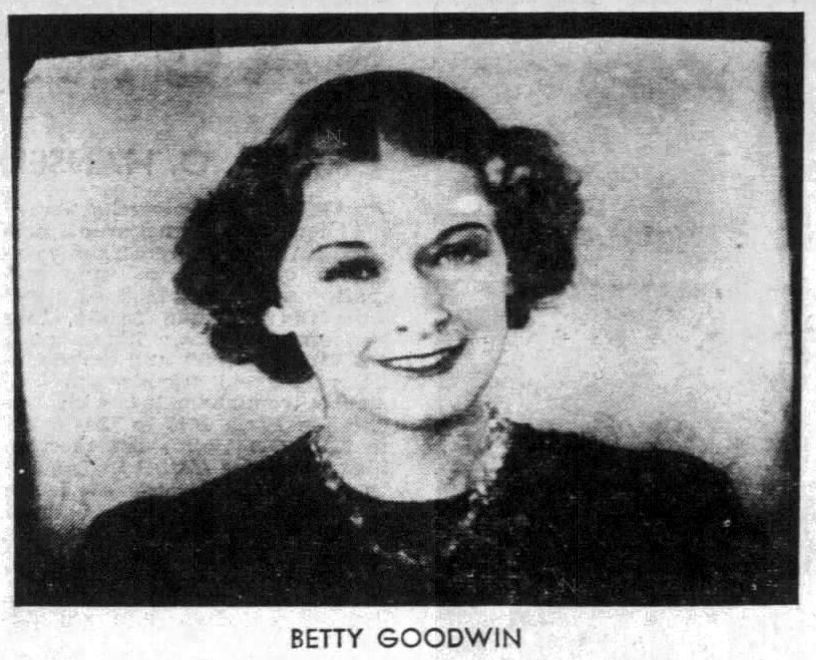
A woman named Betty Goodwin was W2XBS’ star in those days. There were maybe 100 TV sets in New York at the time, and they seem to have been in the hands of RCA/NBC engineers, not the general public. By the time NBC was ready to make television public at the World’s Fair in 1939, she was gone; the New York Times of May 8, 1938 announced her resignation. She tells an amusing tale of how she unexpectedly got into television excerpted on this web page.

CBS finally formally announced its intention to get back into television, after shutting down W2XAB in 1933. For the time being, it intended to use different call-letters.

W9XAT in Minneapolis began a daily schedule in late March 1937. The local papers didn't say what was on the 15-minute broadcast. W6XAO in Hollywood debuted a short film in its regular Saturday night slot, and W9XK at the University of Iowa continued regular broadcasts.

Despite being “around the corner,” television got the attention of movie studios at the start of 1937. Feature films included Murder By Television, starring Bela Lugosi, and Trapped By Television, starring Lyle Talbot. There was a Ray Smeck short simply titled Television Highlights.

TUESDAY, MARCH 2, 1937
W9XK, University of Iowa
7:15 to 7:30—Television program with radio station WSUI.

WEDNESDAY, MARCH 3, 1937
TELEVISION WORK COST RADIO CORP. OVER HALF MILLION
NEW YORK, March 3—(AP)—Radio Corporation of America spent $595,898.83 for Television research last year, it was reported.
“The tests are not yet complete,” the report said, adding however, that “we are moving toward ultimate realization of satisfactory high definition television.”
Distance covered in tests has exceeded expectations, the report said, one favorable location 45 miles from the transmitter obtaining consistent reception. (C.E. Butterfield column)


FRIDAY, MARCH 5, 1937
Demonstrate Television For Lawyers Association
Members of the Communications Committee of the New York County Lawyers' Association will get their first practical experience in the operation of television tonight [5] when they are the guests of National Broadcasting Co. at a television demonstration in Radio City.
The demonstration, arranged by A. L. Ashby, vice-president and general counsel of National Broadcasting, director of the N.Y.C.L.A., and chairman of the Communications Committee, will be held in the NBC board room on the sixth floor of the RCA building. Charles Evans Hughes Jr., president of the association; Robert C. Morris, past president: Terrance J. McManus, secretary, and approximately 30 members of the Communications Committee will be present. The entertainment portion of the demonstration will feature a parade of millinery models; Jean Sablon. French entertainer; Jean O'Neill, recently discovered young blues singer, and a news reel. (Radio Daily)


Progress Made in Television Shown New York Lawyers
NEW YORK, March 6 (AP)—Except that the pictures had greater detail, thus with enhanced entertainment value, Friday night's [5] private demonstration of the RCA system of television was much like previous showings in New York. Guests were the 30 members of the communications committee of the New York County Lawyers' Association.
Transmission from the special NBC studio to the receivers was by direct line rather than via the air. The performers were Jean Sablon, French singer; beautiful Jean O'Neill, blues singer; Joe Lilly, pianist; Easter hat models and Betty Goodwin as announcer.
The purpose of the tests was to show lawyers interested in communication the progress made in television and some of its possible future applications. (C.E. Butterfield column).


SATURDAY, MARCH 6, 1937
W6XAO Hollywood
8:15-8:30—Television (sound on KHJ, KGB, KDB and other Mutual-Don Lee stations).

Television Beauties Require Brown and Orange Make-Up
By C.E. Butterfield
(Associated Press Radio Editor)
NEW YORK, March 6—The television beauty is on the way and, thanks to make-up, she may surpass even the comeliest movie queens. She'll have an exaggerated sun tan with a luscious mouth, gorgeous hair and large lustrous eyes. Right now she's developing in the experimental field tests RCA engineers are conducting.
Oranges and browns predominate in television make-up which has to be different because the electric camera is choosey about certain colors. Red shows up white, hence brown lipstick is used with just enough red for feminine vanity.
READY FOR THE AIR
Betty Goodwin, NBC staff writer used considerably in the tests, tells how the make-up man prepares tier for the air:
"First, he places an even coating of orange-tinted foundation cream all over my face.
“Then my mouth is penciled in, a bit larger than natural and with a dark reddish brown lip rouge. The outline is made with a fine brush, then the color is solidly filled in.
"Of course, nicely shaped black eyebrows are essential to accentuate the eyes, even for blondes like me. A brush puts them on.
“This part completed, a heavy layer of orange-tinted powder goes on, with surplus brushed off. There must be no shine on my face, or the camera will pick it up. After that, a final patting to be sure the surface is evenly powdered.
"Finally, my hair is brushed and fluffed out, to catch the studio lights. Tightly combed hair makes one look bald."
ANNOUNCERS MAKE UP, TOO
When she acts, she must go through her part without a stop, for there can be no retakes in television as in the movies. Even the male announcers must wear make-up.


TUESDAY, MARCH 9, 1937
W9XK, University of Iowa
7:15 to 7:30—Television program with radio station WSUI.

THURSDAY, MARCH 11, 1937
W9XK, University of Iowa
7:15 to 7:30—Television program with radio station WSUI.

SATURDAY, MARCH 13, 1937
W6XAO Hollywood
8:15-8:30—Television (sound on KHJ, KGB, KDB and other Mutual-Don Lee stations).
Television Film Preview On Don Lee-Mutual Net
West Coast Bureau of RADIO DAILY
Los Angeles— Don Lee-Mutual will air a film preview by television Saturday night when the Metropolitan Water District's production, "Empire of the West," goes out by sight and sound over the combined television transmitter W6X80 [sic] and the 10 stations of the Don Lee chain. Picture is in three reels. Don Kinsey, water district director, and other officials will hold special viewing party at D.L.'s receiving plant at the head of Silver Lake, picture starts 8:15, runs 30 minutes.


Television Now Nearly Ready For Public, Assert Expert Observers
By C.E. BUTTERFIELD
New York, March 13 (AP)—Television in America, when will it come? This year, next, or when?
Nobody has been willing to say definitely, but some expert observers, admitting there still are plenty of problems for solution, believe television might well be a public instead of a laboratory possibility today.
That is, provided it faced a situation identical to the introduction of sound broadcasting back in the '20's.
When broadcasting began it had a clear field—a new venture in home entertainment, except for the phonograph.
Television also is something different for the home—fireside movies out of the air. But it is stepping into a field already pretty well occupied. Such as:
Sound broadcasting—a development which in 16 years has grown into a going concern that pays its way, with a good profit.
The movies—now a closer rival to the stage with talk and song added only within the last decade; also a huge industry that does its figuring in the billions.
TELEVISION TO SQUEEZE IN.
Where television is to be fitted into this twin picture is not yet quite clear. There has been much comment as to what might happen.
For one thing, stress is being laid in repeated statements that television is to be supplementary to and not a replacement for sound broadcasting. Also, its reaction on the movies is to be nil, or nearly so. However, many disagree with this prediction.
What effect radio pictures will have on the movies also is conjecture. But experts see it as a possible important user of films for broadcasting, opening a new mass output for Hollywood. These same experts say, too, that it is difficult to determine in advance whether the potential television audience would rather watch air movies at home or go to a theater.
Ultimate public introduction apparently must await an approach to the solution of two important problems. One centers around how it is to be offered. In this connection there is a desire to avoid any radical move that might cause any sudden disruption of the present set-up.
Also, there are no facilities yet for network distribution, although two schemes, wire and radio, are in development. The wire would employ the coaxial cable; the other, ultra short wave relays.
MAY BE STATION AFFAIR.
So, the beginning, if it precedes a network setup, must then be an individual station affair, just like the start of sound, progressing gradually from city to city.
Closely coupled therewith is the cost. Television no doubt will require much more money than sound, both for program production and station operation, to say nothing of equipment.
Most authorities seem to feel television will follow in the footsteps of broadcasting in paying its way. That is, the advertiser would foot the bill, with the home-viewer contributing through the purchase of receivers.
However, broadcasters will have to get started with programs and build up an audience before they can think about returns. That's the way sound did.
Yet, despite these money handicaps, many commentators already are foreseeing television as a billion dollar industry when it gets going.
Another point: Public acceptance is something that cannot be forecast. Advance indications are that receivers will cost maybe $500 at the start. Also there is the likelihood, after the novelty wears off, of a possible reaction due to the fact that early, television will not be the equal of the movies in picture definition. Still there seems to be a belief that improvements will have overcome such drawbacks.
Technical advancement in the laboratory, still with many goals to reach, has been rapid. In fact, persons seeing the pictures for the first time generally remark: "excellent."
That may be, but engineers have been rather hesitant in displaying their handiwork until the last year or so. They have indicated it was their desire to make ready a much more finished device than was the case with sound. Apparently they are seeking to avoid the trials and tribulations of early radio. Sounds sets at first were far from the efficient apparatus of today.
Meanwhile, field tests in New York, Philadelphia, and Los Angeles are actively going forward with engineers and other television experts as the sole observers.
England, too, is running field tests, with this difference: the public can look in by buying receivers already on the market.
But, as to a public introduction date here, there is none in prospect. Most of the comment is negative, like:
"Christmas is more certain of coming this year than television."


MONDAY, MARCH 15, 1937
CBS on Television
Status of CBS on television, summarized by President William S. Paley in his annual report to stockholders, follows:
"There is much still to be done. At the moment I believe that anything like satisfactory television broadcasting is still well in the distance. Yet sudden achievements in the laboratories could accelerate its coming. We are doing our part to hasten it. We shall soon be in position to tell something of what we are doing." (Radio Daily)


Televise Visa Sought
Washington.—The Allen B. Dumont Laboratories have applied to the FCC for a permit for a new television station in Upper Montclair. (Hollywood Reporter)


TUESDAY, MARCH 16, 1937
W9XK, University of Iowa
7:15 to 7:30—Television program with radio station WSUI.

THURSDAY, MARCH 18, 1937
W9XK, University of Iowa
7:15 to 7:30—Television program with radio station WSUI.

FRIDAY, MARCH 19, 1937
Daily Television Show From WDGY, Minneapolis
Minneapolis — WDGY has started a new series of television broadcasts through its station W9XAT, at 12:30 p.m. daily, under the personal direction of George Jacobson, chief technician.
Dr. George Young, owner of the station, is one of the pioneers, in television and has complete studio equipment costing between $40,000 and $50,000. (Radio Daily)


SATURDAY, MARCH 20, 1937
W6XAO Hollywood
8:00-8:15—Television (sound on KHJ, KGB, KDB and other Mutual-Don Lee stations).

MONDAY, MARCH 22, 1937
Television to Be Demonstrated
Purdue university's progress in developing television will be revealed Tuesday evening [23] at a demonstration to be conducted by Profs. R. H. George and H. J. Heim in room 254 of the electrical engineering building, all persons interested being invited to attend. The Purdue branch of the American Institute of Electrical Engineers is sponsoring the event. Signals from the Purdue experimental television broadcasting station W9XG will be picked up on a receiving set that has been devised in the course of research work at the university and images will be received. The set operates without moving parts.
George and Heim established W9XG for broadcasting purposes and have conducted the research work on television at Purdue for seven years, first with funds provided by the Grgsby-Grunow [sic] company and the last few years un-der the auspices of R. C. A. which holds patents on the developments made at Purdue. (Lafayette Journal and Courier)


TUESDAY, MARCH 23, 1937
W9XK, University of Iowa
7:15 to 7:30—Television program with radio station WSUI.

THURSDAY, MARCH 25, 1937
General Television Testing Cathode Ray
Boston — Having rebuilt its station and equipment to conform with new standards. General Television Institute will shortly test its new apparatus, marking the first appearance in New England of the electronic cathode ray television. Hollis S. Baird is chief engineer of the Institute, which has Television Station W1XG. (Radio Daily)


FRIDAY, MARCH 26, 1937
Lasky Asserts Television Not To Come Soon
By RELMAN MORIN
HOLLYWOOD, CALIF., March 26 —(AP)—Television, says Film Producer Jesse Lasky, may be just around the corner, but there's a long road to be traveled before anyone gets to it.
The pioneer movie maker listed three major difficulties.
1. The gregarious instinct that sends people to theaters.
2. The unsuitability of radio stars for filming.
3. The nerve-strain that would be necessitated by heavy concentration on a comparatively small screen.
"Understand, I'm convinced television is coming," the producer said, "but it won't come on enough for any of us to worry about."
He said he believed the technical frailties that now beset television will be corrected.
"But I don't believe people will choose to stay home, by themselves, for a television broadcast, rather than go to a theater to see a movie. To many, the sensation of being in a crowd, with lights and life around, is very important.
"As for talent, we're having trouble finding, in radio, people who are suitable for pictures."
Lasky said television in its present form would be too much of a strain on the tired business man at night.
"After all, you can read or walk around or relax while merely listening. But it would require a genuine effort for a man to sit with his eyes glued on a screen hardly bigger than the average window."
Lasky said he believed television might first develop in the field of news-reporting.
"Assuming that the technical aspects can be straightened out, television would occupy an important function by transmitting pictures of news events directly from the scene.
"But all that is still a long, long distance away."


MONDAY, MARCH 29, 1937
W9XAT, Minneapolis
12:30-12:45—Television with radio station WDGY 1180 kcs.

CBS Television To Include Plant At $500,000 Cost
Application Filed With FCC For Chrysler Bldg. Studios
DIVULGING plans to invest nearly $500,000 in an RCA television tranmitter [sic] to be located atop the Chrysler Bldg. in New York and in specially designed studios, CBS on March 29 filed with the FCC an application for a new experimental television station of 7,500 watts.
Filing of the application substantiated the report published in March 15 issue of BROADCASTING that the network was formulating visual radio plans. It set forth that $330,000 would be expended for an RCA television transmitter, now being manufactured at RCA Mfg. Co. plant at Camden, N. J., with an additional $130,000 for a studio capable of accomodating [sic] both visual and audio pickup. The antenna atop the Chrysler Bldg. will be 971 feet from the ground.
Goldmark In Charge
In its application, CBS requests assignment on the 42,000-66,000 kc., and 60,000 and 56,000 kc. experimental high-frequency television bands. The new station would have the call W2XAX. Experiments will be under the direct supervision of Peter C. Goldmark, television engineer with CBS since January, 1936, and prior to that in charge of television for Pye Radio Ltd., of Cambridge, Eng. From 1934 to 1936 he was chief engineer of World Radio, radio manufacturers of New York. His chief assistant is John N. Dyer, since 1933 a CBS engineer, and since last January specializing in high-frequency television.
Filing of the application followed the designation CBS of Paul W. Keston, vice-president and a general executive of the company, as official in charge of television development and preparation. In its decision to experiment with high-frequency television, CBS proposes to invade a field in which its chief competitor, NBC, has been engaged through its parent company, RCA. NBC has been conducting daily television experiments from atop the 1248 ft. Empire State Building, as well as in the Camden laboratories of RCA, using 441 line pictures. Philco Radio & Television Co. also is experimenting with 441-line images.
In outlining proposed experiments, CBS stated it proposed to study the effect of simultaneous transmission by more than one television transmitter (a) on identical frequencies, with the transmitters geographically separated (b) on different frequencies with transmitters geographically separated and (c) on different frequencies with transmitters not geographically separated. It also proposes comparative field strength measurements, together with studies of receiver and antenna design, elimination of man-made interferences, synchronization with various types of receivers; testing of different types of studio equipment; research into suitable equipment and technique to determine production costs; studio design, illumination and ventilation, and finally, a study of equipment and means of bringing about television network operation. (Broadcasting, Apr. 1)


TUESDAY, MARCH 30, 1937
W9XAT, Minneapolis
12:30-12:45—Television with radio station WDGY 1180 kcs.
W9XK, University of Iowa
7:15 to 7:30—Television program with radio station WSUI.

WEDNESDAY, MARCH 31, 1937
W9XAT, Minneapolis
12:30-12:45—Television with radio station WDGY 1180 kcs.

Now, for your viewing pleasure: TRAPPED BY TELEVISION.