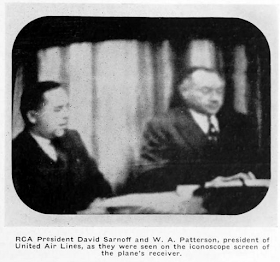
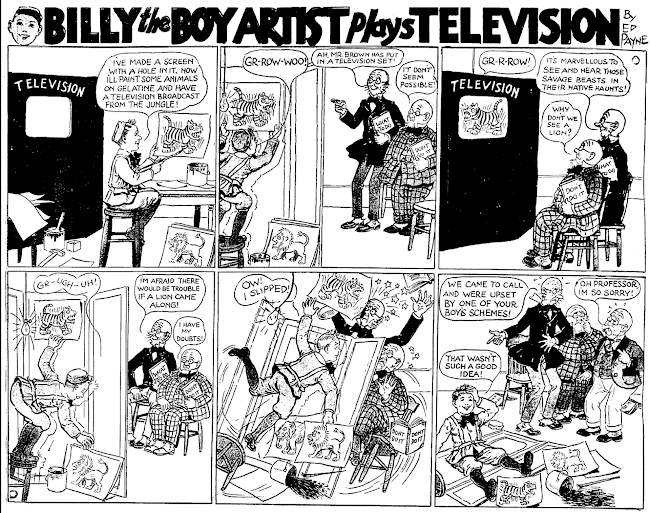
Television was causing a bit of a ruckus on both coasts and the middle of America in June 1931. CBS was experimenting with a station in New York. In Los Angeles, Don Lee admitted his staff had been testing, too, except with an electronic system that didn’t rely on mechanical scanning discs like TV stations back east.
And in Chicago, television was the gimmick packing people into the big radio exhibition, with test broadcasts of a couple of different systems. The young inventor who came up with big screen television conducted a similar demonstration in New York later in the month.
At NBC, Deac Aylesworth and David Sarnoff were making television prognostications. The irony is NBC was doing very little with television. All its station in New York was airing was a model of Felix the Cat spinning around and around and around on a turntable.
Other stations were doing a little more. The Jenkins station in Passaic started cutting back on live programming to 15 minutes a day, but not after chopping up the silent version of The Wizard of Oz (1925) and airing it on three consecutive nights. Rudy Vallee appeared on the screen and it looks like George Jessel did, too.
Below are TV listings compiled from the New York Times and the New York Herald Tribune. They conflict in that one paper has W2XCR, the C. Francis Jenkins station, running an hour longer than the other. There are news snippings, including some from C.E. Butterfield’s daily radio column from the Associated Press. He wrote a feature story, explaining the difference between mechanical and electronic television (the former was dead within two years). The New York Sun devoted a whole page every Saturday to television, but issues from the mid-May to mid-June 1931 are not available. The Newspaper Enterprise Association Science Editor, Israel Kline, wrote a six-part feature story in June 1931 about television. Due to its length, we will not be posting it here.
One of the performers below is Tunis Erkelens. On a whim, I decided to look him up. I found a letter from him published in the December 1927 edition of The Etude magazine. He was a 16-year-old living in Wallington, New Jersey. At the time, he was already a theatre organist; his instrument had 15 traps and 44 stops. When he appeared on the air, he was teaching piano, working in an office in New York and playing the organ at the Wallington Presbyterian Church. Unfortunately, this story has a sad ending. Tunis died at the age of 21 on December 30, 1931 “after a brief illness.”
Monday, June 1, 1931
A series of broadcast sports interviews with television “accompaniment” is schedule to start on New York audiovisual stations WGBS-W2XCR next Saturday at 5:45 p. m. Jack Norman is to be the interviewer and his first guest speakers will be Jimmy McLarnin, welterweight boxer, and Ray Steele, heavyweight wrestler. It is intended to have the guests illustrate their accomplishments for the visual audience while the announcer describes what they are doing for listeners who do not possess a radio receiving eye. (C.E. Butterfield column, Associated Press)
W2XCR—New York (Long Island)—2035k—147.5 M.
(Sound on WGBS—1180kc)
4:00-5:00—Same as WGBS.
4:00—Corinne Cooper, Songs
4:14—Josephine When, Monologues
4:30—Hernan Rodriguez, Guitar
4:45—Weight Reduction—Dr. Shirley Wynne
6:00-9:00—Same as WGBS.
6:00—Marion French, Contralto
6:15—Savit Spray Music
6:30—Dot Morrison
6:45—Sports Talk
7:00—Romantic Troubadour
7:15—Hebrew National Orphan Home—Talk
7:30—Almanac News
7:45—Flanagan Brothers, Songs
8:00—Slumber Boat
8:30—Wayne Orchestra
W2XCD—Passaic, N.J.—146m.-2050k.
(Synchronized Sound on 1604k)
9:00 p. m.—Dorothy Kane, piano.
*9:15—Red Riding Hood, Episode I.
9:30—Annalee Rose, piano.
*9:45—Modeling.
10:00—Experimental films.
W3XK—Washington—2065k
10:30 p. m.—Bamboos.
W2XBS—New York—2100k
2:00-5:00 p. m.—Silhouettes: talks.
7:00-10:00—Silhouettes: announcements.
W2XR—Long Island—2920k
(Sound on 1604k)
4:00-10:00 p. m.—Experimental hour.
5:00-7:00—Experimental animated films (on 2150k).
W1XAV—Boston—2870k
1:00-2:00 p. m.—Halftone pictures.
7:30-10:30 p. m.—Halftone pictures
* Film pickup.
Tuesday, June 2, 1931
LONDON (AP)—The London Herald says that an attempt will be made to broadcast by television the finish of the Derby at Epson Downs tomorrow. Baird televisor apparatus has been set up and is being tested in some preliminary races today.
LONDON (Late Flash)—The scenes at Epsom Downs on the eve of the Derby, including the finish of the 4 p.m. race, were sent to London by television today.
Glimpses of the crowds milling behind the rails, bookmakers busily accepting bets and horses pounding along the turf were transmitted to telephone wire to London and re-amplified.
W2XCR—New York—2035k—147.5 M.
(Sound on WGBS—1180kc)
3:00 p. m.—Film programs.
4:00-5:00—Same as WGBS.
4:00—Kathryn Lewis, Songs.
4:15—Women’s United Synagogue
4:30—Mary Bongert, Soprano
4:45—Tottie Tells a Story
6:00-8:00—Same as WGBS.
6:00—Jolane Duo
6:15—String Quartet
6:45—Sports Talk
7:00—Meb and Mac
7:15—What’s New?—David Schenker
7:30—Night in Italy
W2XCD—Passaic—2035k
(Synchronized Sound on 1604k)
9:00 p. m.—Same as WNJ.
*9:30—Red Riding Hood, Episode II
*9:45—Bleak House
10:00—Experimental films.
W3XK—Washington—2065k
10:30 p. m.—Bamboos.
W2XBS—New York—2100k
2:00-9:00 p. m.—Silhouettes: talks.
7:00-10:00—Silhouettes: announcements.
W1XAV—Boston—2870k
1:00-2:00 p. m.—Halftone pictures.
7:30-10:30 p. m.—Halftone pictures
* Film pickup.
Wednesday, June 3, 1931
A combination broadcast designed to demonstrate the possibilities of sound and sight as well as photographic transmission is planned for Wednesday evening [3] when a dinner is given aboard the French liner, Isle de France, at its dock in New York in honor of Steven Zukor, director of the Polyphonic Symphony society, New York.
Beginning at 9 o’clock, a number of radio artists will be at the studios of the audiovision stations WGBS-W2XCR, where they will entertain before microphone and television camera, both to be received on the boat.
At the same time, photographs of the artists are to be sent to the liner from Passaic, N. J., by means of a system developed by Capt. Oaho Fulton, of Vienna.
EPSON DOWNS (UP)—John A. Dewar’s Cameronian, a game little colt with a fighting spirit, shook off the driving efforts of his opposition in a thrilling stretch duel today to win the 148th running of the English Derby.
Television plus wireless telephony enabled approximately 5,000 owners of home receiving sets throughout Europe to see Cameronian win the Derby while they simultaneously listened to a British broadcasting company’s running commentary on the race. The result was something similar to a cinema “talkie.”
It was the first time television broadcast had been employed for an outdoor event.
Reception was marred at times, but there were occasional sharply distinct scenes. Experts expressed the opinion that the demonstration indicated it will be only a matter of time before televised outdoor programs will become commercially practical. Today’s broadcast was considered a success from an experimental standpoint, and it was felt to have paved the way to commercialization.
Through television, spectators at the instruments were given glimpses of the crowd, the parade of horses in front of the grandstand, and finally the stirring finish.
The scenes were visible in a small televisor window in each instrument, approximately two by five inches in size.
The Baird television studio instrument had too small a screen to enable recognition of the horses or distinguishing of numbers. Reception was picked up from Brookman’s Park and was witnessed by a group of newspapermen.
W2XCR—New York—2035k—147.5 M.
(Sound on WGBS—1180kc)
3:00 p. m.—Film programs.
4:00-5:00—Same as WGBS.
4:00—Idle Roomers—Skit
4:15—Talk—Amy Bonner
4:30—Billie Davis, Songs.
4:45—At the Movies
6:00-8:00—Same as WGBS.
6:00—Kathleen Gordon, Soprano
6:15—Janet Burroughs and Eric Dressler—Skit
6:30—Television Trio
6:45—Sports Talk
7:00—Musical Angles
7:15—Theatre Topics—Harriet Menken
7:30—Grupo Antiallano Music
W2XCD—Passaic—2035k
(Synchronized Sound on 1604k)
9:00 p. m.—Rachel Caputo, songs.
*9:15—Red Riding Hood, Episode III.
9:30—Rachel Caputo, songs.
*9:45—Goldie Locks.
10:00—Experimental films.
W3XK, W2XBS, W1XAV, W2XR as above
Thursday, June 4, 1931
W2XCR—New York—2035k—147.5 M.
(Sound on WGBS—1180kc)
3:00 p. m.—Film programs.
4:00-5:00—Same as WGBS.
4:00—Marie Guion, Contralto
4:15—One-Man Band
4:30—Clair de Soleil Beauty Demonstrations
4:45—Over the Radio Waves
6:00-8:00—Same as WGBS.
6:00—Helene Vincent, Songs
6:15—Savit Spray
6:30—Studio Music
6:45—Sports Talk
7:00—Max Weiser, Violin
7:15—Law for the Layman—Albert Levin
7:30—Carroll’s Orchestra
W2XCD—Passaic—2035k
(Synchronized Sound on 1604k)
9:00 p. m.—Alice Remsen, songs.
*9:15—Red Riding Hood, Episode IV.
9:30— Alice Remsen, songs.
*9:45—Kidnaped by Indians.
10:00—Experimental films.
W3XK, W2XBS, W1XAV, W2XR as above
Friday, June 5, 1931
W2XCR—New York—2035k—147.5 M.
(Sound on WGBS—1180kc)
3:00 p. m.—Film programs.
4:00-5:00—Same as WGBS.
4:00—Two Lads of Melody
4:15—French Lessons—Thatcher Clark
4:30—Clair de Soleil Beauty Demonstrations
4:45—Eule Gambarelli, Songs
6:00-9:00—Same as WGBS.
6:00—Ship Ahoy Trio
6:30— Clair de Soleil Beauty Demonstrations
6:45—Sports Talk
7:00—Romantic Troubadour
7:15—Sports Chat—Jack Curley
7:30—Chamberlain Brown’s Stars of Broadway: Interview With Rudy Vallee and Otto Kruger; Sketch—In the Wilderness; Ina Haywood, Songs, and Others
8:00—G. Aldo Randegger, Piano
8:30—Educational Talk—Dean J. J. Dandreau
8:45—Kitty Borschman and Bernd Huppertz, Duets
W2XCD—Passaic—2035k
(Synchronized Sound on 1604k)
*9:00 p. m.— Red Riding Hood, Episode V.
*9:15—Saturday.
*9:45—Golf and How
10:00—Experimental films.
W3XK, W2XBS, W1XAV, W2XR as above
(W1XAV, 1 to 2 p.m. only)
Saturday, June 6, 1931
SAN FRANCISCO (AP) — Laboratory experiments looking to the transmission of television by means of electrical rather than mechanical scanning appear to be passing the preliminary stages.
In fact, Philo T. Farnsworth, 24-year-old engineer who has been investigating the possibilities of television through the use of special tubes in both transmitter and receiver, replacing scanning disks and neon lamps, believes his process is nearly ready for possible practical use. Plans also provide for possible broadcasting facilities.
Announcement by Television Laboratories, Inc., the organization with which Farnsworth is associated, was that radio pictures have been reproduced with all the detail of a newspaper half tone.
As far as clarity and flicker are concerned, it was added that the pictures were somewhat better than the early movies, with an intensity sufficient for possible enlargement up to four feet square.
Because a transmitted television signal is similar to that of sound, it has many of the interference properties that hinder reception of broadcast and other types of radio transmission.
 There is also a tendency to a slight “sway” or fading in the reception of the pictures from left to right, but this, it was said, will be overcome.
In the laboratory tests pictures were received on a screen slightly larger than a foot square. This screen consists of ordinary tracing paper.
The screen can be removed and a larger picture obtained by turning the receiver toward a wall and focusing the image on a silvered screen or white cloth.
At the laboratory demonstration the picture was thrown on an ordinary kalsomined wall and increased to four feet square.
Previously the largo flat end of the receiving tube, a specially built vacuum device that replaces scanning disk and neon lamp, was used. With the improved method the picture is reflected by a mirror to the tracing paper screen.
A change in the scanning system also has been effected. Now the scanning spot is moved only from left to right instead of in both directions. The change was found to eliminate the blur that resulted from a failure to make the left to right picture superimpose itself directly upon that formed by the right to left movement of the scanning beam.
W2XCR—New York—2035k—147.5 M.
(Sound on WGBS—1180kc)
3:00 p. m.—Film programs.
4:00-5:00—Same as WGBS.
4:00—Prosperity Girls
4:15—Pasadena Serenaders
4:45—Speech Correction—William Peppard
6:00-9:00—Same as WGBS.
6:00—Arthur Allen—Sketches
6:15—Quinn’s Dublin Boys
6:30—Tales of Irving Hoffman
6:45—Sports Talk
7:00—Weiser Trio
7:15—Samuels Proteges.
7:45—Jack Norman’s Sports Celebrities—Jim Londos
8:00—Nita O’Neill, Songs
8:15—Character Analysis—W. E. Benton
8:30—Detective Stories—Plays
W2XCD—Passaic—2035k
(Synchronized Sound on 1604k)
*9:00 p. m.— Invisible Revenge.
*9:15—Chop Suey Louie.
*9:45—His Ups and Downs.
10:00—Experimental films.
W3XK, W2XBS, W1XAV, W2XR as above
(W1XAV, two transmissions again)
Sunday, June 7, 1931
W2XCR—New York—2035k—147.5 M.
(Sound on WGBS—1180kc)
6:00-9:00—Same as WGBS.
6:00—Musical Etchings
6:15—Cuadra’s Mexican Songs
6:30—Bufano’s Marionettes
7:00—Vladimir Radeef, Baritone
7:15—Dorothy Rosenthal, Violin.
7:30—Galician Serenaders
8:00—Barnum Orchestra
8:30—German Musicale
Monday, June 8, 1931
W2XCR—New York—2035k—147.5 M.
(Sound on WGBS—1180kc)
4:00-5:00—Same as WGBS.
4:00—Rasa Brothers Orchestra
4:30—Hernan Rodriguez, Guitar
4:45—Weight Reduction—Dr. Shirley Wynne
6:00-9:00—Same as WGBS.
6:00—Mildred Hartley, Contralto
6:15—Savit Spray Music
6:30—Dream Lovers
6:45—Sports Talk
7:00—Tips and Topics
7:30—Almanac News
7:45—Flanagan Brothers Program
8:00—Slumber Boat
8:30—Wayne Orchestra
W2XCD—Passaic—2035k
(Synchronized Sound on 1604k)
*9:00 p. m.— Wizard of Oz, Episode I.
*9:30—Built on a Bluff.
*10:00—Experimental films.
W3XK, W2XBS, W2XR, W1XAV as above
Tuesday, June 9, 1931
Dr. Robert Underwood Johnson, former American Ambassador to Italy and now director of the Hall of Fame of New York University, will be the subject of a television interview to be broadcast Friday [12] at 8:30 p. m. over Station W2XCR. The sound broadcast will be carried by WGBS. Dr. Johnson will read some of his poems and discuss the unveiling of the Woodrow Wilson Memorial at Posen, Poland, which he will attend. (Herald Tribune)
RCA will build three experimental stations for Television in the next year, one to be located on the Pacific Coast, according to a formal statement by David Sarnoff, president, issued on the coast. Other two will be on top of the new 50-story RCA Building at 570 Lexington avenue, New York, and on a still higher building in New York City. Height is declared an important factor in the transmission of sound pictures. Additional experimental stations may be located in other sections of the country, Sarnoff says.
When Television emerges from the trial stage it will be switched from RCA to NBC. (Variety)
W2XCR—New York—2035k—147.5 M.
(Sound on WGBS—1180kc)
4:00-5:00—Same as WGBS.
4:00—Kathryn Lewis, Songs
4:15—Women’s United Synagogue League
4:30—Mary Bongert, Soprano
4:45—Tottie Tells a Story
6:00-9:00—Same as WGBS.
6:00—Jolane Duo
6:15—String Quartet
6:45—Sports Talk
7:00—Meb and Mac
7:15—What’s New?—A. David Schenker
7:30—Night in Italy
8:00—Salon Trio
8:30—Movieless Movies
W2XCD—Passaic—2035k
(Synchronized Sound on 1604k)
*9:00 p. m.— Wizard of Oz, Episode II.
*9:30—Shorty, Bogus Duke.
*10:00—Experimental films.
W3XK, W2XBS, W1XAV as above
Wednesday, June 10, 1931
DON LEE WILL TRY TELEVISION
Television of motion pictures will be attempted by Don Lee, Inc., it was revealed here and in Washington yesterday through a recommendation to the Federal Radio Commission that Lee be granted a license for a television station near Gardena. Plans of Lee’s company came to light when Examiner Walker made the recommendation in Washington.
It was admitted at Lee’s local station, KHJ, over which The Times broadcasts world-wide news, that experiments in projecting motion-picture film by television have been under way in the station’s laboratories for some time. “We do not want to create the impression, however, that television will be available from any of our stations in any short space of time,” Lee declared.
“A staff of television engineers is continuously at work in our laboratories conducting experiments.
“Ordinary motion-picture films are being used in these experiments, but the work is strictly experimental and a good deal removed from practical utility.
“Unscrupulous persons may attempt to take advantage of the public sale of television receiving apparatus.
“There are several basic principles involved in the design of these receiving sets and until something resembling a standardized unit is evolved I suggest that the public investigate very thoroughly before purchasing or investing.”
The first successful television image was cast in the Don Lee laboratories about three weeks ago under supervision of Federal Inspector Linden of this district, it was stated, at the local station.
The Federal Radio Commission is expected to act favorably on Walker’s recommendation. It was pointed out in Washington dispatches. This will mean that Los Angeles will have the first television station west of Chicago.
The type of radio vision station to be constructed will not operate with a scanning disk, nor will it project images from studios, according to Walker’s report.
Electrical scanning of motion-picture film will be employed instead. One of the reasons Walker urged the granting of the license was because the proposed station intends to carry on the development of this diskless type of radio vision transmission, the dispatches stated.
FAVORABLE COMMENT
Harry L. Lubeke, chief of the Don Lee radio station technical staff, received favorable comment in the examiner’s report, along with P. C. Tait and C. C. Campbell.
The proposed station is expected to cost about $18,000 and will operate on a 100-kilocycle band between the frequencies of 2850 and 2950 kilocycles, it was stated in Walker’s recommendation. (Los Angeles Times)

CHICAGO (AP)—Television pictures in black and white, reproduced with unusual definition and clarity on screens 15 inches square, two feet square and six feet square, were shown to radio editors and others last night.
It was another development of U. A. Sanabria, young Chicago engineer, who previously demonstrated the possibilities of the ten-foot screen. However, radio waves were not used, the connection between transmitter and receiver in the same room being by wire.
Comments of the viewers centered in the fact that such good results could be obtained, as only 45 lines were used in the pictures compared with the 60-line transmissions of most of the experimental television stations in the East. As a rule 60 lines give more detail than 45.
Naturally the smaller reproductions came out better than the six-foot pictures due to the fact there was a certain loss of light with the bigger screen.
The good definition obtained, it was explained, was due to the fact there had been a 20 times increase in detail through the use of regeneration in the transmitter. Sanabria has never tried the large screen on the air, but good results have been obtained with the smaller pictures in test transmissions via radio.
The transmitter was the usual set-up of scanning mechanism and photo-electric cells, with large ones being used.
CHICAGO (UP)—The Boston Red Sox can think of all kinds of arguments against the proposal of the Short Wave and Television Corporation that big league baseball games in Fenway Park, Boston, be televised.
Bob Quinn, president of the Boston club, put forward a few reasons in his reply to the television company’s offer.
“It has rained every Sunday, our club is in last place, and now you want me to let them see the game at home,” Quinn wired, “How do you suppose we are going to pay the players? If you can furnish me with a substitution for money, please let me know immediately.”
W2XCR—New York—2035k—147.5 M.
(Sound on WGBS—1180kc)
3:00 p. m.—Film programs.
4:00-5:00—Same as WGBS.
4:00—Idle Roomers—Skit
4:15—Talk—Amy Bonner
4:30—Billie Davis, Songs.
4:45—At the Movies
6:00-8:00—Same as WGBS.
6:00—Musical Angles
6:15—Dud and the Duke, Songs
6:30—Louise Vermont, Contralto
6:45—Sports Talk
7:00—Theatregoing—Doug Brinkley
7:15—Theatre Topics—Harriet Menken
7:30—Grupo Antiallano Music
W2XCD—Passaic—2035k
(Synchronized Sound on 1604k)
*9:00 p. m.— Wizard of Oz, final.
*9:30—Ringling’s Rivals.
*10:00—Experimental films.
W3XK, W2XBS, W2XR, W1XAV as above
Thursday, June 11, 1931
A series of experimental television broadcasts will be started this week by engineers of the Columbia Broadcasting System, according to Edward K. Cohan, technical director. Eight “looking-in” points have been placed in the metropolitan area to gauge the clarity of reception. The sender is situated on the twenty-third floor of the WABC building, 485 Madison Avenue. (New York Times)
CHICAGO (AP)—Another of those rather convincing television demonstrations, this one with a receiver that puts the picture on a small screen, has come outside the radio trade show.
The outfit over which the pictures were picked up from the transmitter of 29XAP, companion short-wave station of WMAQ, owned by the Chicago Daily News, is designed for possible home use.
It has a small frosted glass screen at the top on which the radio pictures can be seen. This is four inches square. By removing the glass and placing a larger screen in front of the set, pictures up to two feet square have been reproduced.
The complete outfit is housed in a cabinet about three feet tall and placed on a small table.
The projection was made possible through the use of a lens disk only eight inches in diameter and a crater type of Neon lamp developed by Lloyd P. Garner, director of research of the Western Television Laboratories. It operates on only fifteen volts. Focusing apparatus is incorporated to clear up the picture when its size is changed.
Included in the reception was a full-length view of two young women dancing. By using two scanning systems it the transmitter, one scene could be faded out and another brought in, just like in the films.
WASHINGTON (AP)—Television may be just around the corner, but the Radio Commission intends to see that it makes the turn without skidding.
The commission has decided to hold public hearings on all applications for television broadcasting wave-length ass1gnments. Two such applications—by J’Seborne McClane and William T. Smith of New Orleans, and the Pioneer Mercantile Company of Bakersfield, Cal—will be heard by the commission tomorrow.
About twenty television stations are in operation. Permission has been asked to put six others on the air. With the flood of requests, the commission’s engineering division decided to recommend that all applicants be required to show they have something beneficial to offer.
W2XCR—New York—2035k—147.5 M.
(Sound on WGBS—1180kc)
3:00 p. m.—Film programs.
4:00-5:00—Same as WGBS.
4:00—Marie Guion, Contralto
4:15—Joe Trent, Songs
4:30—Sotto Voce Girls
4:45—Over the Radio Waves
6:00-8:00—Same as WGBS.
6:00—Helene Vincent, Songs
6:15—Savit Spray Musaic
6:30—Symphony’s Rival
6:45—Sports Talk
7:00—Max Weiser, Violin
7:15—The Crime Situation—Judge Daniel F. Cohaian
7:30—Carroll’s Orchestra
W2XCD—Passaic—2035k
(Synchronized Sound on 1604k)
*9:00 p. m.—Capital Punishment, Episode I.
*9:30—Exploits of U-35.
*10:00—Experimental films.
W3XK, W2XBS, W2XR, W1XAV as above
Friday, June 12, 1931
ATLANTIC CITY, N. J. (AP)—The television era has definitely dawned, but television today is considerably of an experiment. M. H. Aylesworth, president of the National Broadcasting company, told the National Electric Light association convention here today.
“Technically and commercially, television today is just as much of an experiment, just as crude, yet just as promising as the feeble attempts at propagating entertainment by radio telephony prior to 1920,” he said.
Even after television has been developed to the point where receivers are simple and dependable, Mr. Aylesworth said, sight by radio will be utilized only as a supplement to sound broadcasting.
The immediate application of television will be the visual presentation of the broadcast artist.”
W2XCR—New York—2035k—147.5 M.
(Sound on WGBS—1180kc)
3:00 p. m.—Film programs.
4:00-5:00—Same as WGBS.
4:00—Two Lads of Melody
4:15—French Lessons—Thatcher Clark
4:30—Edith Klein, Soprano
4:45—Speaking of Women—Edna McKnight
6:00-9:00—Same as WGBS.
6:00—Bill Reitz, Songs
6:15—Ship Ahoy Trio
6:45—Sports Talk
7:00—Romantic Troubadour
7:15—Sports Chat—Jack Curley
7:30—Chamberlain Brown’s Stars of Broadway
8:00—G. Aldo Randegger, Piano
8:30—Educational Talk—Dean J. J. Dandreau
8:45—Nathalie Boshko, Violin
W2XCD—Passaic—2035k
(Synchronized Sound on 1604k)
*9:00 p. m.—Capital Punishment, Episode II.
*9:30—Dream Doll.
*10:00—Experimental films.
W3XK, W2XBS, W2XR, W1XAV as above
Saturday, June 13, 1931
Preliminary tests of the new CBS experimental television transmitter, W2XAB, are now under way. The station is located on top of the chain’s New York headquarters, and will be on the air at various intervals to check up on signal strength, etc. Power is 500 watts.
It has not been determined when the regular experimental schedule will be put into effect. Apparently it will be some time after June 15 when it is hoped to be on the air with at least six hours a day of studio snapshots. (C.E. Butterfield column, Associated Press)
W2XCR—New York—2035k—147.5 M.
(Sound on WGBS—1180kc)
3:00 p. m.—Film programs.
4:00-5:00—Same as WGBS.
4:00—Prosperity Girls
4:15—Norma Atwater, Soprano
4:30—Shirley Herman, Songs
4:45—Speech Correction—William Peppard
6:00-9:00—Same as WGBS.
6:00—Jean Riddel and Clinton Deane, Sketch
6:15—Quinn’s Dublin Boys
6:30—Tales of Irving Hoffman
6:45—Sports Talk
7:00—Max Weiser Trio
7:15—Samuel's Proteges.
7:45—Jack Norman’s Sports Celebrities
8:00—John Murphy, Tenor
8:15—Doris Blaul, Piano
8:30—Arcadia Orchestra
W2XCD—Passaic—2035k
(Synchronized Sound on 1604k)
*9:00 p. m.—Capital Punishment, final.
*9:30—Slow Motion Baseball.
*9:45—Oceans of Trouble.
*10:00—Experimental films.
W3XK, W2XBS, W1XAV as above
Sunday, June 14, 1931
CHICAGO — The Chicago Federation of Labor affiliated with the American and Illinois federations of labor in the use of radio through station WCFL and its short wave auxiliary W9XAA has announced its entrance into television in conjunction with the Shortwave and Television Corporation of Boston. Present plans call for the construction of one of the latest type television transmitters in the new studios of the station In the furniture mart.
Pictures of the latest type, with sixty line twenty frame scanning, will be transmitted from the station as soon as sanction is received from the Federal Radio Commission. Application for license has already been filed. The announcement was made jointly by E. N. Nockels, general manager of the station, and Douglas Rigney, chairman of the executive board of the Boston engineering and manufacturing concern. (New York Herald Tribune)
W2XCR—New York—2035k
(Sound on WGBS)
6:00-9:00 p. m.—Same as WGBS.
6:00—Musical Etchings
6:15—Cuadra Mexican Songs
6:30—Salon Trio
6:45—Small Time, Playlet
7:00—Vladimir Radeef, Baritone
7:15—Alfred Wertheim, Violin.
7:30—Annette Wagner, Soprano.
7:45—Janet Burroughs and Locke Taylor, Sketch
8:00—Barnum’s Orchestra
8:30—Furguiele’s Artists
Monday, June 15, 1931

4:00-5:00—Same as WGBS.
4:00—Four Rasa Brothers
4:30—Hernan Rodriguez, Guitar
4:45—Weight Reduction—Dr. Shirley Wynne
6:00-9:00—Same as WGBS.
6:00—Berry Orchestra
6:30—Dream Lovers
6:45—Sports Talk
7:00—Romantic Troubadour
7:15—Theatre Topics—Harriet Menken
7:30—Almanac News
7:45—Flanagan Brothers Program
8:00—Slumber Boat
8:30—Salon Trio
W2XCD—Passaic—2035k
(Synchronized Sound on 1604k)
9:00 p. m.—Fred Link, amateur transmitters.
9:15—Films.
W3XK, W2XBS, W2XR, W1XAV as above
Tuesday, June 16, 1931
W2XCR—New York—2035k—147.5 M.
(Sound on WGBS—1180kc)
4:00-5:00—Same as WGBS.
4:00—Katharine Lewis, Songs
4:15—Women’s United Synagogue League
4:30—Mary Bongert, Soprano
4:45—Tottie Tells a Story
6:00-9:00—Same as WGBS.
6:00—String Quartet
6:15—Selbert-Wilson Music, With George Jessel
6:45—Sports Talk
7:00—Meb and Mac
7:15—What’s New?—A. David Schenker
7:30—Night in Italy
8:00—Ralph Leopold, Piano
8:30—Aviation—Lieut. Commander John W. Iseman
8:45—Elena Marisa, Soprano
W2XCD—Passaic—2035k
(Synchronized Sound on 1604k)
9:00 p. m.—Benorick Trio.
9:15—Films.
9:30 p. m.—Benorick Trio.
9:45—Films.
W3XK, W2XBS, W1XAV as above
Wednesday, June 17, 1931
W2XCR—New York—2035k—147.5 M.
(Sound on WGBS—1180kc)
3:00 p. m.—Film programs.
4:00-5:00—Same as WGBS.
4:00—Idle Roomers—Skit
4:15—Talk—Amy Bonner
4:30—Billie Davis, Songs.
4:45—At the Movies
6:00-9:00—Same as WGBS.
6:00—Musical Angles
6:15—Dud and the Duke, Songs
6:30—Louise Vermont, Contralto
6:45—Sports Talk
7:00—Theatregoing—Doug Brinkley
7:15—Zuna Schneiderman, Songs
7:30—Herma Menth, Piano
8:00—Debate: Prohibition—Bruce Sotkin vs. Harold Liff
8:30—John Murphy, Tenor
W2XCD—Passaic—2035k
(Synchronized Sound on 1604k)
9:00 p. m.—Anne Pida, songs.
9:15—Films.
9:30 p. m.— Anne Pida, songs.
9:45—Films.
W3XK, W2XBS, W2XR, W1XAV as above
Thursday, June 18, 1931
W2XCR—New York—2035k—147.5 M.
(Sound on WGBS—1180kc)
3:00 p. m.—Film programs.
4:00-5:00—Same as WGBS.
4:00—Marie Guion, Contralto
4:15—Deacon Jazz
4:30—Etchings—William Cox
4:45—Over the Radio Waves
6:00-9:00—Same as WGBS.
6:00—Helene Vincent, Songs
6:15—New Yok Satellites
6:30—Symphony’s Rival
6:45—Sports Talk
7:00—Max Weiser, Violin
7:15—Transit Facts—Clarence M. Lewis
7:30—Carroll’s Orchestra
8:00—Jewish Little Symphony
8:30—Relativity—Rev. Edwin Curtis
W2XCD—Passaic—2035k
(Synchronized Sound on 1604k)
9:00 p. m.—Lenore Struck, pianist.
9:15—Films.
9:30 p. m.—Lenore Struck, pianist.
9:45 to 10:30—Films.
W3XK, W2XBS, W2XR, W1XAV as above
Friday, June 19, 1931
Recognizing rapid development being made by Don Lee Inc., in the projection of motion pictures via television, the Federal Radio Commission yesterday granted a license for construction of a radio vision station here, Washington dispatches state.
The license grant followed in line with the recommendation made several days ago by R. L. Walker, examiner for the commission, assuring Los Angeles the first station of this type west of Chicago.
It was indicated in Walker’s recommendation that the broadcasting equipment will be installed in a station near Gardena, but local offices of the broadcasting system are reluctant to announce anything definite on construction.
“As a result of the commission’s action we again say that the public should be very careful in the choice of television receivers or in any manufacturing investment,” Lee stated last night.
“Practically no standardization exists in the construction of television receivers. The receiver of one system of transmission cannot be used satisfactorily with the transmitter of another system. We have not authorized sale of any receivers for our system at this time, and since we employ the diskless electrical scanning method, it is obvious that disk receivers of any type will not operate with it.
“We regard our work although promising, as purely experimental—the category in which all television broadcasting is placed by the Federal Radio Commission at present.
“It is planned to have our television supplement our broadcasting service—not supplant it.
“Granting this permit should not be construed as an announcement that television will be broadcast from any of our stations in the immediate future. This will come as future developments are perfected. Announcement will be made to this effect in due time.”
Lee pointed out that when television is available present radios will not become obsolete.
Sound accompaniment for television can be received over standard sets, he explained.
“Combination receivers, supplying both light and sound, will become available, but the combining of these receivers in a single cabinet is no more necessary than is the single unit of a radio and phonograph,” it was declared by Harry R. Lubeke, director of the Don Lee television activities.
The first successful television image was cast in the local Lee laboratories less than six weeks ago. Ordinary motion-picture films are being used in the experiments.
The commission granted the loca1 station the right to broadcast with power of 500 watts and frequencies of 2100 to 2200 and 2850 to 2950 kilocycles. (Los Angeles Times)
W2XCR—New York—2035k—147.5 M.
(Sound on WGBS—1180kc)
3:00 p. m.—Film programs.
4:00-5:00—Same as WGBS.
4:00—Two Lads of Melody
4:15—French Lessons—Thatcher Clark
4:30—Helene Chappelle, Songs
4:45—Speaking of Women—Edna McKnight
6:00-9:00—Same as WGBS.
6:00—Ship Ahoy Trio
6:30—Selbert-Wilson Program with Ethel Norris
6:45—Sports Talk
7:00—Romantic Troubadour
7:15—Sports Chat—Jack Curley
7:30—Chamberlain Brown’s Stars of Broadway
8:00—G. Aldo Randegger, Piano
8:30—Educational Talk—Dean J. J. Dandreau
8:45—Edith Kline, Soprano
W2XCD—Passaic—2035k
(Synchronized Sound on 1604k)
9:00 p. m.—Vincent Figarotta, pianist.
9:15—Films.
9:30 p. m.—Signe Springer, pianist.
9:45 to 10:30—Films.
W3XK, W2XBS, W2XR, W1XAV as above
Saturday, June 20, 1931
“People I Have Shot" is the title of a series of four vision broadcasts by Harold Stein, photographer. As his guest for the first broadcast Mr. Stein will chat with Miss Dorothy Stone. The program will be given over WGBS and W2XCR Monday evening [22] at 8:30. (New York Sun)
Nathalie Boschko. concert violinist, and her sister, Victoria, pianist, will be televised by Jenkins station W2XCR during their recital over WGBS tomorrow evening [21] at 7:30. (New York Sun)
W2XCR—New York—2035k—147.5 M.
(Sound on WGBS—1180kc)
3:00 p. m.—Film programs.
4:00-5:00—Same as WGBS.
4:00—Prosperity Girls
4:15—Benridge’s Orchestra
4:45—Speech Correction—William Peppard
6:00-9:00—Same as WGBS.
6:00—Frances Stevens, Songs
6:15—Quinn’s Dublin Boys
6:30—Tales of Irving Hoffman
6:45—Sports Talk
7:00—Max Weiser Trio
7:15—Samuel's Proteges.
7:45—Jack Norman’s Sports Celebrities
8:00—Katherine Giles, Soprano
8:15—Florenz Playreaders
8:30—Salon Trio
W2XCD—Passaic—2035k
(Synchronized Sound on 1604k)
9:00 p. m.—“Hop” O’Dell, songs.
9:15—Films.
9:30 p. m. —“Hop” O’Dell, songs.
9:45 to 10:30—Films.
W3XK, W2XBS, W1XAV as above
Sunday, June 21, 1931
 Natalie Towers, the first girl to be selected by a network for television broadcasting, has signed an exclusive contract with Columbia.
The television beauty was born in Manhattan, where she graduated from Washington Irving High School. She then entered Wellesley, where she specialized in English and was active both in dramatics and sports. Before graduating last year she won the Davenport prize for the best reading and speaking voice.
Natalie Towers’ mother is a painter, a violinist and a trained singer. She started Natalie on voice lessons at an early age. Natalie also has studied piano for 12 years and has received dancing instruction from Ottokar Bartik, ballet master of the Metropolitan Opera Company. In the summer months of her last two years at college she played in stock at Boothbay Harbar, Me. (Pittsburgh Press)
W2XCR—New York—2035k
(Sound on WGBS)
6:00-9:00 p. m.—Same as WGBS.
6:00—Musical Etchings
6:15—Moralles Spanish Group
6:30—Irish Echo Boys
7:15—Vladimir Radeef, Baritone
7:30—Nathalie Boshko, Violin; Victoria Boshko, Piano
8:00—Suzanne Kenyon, Songs
8:15—The Toreadors
8:30—Nita O’Neil, Songs
8:45—Janet Burroughs and Locke Taylor, Sketch
Monday, June 22, 1931
W2XCR—New York—2035k—147.5 M.
(Sound on WGBS—1180kc)
4:00-5:00—Same as WGBS.
4:00—Rasa Orchestra
4:30—Hernan Rodriguez, Guitar
4:45—Weight Reduction—Dr. Shirley Wynne
6:00-9:00—Same as WGBS.
6:00—Blue Melody Ramblers
6:30—Dream Lovers
6:45—Sports Talk
7:00—Romantic Troubadour
7:15—Theatre Topics—Harriet Menken
7:30—Almanac News
7:45—Irish Program
8:00—Slumber Boat
8:30—People I Have ‘Shot’—Harold Stein
W2XCD—Passaic—2035k
(Synchronized Sound on 1604k)
9:00 p. m.—Harold Brown, television.
9:15 to 10:30—Films.
W3XK, W2XBS, W2XR, W1XAV as above
Tuesday, June 23, 1931
Birmingham, Ala., June 22.—Memphis, that far famed worst show town in America, is going to get a broadcasting station equipped with television. WMC, operated by “Commercial Appeal,” has applied to the Federal Radio commish, for a television permit Action is expected within 90 days.
If a favorable answer is received the station will spend $27,000 for improvements. And with television coming on, Memphis may be worser and worser. (Variety)
W2XCR—New York—2035k—147.5 M.
(Sound on WGBS—1180kc)
4:00-5:00—Same as WGBS.
4:00—Kathryn Lewis, Songs
4:15—Claire de Soleil—Beauty Talk
4:30—Mary Bongert, Soprano
4:45— Women’s United Synagogue League
6:00-9:00—Same as WGBS.
6:00—String Quartet
6:30—Selbert-Wilson Music, With Lupe Velez
6:45—Claire de Soleil—Beauty Talk
7:00—Meb and Mac
7:15—What’s New?—A. David Schenker
7:30—Night in Italy
8:00—Wertheim Music
8:30—Aviation—Lieut. Commander J. W. Iseman
8:45—Diane Irvine, Soprano; Frank Gough, Baritone
W2XCD—Passaic—2035k
(Synchronized Sound on 1604k)
9:00 p. m.—Miss Steffner, contralto; Miss Hudgins, piano.
9:15—Films.
9:30 p. m.—Miss Steffner, contralto.
9:45 to 10:30—Films.
W3XK, W2XBS, W1XAV as above
Wednesday, June 24, 1931
W2XCR—New York—2035k—147.5 M.
(Sound on WGBS—1180kc)
3:00 p. m.—Film programs.
4:00-5:00—Same as WGBS.
4:00—Idle Roomers—Skit
4:15—Talk—Amy Bonner
4:30—Billie Davis, Songs.
4:45—At the Movies
6:00-9:00—Same as WGBS.
6:00—Musical Angles
6:15—Dud and the Duke—Skit
6:30—Marcia Wallach, Songs
6:45—Sports Talk
7:00—Theatregoing—Doug Brinkley
7:15—Herma Menth, Piano
7:45—Matty Medlin, Songs
8:00—Debate: Resolved: That Baumes Habitual Offender Law Be Advocated—Morris Kessler vs. Jules Grayer
8:30—John Murphy, Tenor
8:45—Nathalie Boshko, Violin
W2XCD—Passaic—2035k
 (Synchronized Sound on 1604k)
9:00 p. m.—Bonelley Boys.
9:15—Films.
9:30 p. m.—Bonnelly Boys.
9:45 to 10:30—Films.
W3XK, W2XBS, W2XR, W1XAV as above
Thursday, June 25, 1931
Television programs will be broadcast to a vessel at sea for the first time next month while the United States liner Leviathan is making her short cruise to Halifax and return. Arrangements have just been completed for the installation of apparatus and the broadcasting of special feature programs to the ship, which will sail from New York July 23 and return four days later.
The Short Wave and Television Corporation of Boston and New York, owners and operators of stations W1XAV and W1XAU, will have its engineers, under the supervision of Hollis S. Baird, young short wave and television expert, on board to supervise the experiments. The same apparatus will be employed for the reception of high frequency programs from France, Germany and England and passengers will dance to music direct from these transmitters 3,000 miles or more away.
Steamship companies closely follow scientific developments on land and adopt them as soon as possible. The Leviathan was the first merchant vessel from which an airplane took off at sea. This was more than three years ago when Clarence Chamberlin hopped off in a plane from the vessel several hundred miles off New York and landed the ship’s mail in New Jersey.
The American liner also claims the honor of being the first merchant vessel to inaugurate a ship-to-shore commercial telephone service; the first from which a sustaining program was broadcast at sea and over a network of American stations, and the first to sail from New York with a brokerage office which receives quotations from stock exchanges in the United States. (New York Herald Tribune)
W2XCR—New York—2035k—147.5 M.
(Sound on WGBS—1180kc)
3:00 p. m.—Film programs.
4:00-5:00—Same as WGBS.
4:00—Marie Guion, Contralto
4:15—Deacon Jazz
4:30—Etchings—William Cox
4:45—Over the Radio Waves
6:00-9:00—Same as WGBS.
6:00—Helene Vincent, Songs
6:15—Calendar Sketches
6:30—Dorothea Edwards, Songs
6:45—Sports Talk
7:00—Edward Sibler, Baritone
7:15—Law for the Layman—Albert Levin
7:30—Carroll’s Orchestra
8:00—Jewish Little Symphony
8:30—Relativity—Rev. Edwin Curtis
8:45—Doris Blaut, Piano
W2XCD—Passaic—2035k
(Synchronized Sound on 1604k)
9:00 p. m.—Anne S. Lane and Lillias Baxter, ballads.
9:15—Films.
9:30 p. m.—Anne S. Lane and Lillias Baxter, ballads.
9:45 to 10:30—Films.
W3XK, W2XBS, W2XR, W1XAV as above
Friday, June 26, 1931
WASHINGTON—New England’s second applicant for authority to operate a television broadcasting station is the National Company. Inc., of Malden, which applied to the Federal Radio Commission today for a construction permit to erect a 150-watt station to operate in the television band of wavelengths between 2100 and 2200 kilocycles.
Shortwave & Television Corporation of Boston, now holding licenses to transmit television in the 2850—2950 kilocycle band and on the ultrashort waves, is the only other company in the New England states which has applied for the television broadcasting privileges. (Christian Science Monitor)
W2XCR—New York—2035k—147.5 M.
(Sound on WGBS—1180kc)
3:00 p. m.—Film programs.
4:00-5:00—Same as WGBS.
4:00— Helene Chappelle, Songs
4:15—French Lessons—Thatcher Clark
4:30—Sotto Voce Girls
4:45—Speaking of Women—Edna C. McKnight
6:00-9:00—Same as WGBS.
6:00—Ship Ahoy Trio
6:30—Selbert-Wilson Music
6:45—Sports Talk
7:00—Romantic Troubadour
7:15—Sports Chat—Jack Curley
7:30—Chamberlain Brown’s Stars of Broadway
8:00—G. Aldo Randegger, Piano
8:30—Are Higher Pharmacy Standards Necessary?—Dean J. J. Dandreau
8:45—Edith Kline, Soprano
W2XCD—Passaic—2035k
(Synchronized Sound on 1604k)
9:00 p. m.—Walker Crommlin, songs.
9:15—Films.
9:30 p. m.— Walker Crommlin, songs.
9:45 to 10:30—Films.
W3XK, W2XBS, W2XR, W1XAV as above
Saturday June 27, 1931
ENTERTAINERS who already have become established radio favorites figure largely in the plans of the Columbia Broadcasting System for its daily television experiments scheduled to begin in June. The experiments will be broadcast in the New York area on a wave band of from 2750 to 2850 kilocycles.
Few additions to the artist personnel are contemplated, one outstanding exception being Natalie Towers, youthful showgirl who so successfully passed preliminary tests that she was chosen expressly for work before television’s photoelectric cells.
On the whole, however, the performers who will be most called upon are those who already have sustaining programs on the Columbia network. Morton Downey and the Dodge twins, for instance, have had considerable stage experience along with their radio training and executives are planning to use them frequently.
Nevertheless, scores of applicants for positions in connection with the prospective experiments are received daily at the headquarters of the broadcasting system.
Edwin K. Conan, technical director, has announced that the television station, W2XAB, will utilize 60 line scanning, 20 frames per second, Standards. Equipment rooms and studios for the television work have been constructed on the twenty-third floor of the Columbia building at 485 Madison Avenue, New York. The actual equipment will be set in place within a fortnight. Work on erection of the doublet antenna on the building will be begun within a week, Mr. Cohan said.
Especially constructed receiving sets will be installed at strategic points around the Metropolitan area for “lookers-in” to determine the results of the experiments.
W2XAB, which will use 500 watts power, will be on the air six hours daily. (Christian Science Monitor)
Station WMCA of the Knickerbocker Broadcasting Company, is the latest New York City broadcaster to apply to the Federal Radio Commission for authority to install a television transmitter, to he operated in conjunction with its broadcasting activities. The application, filed June 18, asks for 1000 watts in the 2850-2950 kilocycle band. The applicant states that the object is to conduct regularly in this country the letest form of television experimentation developed by the Baird Television interests in England, France and Germany. Equipment, however, will be purchased and manufactured in this country through a subsidiary here called the Baird Television Corporation of America according to the application. (New York Sun)
Coincident with receipt of an application for a television construction permit from WGN of the Chicago Tribune, the Federal Radio Commission was informed that W9XAA, television broadcaster of the Chicago Federation of Labor's station, WCFL, will shortly install the Sonabria system of television. Station WCFL has held a 1,000 watt television license for more than a year, but suspended operations some time ago.
The commission also received an application from Purdue University, holder of a 1,500 watt television construction permit for W9XG, at West Lafayette, Ind., asking for an extension until next October 1 in the time set for the completion of that visual broadcasting station. (New York Sun)
Tom Van Dycke, Broadway producer, will present a regular weekly feature to be known as "Tom Van Dycke's Broadway Interlude" on Saturdays, commencing July 4 at 6:30 P. M. over WGBS and W2XCR. (New York Sun)
Dr. Sigmund Spaeth will make his television debut on Tuesday evening, June 30, at 8:45 P. M. over stations W2XCR and WGBS as the "Old Time Balladeer."
He will appear in the costume of the gay nineties at an old-fashioned square piano, with appropriate decorations of the period, all of which will be visible to those possessing television receivers. Strictly preserving the atmosphere of the time, he will present various ballads and popular songs of forty or fifty years ago. (New York Sun)
W2XCR—New York—2035k—147.5 M.
(Sound on WGBS—1180kc)
3:00 p. m.—Film programs.
4:00-5:00—Same as WGBS.
4:00—Prosperity Girls
4:15—Wilson’s Orchestra
4:45—Speech Correction—William Peppard
6:00-9:00—Same as WGBS.
6:00—Peter Liversedge, Monologues
6:15—Quinn’s Dublin Boys
6:30—Tales of Irving Hoffman
6:45—Sports Talk
7:00—Eleanor Corey, Soprano
7:15—Samuel’s Proteges.
7:45—Jack Norman’s Sports Celebrities
8:00—Rietta Duval, Songs
8:15—Rosalind Florenz, Reader
8:30—Television Trio
W2XCD—Passaic—2035k
(Synchronized Sound on 1604k)
9:00 p. m.—Tunis Erkelens, pianist.
9:15—Films.
9:30 p. m.—Tunis Erkelens, pianist. 9:45 to 10:30—Films.
W3XK, W2XBS, W1XAV as above
Sunday June 28, 1931
W2XCR—New York—2035k
(Sound on WGBS)
6:00-9:00 p. m.—Same as WGBS.
6:00—Musical Etchings
6:15—Spanish Music
6:30—Irish Echo Boys
7:15—Vladimir Radeef, Baritone
7:30—Silhouettes—Dora Jackson
7:45—Victor Turner, Xylophone; George Volkel, Piano
8:00—Three Guitars
8:15—The Last Word—Play
8:30—Nita Edwards, Songs
8:45—Snapshots, Skit
Monday, June 29, 1931
W2XCR—New York—2035k—147.5 M.
(Sound on WGBS—1180kc)
4:00-5:00—Same as WGBS.
4:00—Bessie Bickford, Songs
4:30—Hernan Rodriguez, Guitar
4:45—Weight Reduction—Dr. Shirley Wynne
6:00-9:00—Same as WGBS.
6:00—Blue Melody Ramblers
6:30—Dream Lovers
6:45—Sports Talk
7:00—Romantic Troubadour
7:15—Theatre Topics—Harriet Menken
7:30—Sotto Voce Girls
7:45—Innasail Trio
8:00—Slumber Boat
8:30—Kurley’s Orchestra
W2XCD—Passaic—2035k
(Synchronized Sound on 1604k)
9:00 p. m.—Talk by Marsden.
9:15 to 10:30—Films.
W3XK, W2XBS, W2XR, W1XAV as above
Tuesday, June 30, 1931
W2XCR—New York—2035k—147.5 M.
 (Sound on WGBS—1180kc)
4:00-5:00—Same as WGBS.
4:00—Kathryn Lewis, Songs
4:15—Women’s United Synagogue League
4:30—Mary Bongert, Soprano
4:45—Beverly Sitgrave, Reading
6:00-9:00—Same as WGBS.
6:00—String Quartet
6:30—Selbert-Wilson Music
6:45—Sports Talk
7:00—Meb and Mac
7:15—What’s New?—A. David Schenker
7:30—Night in Italy
8:00—Wertheim’s Music
8:30—Aviation—Lieut. Commander J. W. Iseman
8:45—Dr. Sigmund Spaeth, Songs
W2XCD—Passaic—2035k
(Synchronized Sound on 1604k)
9:00 p. m.—Edwardian Ensemble.
9:15 to 10:30—Films.
9:30 p. m.—Miss Steffner, contralto.
9:45 to 10:30—Films.
W3XK, W2XBS, W1XAV as above
What do TV fans think of programming? Here are letters from pioneer television DXers to the New York Sun, May 16, 1931.
Reception Improving
L. B. LOGAN, Brooklyn, N. Y.—Television programs still come over my receiver in good shape, and I observe considerable improvement in the last few months. Direct vision transmission from W2CXD in Passaic, N. J., comes over quite well. I get more detail than ever before. The talking pictures have always been picked up in my home, where I make nightly observations. Personally, this is my best station, and I feel that they have done some nice work in television. Their transmission is very good. I do not hesitate to invite persons to my home to see what is put on the air. They have expressed astonishment at the way the pictures come over. I am able to receive pictures without any ghost effects and can hold them for an hour or more. The sound programs have always been enjoyed by my entire family. We seldom miss a night's program. The set-up I am now using gives me a good size picture, about 4 inches by 4 inches. As many as eight persons have assembled around the machine at one time to look in on the programs. We seldom listen to the usual radio programs, inasmuch as we don't get a thrill out of them. What is needed now in television is better programs and more variety.
Enjoys Looking-In.
K. L. KRUSE, Astoria, L. I., N. Y.—Last evening with my machine I looked in on programs from W2XBS, W2XCR, both in New York city, and W1XAV in Boston. Looking in on W2XBS, one sees the stuffed dog revolving about. The pictures are well defined and come in great. Looking in at this station at any great length makes one turn the dial, as there is nothing of interest to look at. From W2XCR we get some very interesting subjects. It was only last week that I finished my homemade television set, consisting of six tubes, not including the rectifer and neon lamp. My scanner is one having a disk of sixty holes, while the motor is of the universal type with adjustable rheostat. This allows me to run the motor at almost any speed up to 1,800. My broadcast receiver is tuned to WGBS and my television receiver tuned to W2XCR when looking in on their programs. For the last few years I have always wanted to see what some of the artists looked like, and may I say that I was the most surprised person in the world after looking in on this station for two hours the other evening. The little skit between the girl and the boy friend registered as well as any talkie so did the girl who sang most of Victor Herbert's selections. The young woman who delivered the talk on "Best Books to Read" came over with good detail. W1XAV comes in fairly well, but his signal fades so badly that I only look in on their programs occasionally. W3XK comes in loud, but I am unable to scan its pictures as I only have a sixty-line disk. The announcer stated that beginning May 25 they will shift over to twenty pictures with sixty scanning lines.
Makes Own Set.
ARTHUR JOHNSON, East New York—Here is how television signals come in at my location. My set is homemade and built from a circuit which I secured from a radio magazine. The radio frequency stages employ three stages of tuned screen grid amplification, a power detector and a resistance coupled amplifier feeding a minus 50 type power tube. My scanner is a disk of sixty holes, a universal motor with a variable resistor, all contained in a neat box in which I have constructed an optical arrangement of two lenses which gives me a picture about 6 by 6 inches. W3XK and W2XBS are my best stations, although W2XCR comes in good but fades. W2XCD at night are by far the best from an entertaining standpoint. W2XR and W1XAV are also good, but I prefer to look in on W3XK best of all. The main reason for this is that with the forty-eight-hold [hole] disk and the motor speed of 900 r. p. m. it is easy to adjust so that I can regulate the motor so the programs when looking in will not drift and go off frame. Of course, when tuned to W2XR a slight push on the shaft of the motor by the thumb will bring them into synchronism. At times I can hold their programs in frame for hours with an adjustment of the motor now and then. I get quite a thrill from this and it makes my evenings interesting.
Wants More Programming Hours.
LOUIS REED, New York City — Television programs are improving immensely, as I have been an observer for the last few months. Of course, it must be understood that some programs are not as interesting as others, and, of course, one only has to turn the dial. My complaint, though, is that some of the stations should stay on the air longer. For Instance, W2XBS comes on at 7 P. M. and goes off at 10 P. M. This is one of my best stations. W2XCR has the best program for entertainment bar none, but is only on for two hours. I begin looking in at about 7 P. M. most every night, hut after a have to depend upon distant stations, such as W3XK, W1XAV and W2XCD. Is there any reason why the New York stations can't he on the air a little later in the evening?
And for your viewing pleasure, is the complete Wizard of Oz, shown in three parts on W2XCD.