It was supposed to be a TV first—a cable now connected Washington D.C. with New York City and a big broadcast was planned.
It was also the day New York was practically stilled by a fuel emergency—and that meant one of the stations that was to put the big event on the air, didn’t.
In a reverse situation to WCBW’s, the DuMont station broadcast the Lincoln’s Birthday ceremonies. It was the only time WABD was on the air in February 1946.
In fact, other stations were getting ready to sign off as the FCC had moved them to new frequencies in a reshuffling that meant no more Channel 1 on TV.
The month also brought the first full-length play made for television, a new game show moderated by Bennett Cerf, the future “What’s My Line?” panellist, and a sports show hosted by the great boxing announcer Don Dunphy. Howard Hughes dropped by WNBT for a brief chat. On the other side of the continent, making likely her first TV appearance was Doris Day.
Reviews and news for the month include lots of dancing, live sports and seven more 1942 movies by poverty row studio PRC.
 Friday, February 1
WNBT Channel 1
8:00 “In Town Today”: Chinese New Year Celebration.
8:15 “The World in Your Home.”
8:30 Boxing from Madison Square Garden. Freddie “Red” Cochrane vs. Marty Servo.
WCBW Channel 2
8:00 News with Tom O’Connor.
8:15 “Tales by Hoff,” modern picture version of age-old fairy tales by cartoonist Sid Hoff.
8:30 Film.
8:45-9:00 Solo dance recital by Atty Vandenberg.
Shades of things to come: WCBW (CBS, N. Y.) sent its television newsreel cameraman out to film the Harry Hopkins funeral Friday afternoon (1), developed and edited the film and transmitted it to home viewing audiences on its regular news show Friday night at 8 o'clock. Earliest that commercial newsreels could get the event on the screen was yesterday (Tuesday), a time lag of four days.
WCBW, together with WNBT (NBC, N. Y.), has scored similar clean scoops on previous news events, including the Navy Day celebration in November and the 82nd Division parade last month. (Variety, Feb. 4)
Saturday, February 2
WNBT Channel 1
8:00 Film.
WASHINGTON, Feb. 2.—Du Mont's Capital station, W3XWT, is on the air three times a week without an announcement. This was tipped during Irwin Shane's Television Institute when Du Mont put on an airshow for the ad club that sponsored the gathering. Station is strictly experimental and the airings are tabbed as "for test purposes only." (Billboard, Feb. 9)
Sunday, February 3
WNBT Channel 1
8:00 Newsreel.
8:15 “Children of Old Man River,” musical drama with Buddy Pepper, Lillian Cornell.
9:55 Hockey from Madison Square Garden. Rangers vs. Toronto.
Monday, February 4
WNBT Channel 1
8:00 Feature Film:
“Law of the Timber” with Marjorie Reynolds, Monte Blue and a model train. Music by Clarence E. Wheeler. (PRC, 1942).
9:00 Short: “Home, Safe Home” (Sarra Films, 1945)
9:15 Boxing from St. Nicholas Arena. Holman Williams vs. Aaron (Tiger) Wade.
Tuesday, February 5
WCBW Channel 2
8:00 News analysis.
8:10 Motion picture.
8:30 “It’s a Gift” comedy-audience participation with John Reed King.
9:00 Motion picture.
9:10 “You Be the Judge,” re-enactment of famous trial.
Wednesday, February 6
WNBT Channel 1
8:00 Film:
“Panther’s Claw” with Sidney Blackmer, Byron Foulger (PRC, 1942).
WCBW Channel 2
8:00 News.
8:15 “There Ought to Be a Law,” discussion among high school students.
8:50-10:05 Feature Film: “Code of the Red Man” aka “King of the Stallions” with Chief Tonto Thundercloud aka Victor Daniels (Monogram, 1942).
Thursday, February 7
WNBT Channel 1
7:00 “Teletruth,” children’s quiz; Yale University Press American Historical Series film: “Yorktown.”
7:50 Film: “Tumbleweed Trail” with Bill Boyd (PRC, 1942).
Balaban & Katz
Reviewed Thursday (7), 7:30 to 8:45 p.m, Style—News, variety, drama. Sustaining and commercial on WBKB, Chicago.
WBKB gets an "A" for effort tonight, even tho results did not always deserve a similar mark. Part in which the greatest effort was noticeable was the dramatic undertaking Sham. Television adaptation of Sham, an often presented stage one-acter written by Frank G. Tompkins, was done by WBKB staff member, Beulah Zachary, who also directed tonight's video version. Because of her experience as a New York stage director Miss Zachary did her best work on backgrounds, scenic designs and direction. Acting by Joe Wilson, Betty Babbock and Sid Breese, radio line readers, was not of top caliber and the half-hour drama suffered somewhat for this reason.
The production staff figured out excellent camera angles, powerful character-revealing close-ups, and distant shots that gave a complete view of action without making the characters too small which compensated most of the time for the poor story and sometime ineffectual acting.
New gimmick titled Vis Quiz showed planning effort, but not enough. It had, however, the earmarks of a good video commercial. WBKB used it as a plug for the theaters of B. & K., company owning the station.
First part of the quiz consisted of an announcer explaining that an old, hard-to-name article was going to be flashed on the video screen later in the program, with the stipulation that the first person to identify it and call the station would receive passes to one of the B&K houses, and, of course, an ad pitch of what was appearing at these houses. Later the object, which happened to be an antique wine-press, was telecast during a scene change. More planning would have resulted in better timing, avoiding press shot telecast for about five minutes.
Low point in the show and out of place was national safety council bit featuring Paul Jones, council p.a. and a council cartoonist. Jones stated that he would make up little poems with safety morals as the cartoonist depicted the same subject matter in cartoons. But it was obvious that Jones had made up the poems in advance and was reading them as the cartoons were being drawn. This gave the routine a fraudulent air that distracted much from the work of the cartoonist, who did a bang-up job.
Rounding out the program was acted "spot announcement" for Elgin Watch Company and the golf lessons of Packey Walsh. Maybe sport lovers would find Walsh's lessons interesting, but in our opinion they were dull and boring. (Billboard, Feb. 16)
NBC and the Dramatists’ Guild in New York yesterday [7] closed a deal whereby plays produced by the group and ultimately intended for the Broadway stage will be televised over the net’s New York video station, WNBT, starting in the Fall of 1946. The series, called “Broadway Pre-View,” will have eventual weekly productions.
According to the terms, made public jointly by John Royal, NBC television chief now in Hollywood, and Richard Rodgers, president of the guild, the network will foot the bill, including costs for the cast and production.
The new television show is expected to prove a boost for potential stage material which has hitherto been hampered by the tremendous costs involved in launching a new play. Broadway producers will be invited to attend these plays, with the possibility that a “Life With Father” or “Abie’s Irish Rose” will be unearthed. (Hollywood Reporter, Feb. 8)
Friday, February 8
WNBT Channel 1
8:00 “In Town Today.”
8:15 “The World in Your Home.”
8:30 Boxing from Madison Square Garden. Beau Jack vs. Johnny Greco.
WCBW Channel 2
8:00 News with Tom O’Connor.
8:15 “Draw Me Another” art series.
8:25 Film.
8:45-9:00 Valerie Bettis Dancers.
"VALERIE BETTIS DANCERS"
With Valerie Bettis, Duncan Noble, Virginia Miller, Orrin Hill
Producer-director: Paul Belanger
Asst. director: Lucille Hudiburg
Cameras: Frank Hayes, Ralph Warren
Set: James McNaughton
15 Mins.; Friday (8), 8:45 p.m.
Sustaining
WCBW-CBS, N. Y.
Best way to appraise the dance show produced by CBS television Friday (8), without going into too many superlatives, is to quote the words of one viewer who's been following the video field almost since it underwent its labor pains many years ago: "The program gave me the first real television thrill I've had since I saw my first show."
Recognizing the unfairness of comparing television to motion pictures, it's still not amiss to say that the show featured camera work on a comparative level with anything turned out by Hollywood. Producer-director Paul Belanger, working with only two cameras, came up with some dissolve shots, superimpositions, etc., that had the viewers gaping in amazement. With four dancers to screen. Belanger would train his camera on one couple as it went through its routines and then superimpose the images of the other pair, while slowly dissolving out the original couple in the background—all of which signified excellent television.
While Belanger lined up the camera shots and worked the angles from inside the control room, kudos are also due cameramen Frank Hayes and Ralph Warren for following through so well. James McNaughton's wharf set, utilizing a variety of straight lines to achieve a third-dimensional effect that made the comparatively small studio resemble a mammoth ballroom, was also worthy of much praise. Four dancers, in a presentation of modern, impressionistic Terpsichore, went through their paces in professional manner.
Whole thing would seem to point up the steady programming improvement being made by CBS, the work that can be done with limited studio equipment by someone with the know-how and the fact that dancing of any sort is particularly well adapted to the audio-visual medium.(Variety, Feb. 13)
Three's a Crowd
Reviewed Friday (8), 8:50-9.15 Style—Dance sustaining over WCBW (CBS), New York.
Top achievement in this video choregraphy [sic] was the James McNaughton set, which was neither too modern nor too much on the corn side. Dancing was routined by Valerie Bettis, who has a dance studio (not a school), and while there are moments that egged on looking, most of the heel and toeing was chase-'em-from-the-kinetoscope stuff. Technically, the dancing might be on the plus side, but camerawise it had very little to sell.
One or two shots that employed three-quarter dissolves and brought two images of the dancing couple to the screen at the same time gave a little idea of what could have been done by Paul Belanger, who produced the program. Another opening shot thru the spread legs of a third dancer was also effective, but the Belanger inventiveness was spread too thin—there were extended stretches when less than nothing in design or movement happened.
Video dance direction must evolve movement and design or take a central dancer and touch her (or him) with a human appeal that will make the viewer want to follow the dancer's movement—despite what's happening to the feet. It didn't happen here. (Billboard, Feb. 16)

WNBT Channel 1
8:00 Film:
“They Raid By Night” with Lyle Talbot, June Duprez (PRC, 1942).
NEW YORK, Feb. 9.— March 1 will see the air clear of pix, with the exception of WRGB, Schenectady. ...
WRGB, the GE station, doesn't have to go off the air because, altho it shifts from Channel 3 to Channel 4, the old Channel 3 has become the new Channel 4. ...
WCBW First Back
First of the New York stations to come back to the air, as established at this time, will be WCBW, which goes off March 1 and comes back three weeks later. WCBW will not be doing any studio pick-ups the week it comes back, as plans now call for remotes only during the first week.
WNBT will stay off the air for five weeks, exiting March 1, the same as CBS's station. WABD's DuMont-Wanamaker studios are at the stage now where it appears as tho they'll never get on the air, but the physical building job has been completed and they're working on the wiring. They still hope at Du Mont to be able to call back the staff by March 1 and get on the air from Wanamaker's, but the engineers will give no sked yet....
Nobody Cares in Chi
In Chi, WBKB is shifting from Channel 2 to Channel 4 and will be set to go the third week in March. Station will vacate Channel 2 March 1. Zenith's W9XZZ, which shifts from Channel 1 to Channel 2, went off the air January 30 and expects to come back in July. Engineers at Zenith do something about the station when they're not involved in designing or building receiving sets. ...
Don Lee March 4
On the West Coast, Don Lee's W6XAO goes off February 19 and expects to be back March 4. As the station is on only twice a month, the change-over problem isn't great. It moves from Channel 1 to 2.
Hope here is that by summer the station will be on every week and that it won't be too long before it receives its commercial license, and call letters, KTSL. What would happen if the commission suddenly ordered 28-hour programing pronto is something that Don Lee doesn't like to think about.
Mount Wilson Shift
Paramount's W6XYZ, which went off the air December 15 and shifts from Channel 4 to 5, is moving its transmitter to Mount Wilson during the next few weeks and expects to be ready to air within that time. ...
DuMont, D. C. Okay
DuMont in Washington already is working on its assigned channel (5) so that's no worry for the Passaic, N. J., bunch. It will be in a good position to work with DuMont in New York, but not at the outset, as the coaxial deal is a one-way operation at the present time from D. C. to New York. Two-way operation is skedded, but the phone company won't say when, as it wants to study what goes with one-way first. (Billboard, Feb. 16)
Changing the transmitter frequencies necessitates changes at the receiving end also, so that the 4,000 video receivers in the New York area can receive the programs on the new frequencies. For DuMont, whose station shifted only slightly, from 78-84 mc to 76-82 mc, the adjustment can be made with a screwdriver, it was said, but it will be a major repair job, involving the replacement of coils, to retune the receivers for NBC and CBS television programs. (Broadcasting, Feb. 4)
Sunday, February 10
WNBT Channel 1
8:00 Newsreel.
8:15 “Abe Lincoln in Illinois,” play.
9:55 Hockey from Madison Square Garden. Rangers vs. Toronto.
Monday, February 11
WNBT Channel 1
8:00 Feature Film:
“Jungle Siren” with Ann Corio, Buster Crabbe. Music by Clarence E. Wheeler. (PRC, 1942).
9:00 Film:
“Hop-Along Cassidy” with William Boyd and Jimmy Ellison (Paramount, 1935).
Tuesday, February 12
WNBT Channel 1
12:00-12:40 Lincoln’s Birthday Ceremonies at Washington, D.C.
WCBW Channel 2
12:00-12:40 Inauguration of inter-city television between Washington and New York; pick-ups from the Lincoln Memorial and the Capitol steps.
7:55 Play: “Lest We Forget” with Raymond Massey.
8:00 News and analysis.
8:15 Motion picture.
8:30 “It’s a Gift” comedy-audience participation with John Reed King.
9:00 Motion picture.
9:10 “You Be the Judge,” re-enactment of famous trial.
[No CBS programming aired. See note below].
WABD Channel 5
12:00-12:40 Lincoln’s Birthday Ceremonies at Washington, D.C.
 First Washington-New York television broadcast over the Bell system's coaxial cable went off as scheduled at noon yesterday (Tues.), despite Mayor O'Dwyer's edict shuttering virtually all of New York city. Prepared and sponsored by NBC, CBS and DuMont, the program was picked up in good shape by receivers in the N. Y. area, with none of the breakdowns experienced during the Army-Navy game broadcast over the coaxial from Philadelphia last November.
Presaging excellent video coverage of major events in the nation's capital when the three webs begin making daily use of the cable, the show marked the first time that WABD (DuMont) had been on the air since it closed in November to ready the new Wanamaker studios. Station transmitted the show over its newly-assigned channel, having spent the last several weeks reconverting as many home receiving sets as possible to the new frequency.
WNBT (NBC) also transmitted the show to N. Y. audiences, but the CBS station, WCBW, decided at the last minute to call off its part of the transmission program in line with the web's policy of canceling all television broadcasts for the duration of the Mayor's proclaimed state of emergency.
Lasting 40 minutes and based on the Lincoln Birthday memorial proceedings in Washington, the show opened with an introduction from N. Y., and then switched down to D. C. with some excellent panning shots of the Capitol. Bob Edge, CBS television director of sports and special events, introduced Bill Henry, CBS radio newscaster, who interviewed Senators Kenneth McKellar and Burton K. Wheeler, Congressmen Sam Rayburn and Clarence F. Lea. and FCC chairman, Paul A. Porter.
From the Capitol the viewers were taken to the DuMont studios in Washington, where C. B. Plummer, chief engineer of the FCC television division, explained the workings of the cable with charts and diagrams, and projected a short film depicting the work involved in laying a small part of the underground line. Cameras then panned over to the Lincoln Memorial for the NBC part of the show, in which Gen. Dwight D. Eisenhower appeared to lay a wreath on the Lincoln Memorial.
Pointing up the all-seeing eye of the video cameras, the show presented several unexpected comedy bits. At one point, several news photographers dickered with Eisenhower to convince the general to go through the wreath-laying routine again so they could get better still shots. At another point, when the cameras were picking up scenes on the Mall between the Capitol and Washington Monument, an unidentified Navy officer paraded in front of the screen for several moments.
Under the Bell System's plan, the coaxial is now to be made available to each of the three stations two nights weekly for experimental purposes. It's unlikely, however, that any of them will take advantage of it for several months, both because of the dearth of remote pick-up equipment and because NBC and CBS will be closed for several weeks to convert to their new channels, while DuMont is still hard at work on its new studios. Both NBC and CBS sent vanloads of equipment and full crews from N. Y. to Washington to make the broadcast possible, and had to cancel all sports and remote pick-ups in N. Y. for the last several days for that reason.(Variety, Feb. 13)
Lincoln Day Ceremonies
Reviewed Tuesday (12), 12-12:30 p.m. Style—Special events. Sustaining over WNBT (NBC, WABD, DuMont). Skedded over WCBW (CBS), New York, but not aired. (Relayed also to WRGB, General Electric, Schenectady.)
 The AT&T coaxial cable from D. C. to New York received its baptismal with a boring scanning from the nation's Capitol. The entire presentation might well have been tabbed "No Show," because that's exactly what came forth from the kinescopes and NBC's projection tube receiver.
The novelty character—and everyone was doubly amused that AFM Prexy Petrillo "permitted" the Marine Band to be heard on video—held the viewing crowd's interest—but it won't a second time, Newsreels have to be edited and narrated. The footage that comes forth from the average camera coverage of an event like Gen. Dwight D. Eisenhower's placing the Presidential wreath at the foot of the Lincoln Memorial statue of Honest Abe, would have been cut to about one minute. It was very obvious that this should have been done as the viewers watched the General of the Army, Dwight D., go back and repeat his wreath placing for a couple of newsreel men.
The switch to the D. C. studio (Dumont's W3XWT) for the explanation of how the program was being brought to the audience was excellent considering how it proved that a switch from web to local can be done just as rapidly as a switch on sound broadcasting—from web to local. In New York the switch was done from the web to the New York NBC studio and it was smooth (except for a moment during which the synch generator apparently went sour).
Web work was just as smooth as tho the scanning was being handled locally. It was indeed a momentous occasion. It is to be regretted that what God had wrought were scannings that should have been left on the cutting room floor—or whatever can be tabbed as the video equivalent. (Billboard, Feb. 23)
WITH MOST New Yorkers staying at home for lack of anywhere else to go during last week's 18-hour fuel emergency [imposed by city mayor O’Dwyer], observers guessed that Feb. 12 was a day of near-record radio listening.
But no one knew for certain. Recognized audience research firms, like most other businesses in the city, were locked out of their offices and unable to assemble staffs to assess radio audience size. ...
NBC canceled studio tours in Radio City. CBS, taking more drastic action, canceled all television broadcasts, including the Lincoln day pickup from Washington, D. C. and its UHF full color demonstrations. Although the order was rescinded at 6 p.m. Feb. 12, CBS did not broadcast any television throughout the day. (Broadcasting, Feb. 18)
Wednesday, February 13
WNBT Channel 1
8:00 Film: “Texas Manhunt” with Bill Boyd, Art Davis, Lee Powell (PRC, 1942).
WCBW Channel 2
8:00 News.
8:15 “See What You Know,” Bennett Cerf, M.C.
8:40 Film.
"SEE WHAT YOU KNOW"
With Bennett Cerf, emcee; Gypsy Rose Lee, Tex McCrary, S. J. Perelman
Producer-director: Ben Feiner
Ass't director: Jerry Faust
Cameras: Howard Hughes, Ralph Warren
Set: James McNaughton
30 Mins.; Wednesday (13), 8:20 p.m.
Sustaining
WCBW-CBS, N. Y.
Most ambitious venture of CBS television into a quiz-type program, "See What You Know" is the kind of package show that future video advertisers should go for in a big way. This entry, while possessing all the attributes of good entertainment, will require much polishing production-wise, however, before it can pass muster.
Considering that Bennett Cerf, who's to be permanent emcee of the show, as well as guests Gypsy Rose Lee, Tex McCrary, and S. J. Perelman were making their television debut, the foursome did a commendable job in maintaining the viewers' interest. Through faulty stage arrangement of the actors, and the inclusion of some overly-ridiculous antics, however, producer-director Ben Feiner negated much of their good work. Guest trio was seated in a semi-circle, with Cerf circulating behind them, so that several times when the cameras came in for a close-up shot of the seated person, only the lower half of Cerf's body was visible.
In another scene, when all four were grouped around a ship model on a table, Perelman was stuck behind one of the ship's sails and had to play hide-and-seek with the audience everytime he attempted to answer a question. Feiner probably realized that televsiion [sic] would require some other method of arranging the actors than the accepted radio version of having them sit around a table throughout the show, but he'll have to do better than this.
Cerf was a pleasing emcee and, together with Perelman, got in several subtle plugs for his Random House firm, publishers of several of Perelman's books. McCrary, with a deadpan, never entered into the spirit of things but Miss Lee, though victim of a poor make up job, seemed entirely at ease and did much to keep the show moving with her constant quips and kidding of the others. (Variety, Feb. 20)
See What You Know
Reviewed Wednesday (13), 8:18-8:45 p.m. Style—Quiz. Sustaining over WCBW (CBS), New York.
CBS delivered a load of talent plus a load of brains, but no show this evening. It's almost beyond imagination just how bad a combination Gypsy Rose Lee, S. J. Perelman and Tex McCrary, with emsee-ship by Bennett Cerf, can be.
The basic idea had nothing new. A group of people sit around and answer some questions, some visual and some just questions. If the people are terrific the questions are not so important. If the people are, as they were during this quiz, telegenically zero (except McCrary), and if they act as tho they are frying on a griddle, the questions have to be slightly out of this world to hold interest. They weren't.
Ben Finer, who produced the show, trotted out the put-the-marbles-in-the-pie-pan-which-you-balance-on-your-head routine again for the umpteenth time, and as the performers weren't funny, the gag laid its usual egg. Other posers, just as floppy, were identifying a card game by a top hand, tell parts of a sailboat model, tab a couple of long-hair tunes, etc.
Cameramen, Howard Hayes and Ralph Warren, seemed obsessed by the hazy show and managed to keep at least half of the "performers" out of focus more than half the time. Lota Bonner, who kept the score, was as deadly as the rest of the camera subjects.
Even the little kiddies who "adore" television went to bed peacefully while this was being scanned. (Billboard, Feb. 23)
 Thursday, February 14
WNBT Channel 1
7:00 “Teletruth,” children’s quiz; Yale University Press American Historical Series film: “Vincennes.”
7:52 Film:
“Billy the Kid’s Roundup” with Buster Crabbe, Fuzzy St. John, Dave O’Brien (PRC, 1941).
8:48 Hockey at Madison Square Garden. Rangers vs. Boston.
WCBW Channel 2
8:00 Film.
8:25 Hockey at Madison Square Garden. Rangers vs. Boston.
Balaban & Katz
Reviewed Thursday (14) 7:45 to 8:45 p.m. Style—News, educational, variety. Sustaining and commercial on WBKB, Chicago.
WKBK tonight pulled of a good stunt that won it a lot of publicity and could have been top video if it had been produced right. Stunt was that of picking a "Miss Television of 1946" as part of a fashion physody promotion now being conducted by The Chicago Daily News. Picking of the winner and parading of the gals were done during tonight's telecaster. Naturally The News carried plenty on the WBKB stunt, but the job would have been a complete success for the station If more attention had been given to production.
One mistake in promotion was that of not having the judges, Bill Eddy, WBKB director; Victor Borge; John Golde, MGM talent scout, and Nate Platt, production chief at the Chicago Theater, appear as part of the show. We believe that a few shots of the judges, and their reactions to gals parading around in bathing suits would have added plenty. It is a certainty that Borge, always a comedian, could have provided plenty of laughs, just as he did in the office wherein the judges were grouped around a video receiver trying to make their decisions.
There were other production mistakes, such as not rehearsing the gals to prevent possibility of any of them walking off the stage in the wrong direction, as did happen, not showing the gals long enough and having announcer Charles Lyon tell the winner's name in a semi-whisper that was audible to the audience. In fact, gimmick of having Lyon start talking about a fishing trip in the North woods while shots of the in-wooded settings were telecast, turned out to be quite corny.
Altho WBKB cheated its audience on the bathing beauty contest, it more than made up for that by doing a top, but simple, job by presenting representatives of Chi's School of the Art Institute in a demonstration of the fine points of ceramics (pottery making to us). Actual demonstration in specific steps taken in various types of pottery and chinaware making was given. As a lucid bit of education, this part of tonight's program was tops and demonstrated again the power television will have as an education medium. Another part of the show that taught and had plenty of interest—for the fem portion of the audience, anyway—was a hair styling demonstration by Patricia Fitzgerald's Patrician School of Beauty and Social Behavior. Miss Fitzgerald, responsible to a great extent for many of the programs RCA put on during the World's Fair in New York, had a top video presence and ad libbed her lines with ability found most of the time only in video performers as experienced in the medium as she is. (Billboard, Feb. 23)
Friday, February 15
WNBT Channel 1
8:00 “In Town Today,” Howard Hughes, guest.
8:15 “The World in Your Home.”
8:30 Boxing from Madison Square Garden. Allie Stolz vs. Willie Joyce.
WCBW Channel 2
8:00 News with Tom O’Connor, Pearl Cornioley, guest.
8:15 “Tales by Hoff,” fairy tales in modern dress.
8:25 Film.
8:30-9:00 Katherine Dunham and Company, original dance program.
Tales by Hoff
Reviewed Friday (16) [sic], 8:30-8:45 p.m. Style—Bedtime stories. Sustaining over WCBW (CBS) New York.
Sid Hoff has uncovered an easy way of making his art develop and supplement, as well as illustrate, his tale spinning. That's not easy. Most sketch artists find themselves illustrating what they've already told their audience. Hoff makes his paper and charcoal tell the simple stories that he has devised, lifted or stolen. The story of two snowbabies who are adopted by a couple who have no children of their own, only to melt when the sun's rays hit them in spring, was fun as was the solution—the couple moving to the North Pole and an igloo when they find two snowbabies the following year.
The fingers of Hoff moved rapidly, the tonsils slowly and the two youngsters dressed for bed, for whom the tale was told, spoke up at the right moments (apparently ad lib). They even sang, sans accompaniment, Let It Snow! Let It Snow! Let It Snow!
Cledge Roberts handled the scanning effectively, without trickery—and that was well. There are times when programs should use all of the visual mediums flexibility and times when the production should be left in the hands of the talent. Roberts wisely did the latter changing from camera one to two only when the change was logically from Hoff and the youngsters to the drawing board.
This was the first sketch scanning that was worth the price of admission. (Billboard, Feb. 23)
"STORY OF A DRUM"
With Katherine Dunham and dance troupe (14)
Producer-director: Paul Belanger
Asst. director: Lucille Hudiburg
Cameras: Howard Hayes, Ralph Warren
Sets: James McNaughton
30 Mins.; Fri. (15), 8:50 p.m.
Sustaining
WCBW-CBS, N. Y.
Appearance of Katherine Dunham and her dance group on CBS' telescreen Fri. (15) was something of an event. Obviously a staged piece of work, the presentation still gave off an impression of complete authenticity, naturalness and realism. Exotic style and flavor of the Dunham dancers seemed admirably suited to a video performance, to make of the occasion a vivid, exciting experience.
And this is said despite some apparent staginess and flaws. Program titled "Story of a Drum," was a hodge-podge of the various dance presentations the Dunham troupe has done in legit and concert fields—Haitian voodoo rites, Cuban rumbas, Brazilian folk-dance—one following on another in a contrived fashion.
Miss Dunham, as is her custom of late, did much more posing and preening than dancing, and in her doubling role as narrator and dancer made matters a little more confusing. But these criticisms are minor in a program otherwise performed so well and televised so admirably.
Troupe made such things as the Damballah religious ceremony highly intriguing, while in such moments as a snake dance performed by one rubber-torsoed member, and a Cuban rumba by another couple, were simply superb.
What enhanced the presentation were the montage-like effects of camera—the dissolve shots and superimpositions—that had dance ensemble swirling on top of a solo figure: or the quick shift from ensemble to one of its members. Dancing done only to drum-beats and occasional voices of the dancers —no other musical instruments—heightened the program's effect. Backgrounds suggested the jungle, a Brazilian marketplace, a voodoo altar, with surprising vividness and completeness.
Directors Paul Belanger and Lucille Hudiburg; cameramen Howard Hayes and Ralph Warren, and set designer James McNaughton, share credit fully with the Dunham troupe for the success of the performance.
Bron. (Variety, Feb. 20)
Katherine Dunham and Company
Reviewed Friday (15), 8:50 to 9:15 p.m. Style—Dance revue. Sustaining over WCBW (CBS), New York.
Check this scanning as terrific. Paul Belanger, who knows the heel-and-toe stuff (his frau is a top dancer) and WHM went sour with Valerie Bettis (The Billboard, February 16), caught the spirit, the rhythm and the vitality of K. Dunham and her singers and dancers. Even the settings were conceived so that Grey scale was kept in mind at all times . . . and that isn't easy since Negro coloring is tough scanning against any background.
Some of the blendings of two camera shots were nothing short of pictorial masterpieces, while on the other hand there were a few shots where the No. 2 camera was kept so faint as to smudge the pic rather than help it. Belanger effectively avoided chasing the dancers around with the cameras and instead permitted them to dance out of frame frequently, which was as effective as having dancers work in and out of the wings in the live presentations of good dancing.
Sound, too, was nicely handled—neither too loud nor too faint, when rhythm was supposed to give that spinal thrill it did. When the dancing was supposed to quiver the cord, it did. Recorded voice of Dunham enabled the star to narrate and at the same time appear in her own dance tale.
It was a shame but Miss Dunham seemed to be the only amateurish member of the cast, Her white dress was in the best church social tradition and even her dancing seemed to be in the "visitor" tradition, rather than part of the voodoo tale she was supposed to be dancing. Dunham troupe can come back to the mike every Friday night as far as entertainment is concerned. Of course, if the viewer doesn't like primitive emotions, Dunham is hard to take. But hard to take or easy, CBS must be credited with bringing more colorful entertainment to the air via this presentation that it brought, thru color, in its current pigment pitch to the trade and consumer press.
Given genius, credit Paul Belanger with knowing how to scan it—with plenty of telesavy the James McNaughton sets deserve a brow to floor bow too. Brother [?] (Billboard, Feb. 23)
Saturday, February 16
WNBT Channel 1
8:00 NYAC Track Meet at Madison Square Garden.
NEW YORK, Feb. 16.—DuMont's telestation here, WABD, will return to the air March 11, broadcasting from the new Wanamaker Studios. Almost two-thirds of its available time is sold. There is strong sponsor interest in the remainder and the company will sell air time for the first time in its history. DuMont will charge $180 per half-hour for broadcasting time, and a scale of $65, $50 and $40 an hour for rehearsals in studios A, B, C and D, respectively. Only previous rate was $50 per rehearsal hour.
Station has sold one half-hour a week to William Esty for Procter & Gamble (Super Suds), two half-hours a week to American Broadcasting Company, an option for two half-hours to Ruthrauff & Ryan, and five hours a week to Anderson, Davis & Platt for several participating sponsors. Officials of Buchanan ad-agency said last week that they are interested in two half-hours a week and Kenyon & Eckhardt last week told The Billboard that it was interested in time for four sponsors. All were quite positive about the prospects of airing via DuMont.
New Studio Op Only
For the time being, only the Wanamaker four-camera equipped studio will be in operation. Cameras in the old Studio B at 515 Madison Avenue were moved to Washington several weeks ago to be used in the DuMont station there. Programs in B C and D, will begin as equipment comes available. Because of this shortage, some programs, among them the Ruthrauff & Ryan and Anderson, Davis & Platt stanzas, will be postponed for a short time. However, Super Suds seg begins March 12, 8-8:30, and ABC will also bow in the first week.
ABC's programs, possibly sold by the web to clients on a share-cost deal, will net DuMont $1,250 a week since the company has ruled a different price scale for nets and stations (who are prospective competitors) than it has for agencies. Agency broadcast time rate is commissionable but rehearsal prices and costs for sets, etc., are not. Last is a result of DuMont's policy of charging bone cost for rehearsals and additional material.
Production Say-So Valued
Agency tele toppers agree that the reason for the great interest in DuMont's station lies principally in the fact that it is the only outlet in New York which permits an agency to have final say over all phases of production. Best example of this, trade points out, is the decision made by Ruthrauff & Ryan not to take the last two shows which it was sup- posed to air over CBS's WCBW. Original deal between R&R and CBS was for two test programs and two additional ones if the tests were successful. However, the agency decided in November to cut out its tele for the remainder of 1945. Now R&R, which has been the most active big agency in video (it's [sic] tele chief, Lee Coley produced weekly shows for Lever Brothers over WABD for a year and a half) has hopped back to DuMont.
Probably the most ambitious program which will bow in on DuMont next month is the series which William Esty's tele chief Al Foster has lined up for Super Suds. It will be a set of blackout skits similar to the ones which he produced on WABD before it went off the air last fall, but added will be commercial and entertainment film produced by the agency's film department. Length of the pix will vary but none will run more than 10 minutes.
Station, incidentally, will provide publicity-promotion and research for clients. Former will be handled by ad manager Milt Alexander and later by sale's topper Phil Furman. (Billboard, Feb. 23)
NEW YORK, Feb. 16.—Waltham Watch Company, thru its ad-agency, N. W. Ayer, has contracted for the purchase of five time signals a week at 9 p.m. on DuMont's station here, WABD. Signals will be 30 seconds long. Contract is skedded to begin when DuMont returns to the air following its channel shift and the erection of new studios in the John Wanamaker store in New York.(Billboard, Feb. 23)
Sunday, February 17
WNBT Channel 1
8:00 Newsreel.
8:15 “Laughter in Paris,” play with John Graham, Larry Dobkin, Arnold Stang.
9:00 Hockey from Madison Square Garden. Rangers vs. Montreal.
"LAUGHTER IN PARIS"
With Michael Rosenberg, Arnold Stang, Haskell Coffin, Larry Dobkin, Eda Heinemann, Larry Parke, Bill Beach, Graham Velsey, Don Gillette, Charles Avery, John Graham, Frank Lea Short, Eva Langbord, Allen Hayes, Oliver Thorndike
Producer-Director: Fred Coe
Writer: Richard McDonagh
Technical Director: Howard Gronberg
Sets: Bob,Wade
90 Mins.; Sun. (17), 8:20 p.m.
Sustaining
WNBT-NBC, N. Y.
Experimenting with another television innovation — submitting an original story to motion picture producers via video—NBC scored another television first Sunday night (17). Web issued special invitations to film producers and story editors in New York to watch the program in the NBC viewing room and, while reactions of the film men have not yet been reported, it seems a safe bet that the script will someday appear on the screen.
Show chosen was "Laughter in Paris," a psychological drama penned by Richard McDonagh, head of the NBC script department. Necessarily confined within the walls of the studio, the drama was lacking in the action that would have made it suitable film fare first hand but packed enough punch to make it adaptable without too much revision. Told in flashback form, story concerned a fight between two brothers, with one supposedly returning from the grave to torture the other in his old age.
McDonagh created an admirable bit of suspense that mounted steadily throughout the piece, at times rivalling in intensity anything seen on the motion picture screen. Fake switch at the climax, however, indicated the author took the easiest route to ending his story, reminding viewers of the letdown at the end of the recent "Woman in the Window" picture.
Well-chosen cast and rich mountings aided in making the show one of NBC's top video productions. Outstanding among the actors were Eda Heinemann as the housemaid and Oliver Thorndike and Larry Dobkin as the two brothers. All three, incidentally, are good bets for Hollywood. Equal credit for excellent work goes to producer-director Fred Coe and set designer Bob Wade.(Variety, Feb. 20)
Laughter in Paris
Reviewed Sunday (17), 8:30-9:45 p.m. Style—Drama. Sustaining over WNBT (NBC), New York.
NBC labored to produce a full-length original play for the air-pic medium, labored hard and labored long. Producing it with technical excellence, they brought forth a Grade C pic. Laughter in Paris had one merit. It proved that the air picture medium will have something that moving pictures can never have -you can turn the darned thing off. The play might have been written for video as ballyhooed, but most of it was better sans vision. The eyes imagined, while closed, real people, not inadequate muggers. Nothing can ever replace actors in television, just as nothing can replace good writing.
The play, by Dick McDonagh, manager of NBC script division, was an insult to NBC, because if the manager of its script department can't write any better than Laughter, his judgment of the other guy's scribbling can well be questioned. The tale could have been told in one short act. Within a half hour it could have been, as billed, a psychological mystery drama. As it was, it had no mystery, no psychology, no drama. The big screen (RCA's projection model) has the brutal habit of calling a ham a ham. This scanning was reviewed on a big screen. The ham was bad.
Bob Wade's sets were good, as they most often are. Howard Gronberg must have stayed up for weeks getting the correct costumes and props, but all that Fred Coe, director, did with it all was to forget he was directing a play, and call camera shots. There were close-ups when there was nothing to see. There were dolly shots which brought you into nowhere after the dollying was completed. The performers could have posed for a tintype and they would then have been in character. It was only when they started being people that they smelled . . . and most of them knew better. Frank Lea Short, Haskell Coffin, Eda Heinemann and Eva Langbord can act, if they had only had a script and director.
For the record, a number of "ideas" were attempted. The use of dual casts enabled the past to be mixed with the present in the camera telling, which wouldn't have been possible otherwise. The handling of the "threat" as just hands and a back, heightened what little suspense there was. The cueing in of record after record to simulate live piano playing was swell. The elimination of the “intermissions” would have been good had there been something to see.
Laughter in Paris was as false as the opening laughter used as sound cue. There was little to laugh at on both sides of the camera. One thing's certain, NBC's promotion department did a job to stimulate viewing with its special program and mailing cards. Charles Hammond's department should have stepped in on rehearsals before going to town. It's n. g. to promote a miscarriage. (Billboard, Feb. 23)
 Monday, February 18
WNBT Channel 1
8:00 Feature Film:
“The Miracle Kid” with Tom Neal, Carol Hughes. Music by Clarence Wheeler. (PRC, 1941).
9:10 Film: “Realm of Ghosts.”
9:20 Boxing at St. Nicholas Arena. Cecil Hudson vs. Joe Curcio.
WCBW Channel 2
8:00-11:00 Boxing: Golden Gloves City Finals at Madison Square Garden.
GOLDEN GLOVES BOXING TOURNAMENT
With Bob Edge, announcer
Producer: Bob Bendick
Cameras: Marshall Diskin, Ed Leftwich
3 Hours; Monday (18), 8 p.m.
Sustaining
WCBW-CBS, N. Y.
As a preview of what might be expected from a telecast of the forthcoming Conn-Louis heavyweight championship fight. CBS television took its remote pickup equipment to Madison Sq. Garden Monday night (18) to bring viewers the New York city finals of the Golden Gloves tournament. If results were any indication, fight fans watching the Conn-Louis bout on their home receiving sets will get a better view of the fight than the majority of the on-the-scene spectators in the Yankee Stadium June 19.
Perched high up in the Garden rafters, the video cameras, were able to get amazingly good pictures of the bouts with telescopic lenses. With boxing limited to the small confines of the ring, and only the two principals and the referee to pick up, the cameras could follow the action blow-by-blow. Long shots were particularly good, with the faces of the spectators on the far side of the ring clearly discernible in several instances. Closeups, however, sometimes appeared hazy, due probably to the pre-war equipment being used.
If CBS, however, succeeds in getting video rights to the Conn-Louis fight, it will have to find a better announcer than Bob Edge, who handled Monday night's a flair. Rather than pointing up the merits or faults of the fighters and letting the video part of television tell the rest of the story, Edge kept up a running commentary consisting mostly of his views on how the fight was progressing, which detracted from the viewers' interest. CBS could also add to the color of such affairs by piping in more of the noise from the crowds, instead of cutting it to make certain that Edge is heard.(Variety, Feb. 20)
Don Lee
Reviewed Monday (18), 8:30-10 p.m. Style—Vaude, films. Sustaining on W6XAO, Hollywood.
This could have been a terrific video airer, for it had all the elements of good programing. Film portion of the program was well selected and generally amusing. Flesh seg offered good talent and variety, but that old devil production came into the picture. Or rather failed to come into the pic.
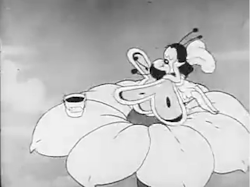
Film seg opened with a clever cartoon, The Bee and the Butterfly [Terrytoon, 1933], followed by a travelog, Coney Island, guaranteed to make transplanted Brooklynites yearn for the joys of Luna Park and Nathan's hot-dog stand. An educational feature, What Happened to Sugar, did a rational job explaining why the sweet stuff is still scarce. So much for the canned show. The listener is in a good mood—comes the live talent and the show slips.
Film actress, Ruth Warrick, and emsee, Jackson Wheeler, opened the show with a piece of biz all leading up to a mythical transformation of the act to a vets' hospital. Wheeler, who did a generally good job of emseeing, detracted from his delivery by nervously clapping his hands as he spoke. To the listener it sounded like a battery of 105mm. Howitzers in action. Amusin'—but confusin'.
First act was Major, an amazingly intelligent German Shepherd dog who could count like that man from the Internal Revenue Bureau.
Doris Day followed, singing Love Letters. Miss Day is a lovely lady, but neither the video camera nor the mike did her much good. Comedian-dancer Nicodemus and hoofer Bill Landon, both of whom have plenty on the ball, suffered from bad camera focusing, too often being out of range.
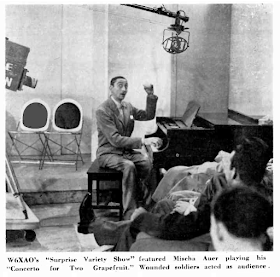 High spot of the evening was the surprise appearance of film comic Mischa Auer, who delighted the audience with his Piano Symphony for Two Grapefruits, a neat trick of playing the piano with several grapefruits. Spot was short but funny. Songstress Julie Lynn, who sang two popular ballads, had a bad time of it, but thru no fault of her own. In fairness to both Miss Lynn and Doris Day, it should be pointed out that songs were done to accompaniment of canned music which fluctuated in volume making it difficult for the singer to follow.
Live portion of the show closed with an appeal by Ruth Warrick on behalf of the Red Cross drive for 1946. Two additional film shorts, Lease on Life, produced by the Los Angeles Tubercular and Health Association, and News Parade of 1945 completed the evening's bill.
Show rebuked the usual complaint of video producers that good talent is unavailable. Performers on this seg were generally loaded with talent. That the airer didn't turn out to be socko was the fault of production, not talent. With a few more hours of rehearsal time allotted, the camera work, staging and lighting would have improved, and a show which was just above average could easily have been made outstanding. (Billboard, Mar. 2)
Tuesday, February 19
WCBW Channel 2
8:15 News and analysis.
8:30 “It’s a Gift” comedy-audience participation with John Reed King.
9:00 The New York Sportsman’s Show from Madison Square Garden.
Wednesday, February 20
WNBT Channel 1
8:00-11:30 Basketball from Madison Square Garden. CCNY vs. Brooklyn, NYU vs. St. John’s.
WCBW Channel 2
8:00-11:15 Basketball from Madison Square Garden.

With Don Dunphy, Charley Peterson, Ethan Allen, Etta Barton
Producer-Director: Bobbie Henry
Writer: Bert Schwartz
30 Mins.; Wed. (20), 7:30 p. m.
Sustaining
WRGB-ABC, Schenectady
In "I Saw It Happen," ABC has devised an interest-maintaining and workable format for presentation of sports shows. Hitherto tele, with the exception of pick-up of actual events, hasn't been paying too much attention to the wealth of material contained in this field.
With the formula devised on "I Saw It Happen" most types of sports can be televised with actual demonstrations interspersed with interviews.
On show caught, two diverse fields —baseball and billiards—were tackled successfully with guest appearances of Ethan Allen, former major league player recently appointed Yale baseball coach, and Charley Peterson, the three-cushion player. Most of the time was devoted to Peterson's mastery of the green felt on which the cameramen worked diligently, since they actually had to be on the ball for many of Peterson's trick shot demonstrations. With Peterson maintaining a running commentary of his play with many humorous asides, this segment worked itself into a highly diverting session.
Allen's task was mainly along interview lines, with Don Dunphy, WINS sports commentator, throwing the questions. He answered them with the dignity worthy of one about to be associated with Yale.
Show also made use of Dunphy's histrionic ability, casting him as a sports columnists trying to bat out his pillar in spite of interruptions by a photog using the office as a studio. Etta Barton, as the photog's subject, provided some nice cheesecake as a divertissement.
It's a two-set show alternating between the billiard table and the news office, allowing fast pacing by show's producer, Bobbie Henry. A knowing job of video writing was turned in by Bert Schwartz.Jose. (Variety, Feb. 27)
WASHINGTON, Feb. 25.—Another sign that upstairs transfer of video is in the immediate offing, is seen here in the wake of the FCC's action Wednesday (20) relaxing requirements for hours of commercial video operations on the air. FCC has waived until July 1 its rule requiring commercial television stations to air not less than, two hours of broadcast daily, with a minimum of 28 hours of program service weekly.
Some insiders have even been guessing that FCC will hold back on practically all commercial video application action until television is moved upstairs. While this view is regarded as extreme, insiders feel bolstered by the impact on FCC of Zenith Radio Corporation's recent announcement that it would discontinue manufacture of video black and white receivers on a 50 mc. band.
The view had gained credence in some circles as the result also of FCC's long delay in announcing District of Columbia television assignments. While no official FCC announcement has been made of the DC assignments, it is known that NBC, Philco and the Washington Star have been told they will get their channels. DuMont, however, is still being weighed against Bamberger for that fourth channel, it is said. (Billboard, Mar. 2)

WNBT Channel 1
7:00 “Teletruth,” children’s quiz.
7:30 Yale University Press American Historical Series film: “Daniel Boone” and “Frontier Women.”
8:14 Film:
“The Lone Rider in Texas Justice” with George Houston (PRC, 1942).
9:12 Hockey at Madison Square Garden. Rangers vs. Boston.
WCBW Channel 2
8:15 News and analysis.
8:30 “You Be the Judge” re-enactment of famous lawsuit.
8:50 Feature film.
Balaban and Katz
Reviewed Thursday (21), 7:30 to 8:30 p.m. Style—Drama, education, variety. Sustaining and commercial on WBKB, Chicago.
One of its best shows in many a month was presented by WBKB tonight. It had just about everything that could be asked of video in its present period of growth—well-varied programing, excellent production, top camera work and ingenuity of television special effects. Mistakes were minor. Altho it isn't often that we can describe a WBKB program in superlatives, this one deserved plenty of critical applause.
Easily the high point of the program was the drama They Had Their Hour. Written by Jack Gibney who also played the one visual role, it utilized plenty of good video staging and production gimmicks that were admirably worked out by Gladys Lundberg who directed it. Excellent assistance by high-grade camera work also was noticeable.
First of a new series to be presented under the same title, tonight's drama told the story of an emperor of Haiti in the year 1820 who had one supreme hour of mastery over paralysis before his death. Most of the story was told by the narration of Don Faust, while the camera was focused on a pair of hands playing drums, on pages of a book, on maps and on drawings depicting the scene. In between these shots Gibney, as the emperor, carried the play alone. Altho he was the only actor used, the visual effects mentioned above and such things as having his shadow cast on a wall while the narrator moved the story along and drum beats provided tone and mood. Top lighting, consisting of dramatic highlights and shadows on Gibney as he gave his lines, also added plenty. If the station had been able to add a few hundred feet of movies to depict the scene in a panoramic form, this drama, only about 25 minutes long and using a very inexpensive, small cast, could easily have been called a paragon of video production that would hold any audience and still bite into any video product's budget.
 Also on the program were an explanation of the construction of plastic home and clothes accessories by Caroline Howlitt of the School of the Art Institute; political commentary and cartooning by the well-known Chi Daily News cartoonist, Shoemaker, and the singing of Rita Warsawska. Miss Warsawska, photogenic and vivacious, had a good voice. Her voice and the way she made just the right type of interest-holding actions based on the mood of her semi-classical songs, made her one of the best video vocalists we have seen in many a moon. (Billboard, Mar. 2)
Friday, February 22
Also on the program were an explanation of the construction of plastic home and clothes accessories by Caroline Howlitt of the School of the Art Institute; political commentary and cartooning by the well-known Chi Daily News cartoonist, Shoemaker, and the singing of Rita Warsawska. Miss Warsawska, photogenic and vivacious, had a good voice. Her voice and the way she made just the right type of interest-holding actions based on the mood of her semi-classical songs, made her one of the best video vocalists we have seen in many a moon. (Billboard, Mar. 2)
Friday, February 22
WNBT Channel 1
8:00 “In Town Today.”
8:15 “The World in Your Home.”
8:30 Boxing from Madison Square Garden. Gus Lesnevich vs. Lee Oma.
WCBW Channel 2
8:00 News with Tom O’Connor.
8:30 “Draw Me Another,” art series.
8:45 “Choreotones,” modern dance series with Bambi Lynn, Robert Pagent.
9:00-9:45 New York Sportsmen’s Show from Madison Square Garden.
Close-Ups
Reviewed Friday (22), 8:25-8:40. Style—Variety. Sponsor—Marxman Pipes, Inc. Station—WNBT (NBC), New York.
This was an apology for a video commercial. Selling a pipe with still pix is about as minus in inspiration as anything can be. A pipe is about as natural a product to sell, via enjoyment, noted visually, as anything that could be sold to man—and the entertainment. Ouch!
Lillian Cornell replaced the billed Vera Holly and because, no doubt, she didn't have much rehearsal in mouthing to her recorded tonsiling, she was ill at ease. The ike sees all and tells all, which is to Miss Cornell's sorrow.
Second entertainer on the program was Sheila Barrett doing her cockney girl saying good-bye to her Yank man. The ike sees all and tells all, much to Miss Barrett's sorrow. When you place a vase of flowers on a wooden column and bring on entertainers to work in front of the flower vase, you put the hex on the performers. They have to be 10 times as good as they are to stand there in front of the camera and give. Why Ernest Colling didn't do something, in a video way, to give either of the girls a crutch to lean on is anybody's guess.
NBC is still holding the commercial production reins on the air pic field, but if this was its idea of good selling, something ought to be done—but quick. (Billboard, Mar. 2)
WNBT (NBC, N. Y.) got caught with its commercials down at the telecast of the Gus Lesnevich-Lee Oma fight at Madison Sq. Garden Friday night (22). Until the end of the fourth round, the show's producers kept their cameras glued to the ring between each round to give viewers the opportunity of watching the handlers work on the fighters.
At the end of the fourth round, however, the producers switched back to the studio to pick up a commercial for Gillette, sponsors, and hence missed completely the scenes showing the boxing commission's medico stop the fight after examining Lesnevich's badly cut eye. Viewers were completely at a loss to understand the throngs milling around the ring when the cameras were switched back to the Garden for what was to have been the start of the fifth round, and announcer Steve Ellis was hard put to explain what had happened. Just another factor for television producers to worry about in the future. (Variety, Feb. 27)
Covering a Fire
Reviewed Friday (22), 8:20-8:30. Style—News pix. Sustaining over WCBW (CBS), New York.
Just how good spot news pic coverage via video can be was demonstrated by CBS's coverage of a big fire down Greenwich Village way. Both cameramen Al Kleban and Dennis McBride were in the fire-fighting all the way and they didn't hesitate to eat a little smoke.
They proved that video-minded news men can take pix with the limitations of the small screen in mind that bring both the news and the atmosphere to the pic scanning.
There were some shots that, were they still pix, would rate awards in any photography exhibit. In fact, it seemed once or twice that Kleban and McBride stopped the progress of the fire-to catch a pose.
Coverage was beyond doubt the best short news job to date.
The follow-up interview of the fire chief, who supervised the two-alarm fire-fighting by Tom O'Connor, fell flat on its face. Straight interviews just don't scan. (Billboard, Mar. 2)
Choretones
Reviewed Friday (22), 8:55 to 9:10 p.m. Style—Ballet. Sustaining over WCBW (CBS), New York.
Altho titled Mississippi, this ballet interlude might well have been from the legiter Showboat, from which most of the music was lifted. Negro dancer, Tally Beatty, is actually in that play currently, while Bambi Lynn and Robert Pagent, who were featured, are in Carousel, all caught the mood of the river and wharf.
Setting by James McNaughton used the perspective floorcloth that he employed several weeks ago for a Belanger slip-up, but the rest of the setting was ideal for the dancing of the heel and toers. This was no guesting of a few stars but a miniature detailed dance drama choregraphed [sic] by Kitty Doner and Pauline Koner. It was a pro holiday for viewer balletomanes.
All toe duets were delightful, including Elmira Beay and Talley Beatty's bit of light romancing. Beatty's solo to Old Man River was sock.
From a scanning point of view, however, there was little to transport anyone to raves. The dissolves were meaningless and while the flower shots were beautiful, the dancer introes thru the foliage were all but invisible.
The camera followed the dancers adequately—but what made the program worth the looking was the choregraphy [sic] and the genius of the dancers. (Billboard, Mar. 2)
"CHOREOTONES"
With Bambi Lynn, Robert Pagent, Talley Beatty, Pauline Koner, Elmira Beay
Producers: Kitty Doner, Pauline Koner
Director: Paul Belanger
Cameras: Frank Hayes, Ralph War
ren
Set: James McNaughton
15 Mins.; Fri. (22), 8:50 p.m.
Sustaining
WCBW-CBS, N. Y.
Chief fault of WCBW's latest "Choreotones" dance session was the fact that it was too short—and that's definitely a compliment. With such stellar terpsichoreans as Bambi Lynn, of "Carousel." and Talley Beatty, of "Showboat," plus excellent production and direction, the show's 15 minutes went all too fast, prompting viewers to wish that an encore would be possible on television.
Producers Pauline Koner and Kitty Doner designed the ballet to tell the story of the Mississippi, with the terpers stepping out to the well-known music of "Showboat." Thus, Miss Lynn and Robert Pagent depicted a young couple in love in "Make Believe," bringing out the hearts-are-young-and-gay mood of the ballad. In much the same way, Beatty brought the pathos of Joe, the colored slave, admirably to life in "Old Man River" and Miss Koner did an expressive dance rendition of "Can't Help Loving That Man."
Paul Belanger, ace director of the WCBW dance shows, again highlighted, the program with his camera shots, using a bevy of lap-dissolves and super-impositions to hypo the needs of the various numbers. Director introduced a new effect for good results on this show—superimposing the profiles of two of the dancers over another couple dancing in the background.
Jim McNaughton's set of a showboat tied to the dock also comes in for its share of kudos. McNaughton is undoubtedly tops in his field at achieving a third-dimensional effect through the simple expedient of using straight lines. Viewers were amazed to discover how small the set actually was in the one instance when Miss Lynn danced too close to the backdrop. (Variety, Feb. 27)
 Saturday, February 23
WNBT Channel 1
8:00 Film: “Return to Yesterday” with Dame May Whitty, Anna Lee, Clive Brook (Associated British, 1940).
[The above was evidently cancelled.]
NATIONAL AAU TRACK MEET
Bob Stanton, announcer
Producer: Burke Crotty
120 Mins., Sat. (23), 8 p.m.
Sustaining
WNBT-NBC, N. Y.
Hauling their remote pickup equipment over to Madison Sq. Garden Saturday night (23) for a telecast of the National AAU indoor track and field meet, the NBC television crew came up with another sports event that's very well suited for video. It's doubtful whether the meet's promoters staged the various events in certain spots of the Garden just for the benefit of the television cameras, but the pickup couldn't have been better if it had been planned that way.
Using only one camera because of the concentrated action, the crew could swing it down to one end of the track to pick up the start of a sprint event, follow the runners as they burned up the track to the finish tape; then, without swinging back, pick up the shot-put at the same end of the oval, while the next heat of sprinters was lining up in the starting blocks. Between events, the cameramen just poked their lenses out to the center of the arena to pick up the pole vault.
Distance runs were televised just as well, with the camera getting very good closeups of the runners' faces as they swung around underneath the lenses, then giving viewers a good picture of the contestants' strides as they strung out along the far side of the track. Minor mishap occurred during the 1,000-yard run, when the camera's cables evidently got tangled up so that the runners were momentarily lost to view. When the cables were unsnarled, the camera had to swing fast to get the runners in range again.
Announcer Bob Stanton, without missing a syllable, swung into a fast radio-type spiel as soon as the mishap occurred, so that the viewers were never, at a loss as to what was going on. During the rest of the meet, Stanton confined his remarks to by-play on the events, letting the home audience take full advantage of the sight aspect of television. And that's something for which he's definitely to be commended. Stanton is rapidly emerging as one of video's best spoils announcers, with a very good knowledge of how to establish a sense of intimacy between himself and the viewers. (Variety, Feb. 27)
NEW YORK, Feb. 23.—DuMont Television's WABD will kick off its return to the air after a three-month silence with a half-hour special event airer from its Washington studios on March 11. Program will be the first non -pool use of AT&T's coax line between the capital and WABD's new Wanamaker studios in New York.
Show, which airs from 8:30-9 p.m., will be preceded by a half-hour variety seg using top Stem talent. The Washington stanza will call on FCC members, congressmen and other government officials in a sort of "it's a great thing, maw" tribute.
By late spring, DuMont intends to have a mobile unit in operation, complete with image orthicons made by the company which is an RCA licensee. Until that time, however, all D. C. programing will come out of the studios in the Harrington Hotel. (Billboard, Mar. 2)
NEW YORK, Feb. 23.—First commercial show to go on DuMont's WABD when it returns to the air March 11 will be an as yet untitled quiz which Duane-Jones Agency is concocting for the C. F. Muller Company, makers of Mueller's Macaroni, Spaghetti and Egg Noodles. Stanza will air in the Monday, 9-9:30 p.m. slot.
Produced by Tom Hutchinson, late of RKO Television, under the general supervision of Duane-Jones, Walter Ware, the program will feature entertainment spots hooked in with the quiz questions. A panel of name judges will try to answer the posers on the basis of hints thrown out via the medium of songs, gags, dances. etc. Emsee is not yet set.
Commercials will be along demonstration lines, similar to the ones which ABC video used for Chef Boy-Ar-Dee Spaghetti at G. E.'s WRGB, Schenectady, some months ago. Food will be cooked on the set and sampled by the studio audience. (Billboard, Mar. 2)
Sunday, February 24
WNBT Channel 1
8:00 Newsreel.
8:15 “Knockout,” comedy by J.C. Nugent, who plays the leading role. Also appearing, Mike Road and Joan Castle.
9:00 Hockey. Amateur teams.
"KNOCKOUT"
With J. C. Nugent, Michael Road, Joan Castle, Walter Long, Ethel Griffies, Frances Tannehill, Alexander Clark, Madeline Clive, Kim Spaulding, John Gerstad, Jeanne Cagney, Lee Nugent
Adapted from original play by Elliott and J. C. Nugent
Producer-Director, Ed Sobol
Technical Director: Al Protzman
Sets: Bob Wade
45 Mins.; Sun;. (24), 8:20 p. m.
Sustaining
WNBT-NBC, N. Y.
WNBT staff must be slowing down, knowing they'll get several weeks' vacation when the station goes off the air at midnight tomorrow (Thursday [28]) for reconversion to its new channel. That's the only understandable reason for the terrific letdown from its usual topnotch work that was evidenced in "Knockout," Sunday night's lull-length drama. Show emerged as one of the most amateurish jobs yet televised by the NBC station, with acting, direction, script and camera work all placing it in the elementary class.
Adapted from an original play penned by Elliott Nugent and his father, J. C., "Knockout" seemed to have something to do with a prize-fighter who was too proud to take money from his wife to further his career. Show featured the usual large cast used by WNBT in its Sunday shows, but not their usual good work. Elder Nugent, as the boxer's father-in-law, was his usual excellent self in a role tailored to his talents, and Michael Road and Nan Castle, as the boxer and his spouse, also did the best they could, but the rest of the cast acted like something out of a high-school play. Chief offender was Walter Long, who, with his extensive film and stage experience, should have known better.
Producer-director Ed Sobol was also way off the beam. Directly responsible for the lineup of camera shots, he limited his usual versatile work to a series of unrelated close-ups and long-shots, with the all-important middle shots hardly ever used, and any trick effects "thrown out the window entirely. Cameras were also out of focus at several points, which must have caused many viewers to start frantically twisting the dials on their sets.
Show's two redeeming factors, besides the work of the lead characters, were the two sets designed by Bob Wade and a minor bit of action in the first scene, when a couple of thieves attempted to make off with a well-loaded pocketbook, but were stopped in a rough-and-tumble. And, oh yes, the decorative figures of several of the actresses that the cameras seemed to pick up without too much trouble. (Variety, Feb. 27)
 Monday, February 25
WNBT Channel 1
8:00 Feature Film:
“Exile Express” with Anna Sten, Alan Marshal. (Grand National, 1939).
9:15 Boxing at St. Nicholas Arena. Lenny (Boom Boom) Mancini vs. Phil Palmer.
WCBW Channel 2
8:00-11:15 Basketball at Madison Square Garden. St. John’s vs. Manhattan; St. Francis vs. Muhlenberg.
 TELEVISION HISTORY was in the making in the projection room of WBKB Chicago when Tom Kelly, cartoonist-conservationist of Milwaukee, recently stepped before his easel and opened an illustrated lecture on soil and water conservation.
The first telecast made by a representative of the U. S. Soil Conservation Service was on for 18 minutes, while the skillful artist used his crayons to drive home the importance of the project. A potential 400 home receiving set owners in WBKB's territory saw and heard the program.
City audiences are as greatly interested as farmers. Within the near future Mr. Kelly is scheduled to return to WBKB with a new program explaining why farmers should abandon the straight row up and down hill to plow on the contour; why they should grow strips of meadow between cultivated crops on sloping land and why they should terrace slopes into gentle, contoured ridges.
Mr. Kelly represents the U. S. Soil Conservation Service in eight midwestern states. He has given more than 4,000 illustrated talks on conservation in the past 13 years, the first 12 of which were spent with the Minnesota Dept. of Conservation. Prior to that time he spent 20 years as a newspaper cartoonist in Minneapolis and St. Louis. (Broadcasting, Feb. 25)
Tuesday, February 26
WCBW Channel 2
8:15 News and analysis.
8:30 “It’s a Gift” comedy-audience participation with John Reed King.
9:00 “Nucleus Revisited,” repeat performance of a program in the musical art “Abstract” series.
Washington, Feb. 26.—Full 28-hour a week programming for commercial video stations need not begin until July 1, FCC ruled last week.
Although recently adopted regulations call for operation no less than two hours a day and 28 hours a week, the commission explained it was giving the television broadcasters a four months' breather to build up their program schedules. The six commercial telecasters now on the air are programming an average of 18 hours weekly. (Variety, Feb. 27)
Wednesday, February 27
WNBT Channel 1
8:00-11:30 Basketball from Madison Square Garden. L.I.U. vs. DePaul; N.Y.U. vs Baylor.
WCBW Channel 2
7:30 “See What You Know,” quiz with Bennett Cerf.
8:00-11:30 Basketball from Madison Square Garden.
MADISON SQ. GARDEN BASKETBALL
Bob Stanton, announcer
Producer: Peter Barker
180 Mins.; Wed. (27), 8 p.m.
Sustaining
WNBT-NBC, N. Y.
WNBT wound up its remote schedule before closing down for its channel change with one of the best out-of-the-studio broadcasts of the season Wed. night (27). Madison Sq. Garden was jammed to capacity for the LIU-De Paul, NYU-Baylor doubleheader, but those New Yorkers lucky enough to own a television set saw the games in the comfort or their own homes—and had a view as good as any of the fans sitting next to the Garden floor.
By using two cameras, the remote crew was able to get clear distance shots of the entire floor, as well as some outstanding closeups. Distance shots were so clear that the faces of at least the first five rows of spectators on the opposite side of the arena were clearly discernible as the cameras caught the over-all action, including long- passes, long shots at the basket, etc. Closeups were valuable for watching the players' faces as they huddled during the-time-out periods or walked off the floor to give way to a substitute.
Outstanding feature of the broadcast was the way in which the lenses covered the baskets. Distance camera covered the ball in flight each time a shot was made. As soon as the ball neared the backboard, however, producer Peter Barker immediately switched, over to the other camera to get an amazingly good closeup of the basket. Viewers consequently received the impression of being almost on top of the backboards at all important points during the games.
Bob Stanton furnished additional highlights with his fine announcing work. Stanton gave viewers u-to-the minute announcements of all substitutions, fouls, etc., but confined the rest of his commentary to point out some of the finer points of the game as they occurred. Announcer deserves several pats on the back for his realization that television includes sight as well as sound and does not require the radio technique of sports description.(Variety, Mar. 27)
Some 3,500 to 5,000 television set owners in the New York area will be left without a show to tune in after tomorrow (Thursday) midnight. To reconvert transmitting equipment to the new channels assigned them by FCC, WCBW (CBS) will sign off at midnight tonight (Wednesday) and WNBT (NBC) 24 hours later.
NBC and CBS outlets in New York will be off several weeks. Earliest of New York's outlets to come back to the air will be WABD DuMont, returning March 11 with video broadcasts from the new Wanamaker studio, where a new transmitter is already attuned to the new channel. DuMont has been off since last fall. Interim will give set owners also the opportunity to reconvert their machines to the new frequencies. DuMont sales staff has already sent out cards notifying owners that the sets must be retuned, and is preparing to send service men to all homes in first-come, first-serve order. Other manufacturers will probably follow suit, with a charge for the service expected to range from $10 to $25, depending on the size of the set and other details.
WNBT, switching from Channel 1 to Channel 4, expects to be back on the air about April 5. Station's execs envisage no change in policy at that time, but will continue along present lines, giving viewers nightly broadcasts of films, live drama and variety shows, sports pickups, etc. Station has not announced the acquisition of any additional sponsored shows.
Bows Off Tonight
WCBW, remaining on Channel 2 but changing its broadcast band, will bow off tonight following presentation of the second in its series of "See What You Know," quiz show featuring Bennett Cerf as permanent emcee. Tonight's session (Wednesday) will guest Jinx Falkenburg, Abe Burrows and Johnny Mercer. CBS execs reported plenty of nibbles had been received from ad agencies for air time, but reiterated that one of their own producers must handle the controls of any show when it goes on the air. Web's video department will continue color demonstrations for the benefit of VIPs from the ad agencies and prospective advertisers.
All three stations are expected to begin regular Washington-N. Y. broadcasts in the near future, following the successful inauguration of the city-to-city transmission over the Bell System's coaxial cable on Lincoln's birthday. Present plans call for the cable to be made available to each station two nights weekly for experimental purposes. With the shortage of cameras and equipment, however, it's doubtful that the new service will begin until the broadcasters are able to buy enough equipment to preclude their having to lug cameras from N. Y. down to D. C. for each broadcast.
WABD has announced that it will sell air time for the first time in its history, with almost two-thirds of available time already purchased by sponsors. Differing from NBC and CBS, DuMont allows a show's producers to handle all phases of production, which is believed the reason for the great amount of time already sold by the station. (Variety, Feb. 27)

Lockheed show, first Coast commercial undertaken by ABC, will comprise four weekly broadcasts, maximum allowed by ABC video policy for commercial programs. It will be heard Thursdays from 8:30 to 9 p.m. and will feature stories about the new Lockheed Constellation, four-engined plane which was baptized last week when Howard Hughes flew a bevy of Hollywood personalities to N. Y. to inaugurate non-stop coast-to-coast flights. (Variety, Feb. 27)
ESSO MARKETERS last Wednesday [27] previewed by television on WNBT New York "A Date With West Virginia," first of a series oftravel films the company is making to promote touring in the states where Esso products are sold. Program was placed by Marschalk & Pratt Co., New York. (Broadcasting, Mar. 4)
 Thursday, February 28
WNBT Channel 1
7:00 “Teletruth,” children’s quiz.
7:30 Yale University Press American Historical Series film: “Alexander Hamilton” and “Dixie.”
8:15 Film:
“Texas Trouble Shooters” with the Ranger Busters (Monogram, 1942).


 WBKB's first show reviewed since the station went back on the air after frequency change, proved program staff had not allowed grass to grow during the hiatus. The program was far above those put on nights about six months ago and certainly above quality of practically all other programs aired during afternoons. Only faults were those in the engineering field which resulted in one camera blanking out completely at one time and dark spots at other times in the pix picked up by the same camera.