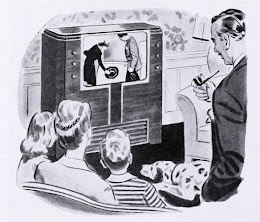
Anyone expecting Jolly Old St. Nick to bring them a nice, shiny, post-war television for Christmas in 1945 would be disappointed. The elves at Philco, Emerson, Admiral and other TV-makers had nothing but promises of something in the future. Materials weren’t available just yet. No new televisions, no new radios.
A few major developments marked the close of the year. NBC used a Bell Telephone coaxial cable between New York and Philadelphia to air the Army-Navy football game on a three-station hook-up December 1st, with the cameras equipped with RCA’s new supersensitive image orthicon. The United Press’ Jack V. Fox estimated there were 3,000 sets in New York able to pick up Red Barber and Bob Stanton making the calls. A coaxial cable was being laid between New York and Washington, even though the only station there was DuMont’s test transmitter.
The FCC wouldn’t begin hearings into handing out licenses to other companies in Washington, but it did finally set the new frequencies for TV stations that currently had the go-ahead to operate. That meant DuMont’s WABD could sign on again after two months, though it didn’t happen in 1945. Meanwhile, the Philadelphia station had to go off the air to make the necessary revisions.
CBS was forced to cancel shows for two reasons—outdated equipment and lousy talent. WCBW hoped to compete against WNBT for basketball games but its mobile unit wouldn’t work. And a young ventriloquist was deemed completely inept by critics (one wonders if they lashed out at Edgar Bergen for moving his lips) that her show was cancelled after one appearance.
In Chicago, a critic griped that a newscaster was ad-libbing. Earlier in the year, a critic was complaining another Chicago newscaster was reading and should have been ad-libbing. Go figure.

Saturday, December 1
WNBT Channel 1
12:00 Pre-Game ceremonies.
1:30 Football: Army vs. Navy from Municipal Stadium, Philadelphia (To End).
Probably the largest audience ever to witness a single television program was introduced to the wonders of long-range video transmission Saturday (1) when WNBT (NBC, N. Y.) accorded the Army-Navy football game the most comprehensive and elaborate coverage yet given a video field pickup. Utilizing the Bell System's coaxial cable, the game was transmitted from Philadelphia's Municipal Stadium to New York, and carried through NBC's facilities on a three-station television network that also included Station WPTZ in Philadelphia and WRGB in Schenectady.
Excepting two or three times, when the screen went blank due to still-unexplained technical difficulties, viewers saw the entire game from a 50-yard line seat in the warm comfort of their own homes, from the time President Truman entered the stands until the final whistle. RCA's supersensitive image orthicon tube, coupled with a special 40-inch lens mounted on one of the other two cameras, provided closeups of most of the game's best action that were far better than those obtained by 102.000 shivering fans in Philly.
Show had its minor faults, of course, but more than amply demonstrated the opportunities to be provided by television when the still-infant industry emerges from its swaddling clothes and the technical kinks are ironed out. Chief fault, insofar as the viewers were concerned, was the manner in which the camera remained glued to one scene after the announcer had already switched the audience's audio attention to something else as, for example, when the announcer was describing the antics of a dog on the field and the camera was still riveted to the midshipmen's pregame drill. Fault, according to NBC engineers, lay in the unwieldiness of the over-sized lens, which made the camera too heavy to be swung last enough on its axis.
Blurred images on some of the closeups, which were also traceable to the large-sized lens, provided another drawback, and the razzle-dazzle of football's T-formation also proved a stumbling block, with the camera unable to follow the ball in many instances. Designed to fool the opposing team, however, the intricacies of the game were not the fault of the cameramen and will naturally not be present in other shows.
Sponsored by the Curtis Publishing Co., the show was a preview of long-distance television service to be available on a regular basis from Washington to New York in January. Transmission was matte possible through the coaxial cable, which functions by channeling a radio beam and amplifying it at regular intervals of about five miles. (Bob Stahl, Variety, Dec. 5)

Sunday, December 2
WNBT Channel 1
2:00 Football: N. Y. Giants vs. Philadelphia at the Polo Grounds.
8:00 Newsreel.
8:10 “The Christmas Television Shopper.”
8:40 Stephen Vincent Benet’s “The Devil and Daniel Webster” with Vinton Hayworth and Grandon Rhodes.
9:10 Matthew Merritt: Good Government.
The Devil and Daniel Webster
Reviewed Sunday (2) 8:50 to 9:40 p.m. (EST). Style—Drama. Sustaining over WNBT (NBC), New York.
There's no substitute for real honest-to-goodness acting on television. Once again NBC has proven this with a sock scaning of Stephen Vincent Benet's The Devil and Daniel Webster. It wasn't the scanning of Stephen Vincent Benet's The easiest to read—realistically—but there wasn't a bad performance in the entire cast.
Of course, the writing is top drawer, and when you add to a Benet scripting, music, visual and ear-impelling, from Disney's Fantasia, you start with an edge, air-pic speaking. But even this combination could have smelled it Reed Davis, director, and Ernest Coiling, producer, hadn't taken the script, the set, the cameras and the cast and made viewers forget that this was television—you just weren't conscious of the medium. Here was entertainment-superb entertainment—as fine as last week's Petticoat Fever was putrid. There was even an amazing depth of focus, seldom seen on the air, and when the cameras moved in for close-ups, damn me man, Daniel Webster Grandon Rhodes was selling the audience on not going to hell and was not lust reading lines.
There was an amazing performance by Arthur Hunnicutt, as Jabez Stone, the man who sold his soul to the devil. You believed that he was a New Hampshire-man, who lived back in the founding days of the nation. Even the Devil Peter Capell, who could have been Jusicy Corn, didn't overplay himself too much.
Double check as plus performances, Fran Lee's Ada Stone (the wife), Dorothy Emery's Winifred Stone (a daughter), Bill Beach's Justice Hawthorne and Gayne Sullivan's Mr. Higgins. A nice commentary was handled by John Patrick Costello, too.
And add to a swell scanning of a fine play, a bonus for the NBC-ite who conceived the idea of blending Disney's Fantasia to Benet's play. If anyone wants to know how to bring music visually to the air, the Fantasia excerpts A Night on Bald Mountain (the bridge) and Ave Maria (the conclusion) can be used at any time to prove the point.
Altho it's a shame to carp about a production like this—the fire in which the devil made his appearance was just a little on the overdone side—it would have toasted even the devil.
Bob Wade's set was New Hampshire and video at the same time, and whoever costumed the pic kept his gray scale in mind and there was no fading into backgrounds.
The Devil and Daniel Webster will do until someone tops it—to prove that it's still the program that counts—on the air. Repeat it soon again, and let the world know it in advance next time. The Army-Navy game may have been important, but it's productions like The Devil and Daniel Webster that will sell video. Joe Koehler. (Billboard, Dec. 8)
The Television Christmas Shopper
Reviewed Sunday (2) 8:22-8:40 p.m. (EST). Style—Dramatized shopping program. Sustaining over WNBT (NBC), New York.
To anyone who has turned pages of yule issues of Esquire, Mademoiselle, or any one of a host of service magazines, this scanning was on the plus side. Not only did the producer make certain that the products suggested for Christmas presents were unusual, but he permitted the cameras to bring them to the home screen. He also showed how they, the presents, were used. More of this type of programing on Int. a-tel (department store video) would prove that the medium can sell—like The Billboard.
Dorothy Parrish, the shopper (and she's to continue shopping for two more weeks), has what the camera takes (if she weren't so busy we'd make a date-play, that's how she came thru that ike). Santa (John Connery), however, was a bit on the plushy side—if NBC could only modernize him—and lose none of the Kris Kringle flavor-all would be swell. And another thing—the shopping was all for grown-ups—Surprise! Surprise!
The scanning was done by grown-ups, too.
And for the carping department—bring the cameras a little closer to the presents next week, Ernest Colling. Thanks. Joe Koehler. (Billboard, Dec. 8)

WNBT Channel 1
8:00 Film, “Wings of Democracy.”
8:13 Feature film, “Too Many Women” with Neil Hamilton, June Lang. (PRC, 1942).
9:20 Televues.
9:30 Objective Security.
9:51 Boxing from St. Nicholas Arena. Lee Savold vs. Al Hoosman.
Don Lee
Reviewed Monday (3) 8:30-10 p.m. Style—Vaude, films. Sustaining on W6XAO, Hollywood.
Tele flesher this time was a salute to the United Nations. As to why these lands should be so greeted at this particular time was not made clear unless, of course, it is always timely (atom bomb or no) to love one's neighbors. Latter must have been the reason, because group singing Hi! Neighbor! was used to start and close the half-hour live show.
 Whatever the cause, the effects were good. First of all, it gave W6XAO an excuse to string up a series of vaude acts which otherwise may have stranded in mid-air. Tie-in is always good, but especially welcome on tele where continuity and form are essential. Also the "good neighbor" gimmick served the purpose of putting home viewers in a friendly and forgiving state of mind toward anything that was to follow.
First act was four Chinese girls singing Purple Bamboo Lullaby, with lyrics in both Chinese and English. Unfortunately the diction was bad, leaving the curious in the dark as to what our brave allies say while crooning a purple bamboo cradle song. However, the tune was pleasingly Oriental (and not too long) and vocal work okay, making the act not hard to take.
Teresita Arias represented the entire continent of South America in a Latin dance which proved colorful and added life to the revue. Due to the element of motion terp as a rule makes good tele fare, This was even true in the case of the six little gals who banded together to offer a Polish dance. Whirling peasant skirts added zip to the show and distracted from the heavy-footed, awkward routines.
Show then took an unfortunate nose-dive with Kria Melissarato's reading of a Russian fairy tale. Despite the heroism of the Russian warriors, this part of the salute was hard to swallow. First of all, scanning a story teller via video is a tough nut to crack. Viewers tire of looking at Ube same person from the same angle in the time it takes to spin a yarn. In this case nothing was done to solve the problem. What made things worse, the woman spoke too rapidly to make comprehension easy. Also considering the great wealth of Russian lore, it seemed that Miss Melissarato could have picked a more interesting and colorful tale.
Altho none of the acts reached pro par, the fact that they were tied in a bundle sold them as good entertainment. Another example of production carrying the load for not-so-hot material.
Scanning showed W6XAO's image quality has taken a turn for the better. However, lighting still needs more attention. Juicers should strive for even flooding, especially in close-ups where an occasional chin shadow can so easily grow into a beard.
Full hour was devoted to canned stuff with only a cartoon proving eye-worthy. Show opened wick three films, closed with three. Lee Zhito. (Billboard, Dec. 15)

Trade reports that either or both may be in the Garden by the end of the year. It is understood that the games have been offered to all television stations with the proviso that the first one to sell them to a sponsor gets an exclusive. If neither is able to peddle the programs, it is quite possible, according to one interpretation, that both may move in. DuMont, of course, is out of the picture because of lack of staff and equipment. If both go in, there will be jockeying for position that will make the old Poughkeepsie Regatta throat-cutting look like a pastel dream of peace.
There is another aspect to the story, and that is the time element. CBS's portable cameras are not yet quite ready and, even if Columbia's sales department comes up with a client, the technical boys may not be able to put it thru. NBC, of course, has all its equipment working and has been using it for some time. Even if NBC does manage to sew up the Garden, trade expects a good special events blood-letting some time in the immediate future. In the past few years, NBC has had sports in this town tied up tighter than the well-known drum. But now, CBS is getting its equipment out of the mothballs and special events director Lieut. Com. Bob Edge, out of the coast guard, is ready to give the senior web a tussle. (Billboard, Dec. 8)
NEW YORK, Dec. 3—Grand total of somewhere between 55 and 60 staff members have been fired by DuMont Television’s station here, WABD, in the past two weeks. Peak strength of the station staff was about 70 people.
On Wednesday (21), the day before Thanksgiving, 14 people were dropped with no prior warning. Wednesday’s layoffs were followed on Friday (23) by six more dismissals. The rest of the firings occurred during the week past. Staffers let out ranged from the head of the film department and the program service manager down to page girls and clerks. It is understood that receiver sales have also been hit.
A group of girls who formerly were members of the studio floor crew have been laid off and the research project in which they were engaged has been suspended. A group of executives, including the station manager, time sales chief, program director, art topper and assistant sales manager have been retained. Most of them still have their secretaries. Several engineers are still on the job.
Most of the people affected in the pre-Christmas firings have been told that they can have their jobs back when and if the station returns to the air. However, many of them have indicated that they would refuse to go back to DuMont, rankled as they are by being fired without warning. Some, in fact, have said that the first indication they had of impending events was a story in The Billboard two weeks ago. (Billboard, Dec. 8)
WBKB Chicago is presenting a series of four television discussions on the modern history of Russia conducted by Don Elder, radio news commentator and analyst. Series, to be aired weekly—Tuesday 7:30 p.m. CST—highlights numerous special effects, including photographs, maps and charts. Elder will climax series with inside information on the present-day structure of the Soviet Union and outline his views on what can be expected in the future.
Frank Kleinjolz, nationally-known artist, appeared on television for the first time, Nov. 20, presenting and explaining backgrounds of several of his foremost paintings to WBIB audiences.
WBKB was off the air Thanksgiving evening but telecast regularly scheduled program No. 29. (Broadcasting, Dec. 3)
Tuesday, December 4
WCBW Channel 2
8:00 News and analysis with Marcus Duffield.
8:15 “Tales to Remember” tales of Americana with Milton Bacon.
8:39 Motion Picture.
9:00 “The Missus Goes A-Shopping” with John Reed King.
Wednesday, December 5
WCBW Channel 2
8:00-8:15 News with Boyce Price.
8:15 Film.
8:30 Amateur Boxing Bouts.
 Thursday, December 6
WNBT Channel 1
7:00-8:30 Children’s Program: “Teletruth,” quiz; Yale University American Historical series “Columbus”; Film: “Billy the Kid Trapped” with Buster Crabbe. Music by Clarence Wheeler. (PRC, 1942).
New York.—A series of 15 Yale University press films on U.S. history, titled “The Chronicles of American Photoplays,” will be televised here by WNBT (NBC), beginning Thursday. The pictures have been adapted for television with special scoring and narration by members of network video staff. (Hollywood Reporter, Dec. 4)
Friday, December 7
 WNBT Channel 1
8:00 “Friday Night Quarterback” with Lou Little.
8:15 “The World in Your Home” sponsored by RCA Victor.
8:30 Boxing at St. Nicholas Arena, Artie Levine vs. George Horne.
WCBW Channel 2
8:00 News with Tom O’Connor.
8:15 “Three Houses,” domestic comedy. “First Proposal.:
8:35 Film.
8:50 “Abstract,” music for television: “Cumulus.”
Balaban & Katz
Reviewed Friday (7), 7:30 to 8:30 p.m. Style—News, variety. Commercial and sustaining on WBKB, Chicago.
The Fair department store, one of Chi's largest, started its new commercial video series on WBKB tonight and proved, among other things, that there is a definite danger point at which a video programer can begin to have too much selling on his show.
The first stanza of The Fair's series consisted of nothing but telecasting various products on sale at the store. This was done intentionally, for the series is supposed to be an important part of a "tele- shopping" service. Articles displayed on the programs can be ordered by phone calls from the home viewers. All of this, of course, is intended to be an experiment based on the theory that at some future date the public will not have to go out of its homes for shopping for some items but will be able to make choices after seeing the items displayed on television programs. The way The Fair handled the experiment indicated, however, that there is a point where too much selling becomes confusing. On tonight's show various men's clothing and sports items, as well as household furniture and table accessories were telecast. Camera work and lighting were good and the articles could be seen and appreciated, but there were so many displayed in such a short time none were sold to the best advantage. After seeing so many items, the viewer's memory of any specific one was hazy.
We think it would be better for The Fair to weave some comedy or drama into the sales pitches. There might be simulated shopping scenes in the store, with children's antics adding human interest, or a husband and a wife out Christmas shopping. At any rate, there should be something to increase audience interest and get the show out of the boring doldrums of sheer salesmanship.
In direct contrast to The Fair's offering, the Commonwealth Edison program, Telequizicalls, showed how entertaining and effective video selling could be woven together to hold audiences interest (and thus increase the chances of the commercial messages being effective). Edison's show, arranged and produced by Adrian Rodner, has its commercial cleverly woven into a quiz program. As a show for a public service company interested in selling electricity, this program is a natural.
For its new program tonight WBKB initiated another gimmick worked out by Bill Eddy. WBKB, cramped for space, has always been troubled with the necessity of having intermission slides telecast during scenery changes. Eddy therefore rigged up a small studio next to the station's control room. Here an announcer sits and reads the news during change of scenery between shows. Ingenious part of the arrangement is that the studio is just about large enough for the announcer and a few lights. The camera used is one that is placed in a permanent spot outside the studio and right in front of the station's slide projector. When slides are to be telecast the camera's swung around and pointed at the projector. If a newscaster is to be caught, the camera is turned completely around on its permanent base and, pointed thru a hole knocked in the wall of the news studio, is focused on the newscaster. The result gives little chance for unusual camera angles or lighting or good background, but it does eliminate a big bug at WBKB. Cy Wagner. (Billboard, Dec. 15)
Saturday, December 8
WNBT Channel 1
8:15-11:00 Basketball: C.C.N.Y vs. Holy Cross; N.Y.U. Violets vs Colgate Red Raidersat Madison Square Garden.
Sunday, December 9
WNBT Channel 1
8:00 Newsreel.
8:10 “The Christmas Television Shopper”; “Philippine Promise Fulfilled”; “The Strange Christmas Dinner” by Margaret Cousins.
9:30 Hockey: Rangers vs. Toronto at Madison Square Garden.
"THE STRANGE CHRISTMAS DINNER"
With Grandon Rhodes. George Mathews, Celia Babcock, Ed Hussey, John Souther, A. P. Kaye, Alan MacAteer, John Martin, Dave Davis, Artie Semon, Lee Molnar, Kevin McCarthy, Bob Tobin
Writer: Margaret Cousins, adapted for television by Fred Coe
Producer: Fred Coe
Technical Director: Al Protzman
45 Mins.; Sunday (9), 8:15 p.m.
Sustaining
WNBT-NBC, N. Y.
WNBT brought a touch of Charles Dickens to its viewers Sun. (9) in "The Strange Christmas Dinner," a piece well suited to the family audience and holiday spirit. Not so long as the station's usual Sunday night plays because of the hockey game telecast from Madison Sq. Garden that followed, the show was an original adapted from a short story in "Good Housekeeping'' that incorporated all the deft Dickensian touches o£ the author's "Christmas Carol."
Replacing Scrooge was a miserly old flint heart named Herman Grubby proprietor of a Broadway eatery who refused to let his employees take off Christmas Day, despite the scarcity of customers. First customer finally appeared, dressed in the height of fashion of the 1870's, and persuaded Grubb finally to change his ways. After customer, still unidentified, walked out, the hat-check girl who'd asked for his autograph, looked at the signature to discover the name was "Charles Dickens."
Producer Fred Coe added much to the show's merits by bringing films of Times Square and references to modern Broadway goings-on to help set the story's locale. Cast, topped by Grandon Rhodes as Dickens and John Souther as Grubb, was uniformly good, and Bob Wade's set was an almost perfect facsimile of a second-rate Broadway chop house. (Variety, Dec. 12)

WNBT Channel 1
8:00 Film, “Wings of Democracy.”
8:13 Feature film: “Broadway Big Shot” with Virginia Vale, Ralph Byrd (PRC, 1942).
9:20 Televues.
9:25 Boxing from Madison Square Garden. Cecil Hudson vs. Fritzie Zivic.
PHILADELPHIA, Dec. 10.— Philco Corporation tele station here, WPTZ, will shortly go off the air for six weeks for a change in channel. WPTZ was on Philadelphia's Channel 3.
It moves down to Channel 2. It is understood that Philco will not release any station staffers during the change-over period. Instead, company will go ahead with its expansion plans.(Billboard, Dec. 15)
NEW YORK, Dec. 10.—Second big-time sponsor for CBS television, General Mills, signed a contract for a one-shot film last week. G. M. will sponsor a pic on the history of cake called 400 Years in Four Minutes.
The 28-minute film will be aired December 18, starting at 8:38. First heavy-billing advertiser to go on CBS was Lever Bros. (Billboard, Dec. 15)
NEW YORK, Dec. 10.—NBC's television station here, WNBT, jumps its weekly number of broadcast hours to 17 1/2, spread over six days, when it begins airings of basketball and hockey games from Madison Square Garden this week. Seventeen and a half hours a week means that WNBT has doubled its time on the air inside of a year.
Basketball and hockey account for nine and a half hours, more than half the total time. Friday night boxing takes another two and a half hours, meaning that almost two thirds of NBC's time is filled by remotes. The Television Quarterback, with Lou Little, adds another half hour to the sports total. Films and drama fill rest of the time. (Billboard, Dec. 15)
Tuesday, December 11
WCBW Channel 2
8:00 News and analysis with Marcus Duffield.
8:15 Iva Kitchell, modern dance program.
8:30 Motion Picture.
9:00 “The Missus Goes A-Shopping” with John Reed King.
"SOCK POLIO"
Don Ward, narrator
Writers: Don Ward, Gladys Lundberg
Producer-Director: Miss Lundberg
Cameras: Rachel Stewart, Esther Rajewski
30 Mins.; Tues. (11), 8 p.m.
SISTER KENNY INFANTILE PARALYSIS DRIVE
WBKB, Chicago
First television demonstration of the Sister Kenny Infantile Paralysis treatment in the history of the medium, this stanza marked video's Chi debut in the national "Sock Polio" campaign. Rather than a straight script job, the show was built around a more or less ad lib narration and emcee job by Don Ward, local commentator.
Material, which was gathered by Gladys Lundberg, also director-producer, covered a short Sister Kenny biog and led up to an actual demonstration of the Kenny treatment on a young polio patient by a qualified technician. Highlighting the program was an impromptu discussion between Chi Times columnist Irv (Kup) Kupcinet and Phil Cavarretta. Chi Cubs' first-sacker and 1945 Most Valuable Player in the National League. Both did passably with little preparation, although the subject matter didn't have much bearing on the polio drive.
Full use of the visual medium continued to be made when, along with the narration by Ward, a series of charts were presented, demonstrating with figures from actual experiments the advantages of the Kenny cure over the usual hospital treatment. Selling was well done.
While there might be some audience objection to the sort of thing shown (i.e., medical treatment of a diseased person), the presentation was a novel and forceful way to bring the point home. Because the show was pretty much on the ad lib side, it could easily have come apart at the seams, and the fact that it didn't is due largely to Ward's narration.
Audience reaction, when caught, would indicate the experiment was a success. (Variety, Dec. 19)
Philadelphia, Dec. 11—Gimbel Bros., which was the first department store to operate a radio station here, has recently finished an experiment in the use of television as an aid to shoppers.
For two weeks, various departments, merchandise displays and the like were televised to 20 RCA-Victor video receivers spotted in different sections of the store. Departments included hairdressing salon, toys, house furnishings, hats, kitchen ware, etc. The shows were purely commercial, with no entertainment gimmicks.
Persons watching the telecasts were pooled by interviewers to test efficacy of this method for advertising product in a department store. More than 70% of those polled said this was first time they had gandered television, about 85% felt that video was a definite aid to shopping. The tele-shopping shows were seen by approximately 250,000 people. (Variety, Dec. 12)
Wednesday, December 12
WNBT Channel 1
8:00 Basketball: Long Island U. vs. Oklahoma A. and M.; St. John’s vs. Utah. From Madison Square Garden.
WCBW Channel 2
8:00-8:15 News.
8:15 Film.
8:18 Shirley Reid, ventriloquist.
8:28 Film.
8:35-9:45 A. A. U. Boxing Bouts.
Basketball-NBC
Reviewed Wednesday (12), 8-11 p.m. Style—Sports remote. Sustaining over WNBT-NBC, New York.
Color television, General Sarnoff, three dimensions or any other fireworks notwithstanding, the best salesman for law frequencies in general and NBC in particular, is the sports coverage which the net's station here, WNBT, is attempting right now. On the tail end of a football season which drew as much press space as anything else in television to date, NBC has delivered another sure-fire space grabber in twice-weekly basketball games from Madison Square Garden.
Basket ball, now enjoying the biggest boom in its history and subject of "learned" essays in the sports pages, is a natural for television. Its action is confined to a small area. It moves fast, but the ball is easy to follow. There is little deception. As in football, it is not subject to weather conditions, is played in brilliantly lighted stadia and even the background a polished hardwood floor, helps make it easier to see. All those elements were present Wednesday night, plus the added boost of two very exciting games.

Chief criticism of the show hinges on the question of fatigue. Two full games, even on the spot, is perhaps a bit too much. But in television, with its ever-present factor of eye strain, the deadening effect on the viewer is intensified. One game, the top one of the evening, would be enough.
Between halves and between games NBC used only a badly painted sign and some recorded music to hold the audience. It would be helpful perhaps if some sort of live show, news or a resume of the game were put in the 10- minute spot. Without doubt, most viewers use the break to rest their eyes, but if something were on, the pull back to the receiver would be increased and the audience loss not so great. When continuity of listening is broken in radio a goodly portion of the audience drops out. Same is probably true in television.
We had hoped to do a comparative review of CBS and NBC on this basketball game, but Columbia, which last week announced that it would be at the Garden, bowed out, explaining that its equipment had not passed muster. Marty Schrader. (Billboard, Dec. 22)
Efforts of WCBW (CBS, N. Y.) to begin televising field pickups shows were stymied this week when the station's engineers decided after a test that the mobile equipment, still pre-war stock, was not up to par. Station had announced it would air a double-header basketball game from Madison Sq. Garden tonight (Wed.) to inaugurate the field pickup service, but called off its plans after the engineers had nixed the idea. Time will probably be filled by a sports show from the studio.
Lawrence Lowman, CBS veepee, has appointed John Southwell, former television director of Young & Rubicam, as a program director. Southwell bows in tonight with direction of "Bedelia," a comedy-skit to be aired from 8 to 8:10 p.m. Prior to joining Y. & R., Southwell was affiliated with B.B.D.&O., where he initiated that agency's video department, and was also a former scripter and assistant director for Metro, working under Victor Fleming. His recently-completed book, "So You Want a Job in Television," will be published by McGraw-Hill early next year.
Lowman also announced the appointment of Jerry Faust, who has acted in several WCBW shows, as an assistant director, and Bob Bendick, as director of the station's mobile unit, as soon as the field pickup program gets going. (Variety, Dec. 12)
"BEDELIA"
With Shirley Reid, Loney Lewis
Writer-director: John Southwell
Cameras: Howard Hayes, Ralph Warren
10 Mins.; Wed. (12), 8:18 p.m.
Sustaining
WCBW-CBS, N. Y.
Despite John Southwell's television experience with Young & Rubicam and BBD&O before joining CBS, his first directorial chore for WCBW left much to be desired. Featuring Shirley Reid and her ventriloquist's dummy, "Bedelia," was supposed to have been a comedy skit, but Southwell's poor direction, plus a dry script and Miss Reid's ineptitude as a ventriloquist, left the viewers with a very unfunny taste in their mouths.
Miss Reid demonstrated a nice range of inflection to distinguish voice from that of the dummy, but hasn't yet learned to keep her lips from moving in her ventriloquist's role. Southwell might have eliminated that fault by keeping the cameras glued to the dummy when the latter was supposedly speaking; instead, he emphasized Miss Reid's inability by keeping the cameras trained on her mouth throughout the show. In addition, the cameras several times picked up the ventriloquist's hand manipulating the dummy's movements from behind, thereby spotlighting another trade secret that shouldn't have been shown.
Story had the dummy, "Bedelia." as Miss Reid's younger sister, a precocious brat given to heckling her sister's suitors, in this ease Loney Lewis. Latter tried hard to be funny, but with the hoary quality of the jokes given him to play with, he never had a chance. (Variety, Dec. 19)
Bedelia
Reviewed Wednesday (12), 8:18-8:28 p.m. Style—Ventriloquist. Sustaining over WCBW, New York.
Southwell demonstrated great potentialities with a series of imaginative effects and the program's general structure, but his choice of material would have been of no credit to the rawest amateur. Bedelía, the comedy show, was distinctly unfunny. The fault in this case presumably rests equally with the star, Shirley Reid, as with Southwell. But it adds to no director's reputation to use anything as sluggish as Bedelía.
On the credit side of the critical ledger is the fact that Southwell tried several intelligent ways to elaborate on and improve the by now well-worn groove of ventriloquist turns. Miss Reid, the voice, became a young woman with a parlor date, and Bedelía, the dummy, became the pesty young sister. Loney Lewis played the boy friend with no great distinction.
Southwell added something to ventriloquism when he utilized television's special advantages to permit the ventriloquist to walk away from the dummy. The first time this was done a long shot, with its lack of definition, covered up for the lack of lip movement. But it was even better the second time when the dummy was left on a sectional couch and operated by a third party, hidden behind the furniture who was able to put his hand between one of the sections.
Technically, the program was good—which is as it should be. It's time that directors stopped congratulating themselves everytime they run thru 15 minutes without too many fluffs. In one or two of Bedelia's long shots, cameraman Howard Hayes took in too much floor and some of Ralph Warren's close-ups were fuzzy, but aside from that both are to be commended. Shading, too, seemed to be much better than it has been in past weeks and the lighting passed muster. Marty Schrader. (Billboard, Dec. 22)
John Reed King and his "Missus-Goes-A-Shopping" program go off CBS' tele station, WCBW, Jan. 8, after one-and-a-half years in the Tuesday 8 p.m. slot on the video outlet. Program, which will continue on WABC, N. Y„ as before, was rated best adaptation of a radio program to tele for 1945 by Television Broadcasters Ass'n.
King decided to take program off tele in order to exploit his own tele programs, which include "Thanks For Looking," "King's Record Shop" and another untitled show, "Thanks" was on DuMont, N. Y., for 26 weeks, sponsored by Lever Bros. "Record Shop" is currently being televised on WRGB, Schenectady, as an ABC presentation, with Paul Mowry supervising. (Variety, Dec. 12)
An elaborate series of Christmas programs has been planned for television audiences by the American Broadcasting Co., covering a seven-day period from Dec. 21 to 27, it was announced yesterday [12].
ABC’s Yuletide video presentations will begin with two sight-and-sound features, one from Schenectady and the other from Washington, D.C. The Schnectady program from WRGB, on the 21st will feature Irene Wicker. The television broadcast from Washington on the same day will be the annual Christmas party for the children of diplomats of all nations, a regular ABC radio attraction each year.
On Dec. 24, the net will present a two-hour television broadcast, from 8 to 10 p.m., EST, of a special Christmas Party from WRGB, Schenectady. On Dec. 26, John Reed King’s “King’s Record Shop: will be aired, and on Dec. 27, from WRGB, in cooperation with WTRY, ABC’s station in Troy, the network will present a video broadcast of the regularly scheduled radio fixture, Town Meeting of the Air, at 8:30 p.m. EST. (Hollywood Reporter, Dec. 13)

WNBT Channel 1
7:00 Children’s Program: “Teletruth,” quiz; Walter Abel with winning illustrations “Domesday Press Illustrating Contest.”
7:30 Yale University American Historical series “Jamestown.”
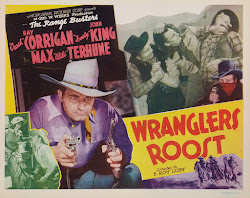
8:00 Film: “West of Pinto Basin” with the Range Busters (Monogram, 1940).
New video policy in spot commercials was inaugurated Thursday (13) at WBKB by Captain William C. Eddy, in charge of the Chi outlet, as a part of the general plan of program experimentation. Pitch was a three-minute spot sponsored by the Elgin Watch Co., which reduced the regular program segment to 12 minutes.
After several weeks trying various break lengths the local video directors decided that the orthodox 20 or 40 seconds were not sufficient for a visual message, and contributed nothing to the tele program. Working without precedent, they lengthened the station breaks gradually until the present 2 ½-3 minute time was reached, in an attempt to meet the added requirements placed by visual plus audio appeal which had to be used. In the traditional few seconds, there was time only for a quick flash of the sponsor's products and a few words, all squeezed between titles and trailers.
Backhanded selling will be the angle plugged in the new spot setup, with dramatized shorts worked into the regular program situation, since local people felt that, after sitting in a darkened room for 15 or 30 minutes of entertainment, audience would never stay for the commercial end of the show which, after all, is the most important to the sponsor. (Variety, Dec. 19)
Jumping the gun on CBS in the color television field, by staging a successful demonstration of tint video at Princeton, N. J., Thursday (13), RCA-NBC execs further took the wind out of the Columbia net sails by declaring simultaneously that any practical color system was still at least five years away. In addition, RCA heads emphasized their point that black-and-white television on the lower frequencies is ready for commercial use.
CBS expects to climb back into the ring at its own color demonstration skedded for early January. ...
Color demonstration consisted of a live talent show picked up directly by the RCA color camera at Princeton, and transmitted through the air to a screen about 2½ miles away on a 10,000 mg. channel, believed to be the highest yet used in video experimentation. Action was reproduced with all the colors visible to the eye, but the images showed a tendency to flicker because, using the same 525-line picture as in black-and-white, the scanning field was enlarged from 120 frames per second to 20 frames per second. (Variety, Dec. 19)
Friday, December 14

8:00 “Friday Night Quarterback” with Lou Little.
8:15 “The World in Your Home” sponsored by RCA Victor.
8:30 Boxing at St. Nicholas Arena, Beau Jack vs. Willie Joyce.
WCBW Channel 2
8:00 News with Tom O’Connor.
8:15 Film.
8:20 “Three Houses,” domestic comedy.
8:40 Film.
8:45“Tales to Remember” tales of Americana with Milton Bacon.
Saturday, December 15
WNBT Channel 1
8:00 Pre-game activities.
8:15-11:00 Basketball: N.Y.U. Violets vs Arkansas Razorbacks; St. John’s vs. Rhode Island State. Madison Square Garden.
PRINCETON, N. J., Dec. 15— During one of the rehearsals for the color television presentation of RCA-Victor this past week one of the girls poured on the black eye shadow to give her a glamour puss, but as the present RCA color cameras are oh, so sensitive, Ed Sobol, the director, knew that the black would make the shapely fern look like hell.
Sobol therefore swung around and told her to "take it off." The model looked at S and said:
"Are you kidding?"
S assured her he was not.
The model then said okay, but it's going to cost you an extra $50.
P. S.—It seems that she thought he meant the bathing suit she was wearing, not the eye shadow. (Billboard, Dec. 22)
Sunday, December 16
WNBT Channel 1
8:00 Newsreel.
8:10 “The Christmas Television Shopper.”
8:30 “Now You Can Go Places.”
8:36 Live play: “A True Christmas Story.”
9:01 Hockey: Rangers vs. Montreal at Madison Square Garden.
NBC
Reviewed Sunday (16) 8 -10:30 p.m. Style—Pix, Shopping hints, comedy, sports. Sustaining WNBT (NBC), New York.
Boredom came forth from NBC video this evening. Add up everything but the hockey and the entertainment score wouldn't touch bottom. Hold everything, the news pix were okay, especially the army shots of the execution of that German general in Italy. The close-ups of the general as he received the bullets of the firing squad were something that won't be forgotten in a long, long time. Paul Alley did his usual swell cutting job. You were there, Charlie.
Third episode of the Television Christmas Shopper was enlivened only by some cartoons of Aunt Minnie and forgotten relatives. Aside from that, the scanning was a lot of nothing, and, while Lenore Kingston, who replaced Renee Terry, was permitted to do a little more than Terry last week, it all added up to why people turn off pic receivers.
Shopper, however, wasn't as horrible as a so-called comedy bit titled How To Wrap Your Christmas Gifts. This, in writing and direction, was far worse than a B short, without an amusing conceit in the entire episode. The cast, Richard Goode, Jane Thomas and Jon McQuade, can't be blamed. They were given nothing to do to tickle viewers risibilities. They tickled nothing.
Both Shopper and Wrapper were from Fred Coe's non-imaginative department.
Last studio live show was In Town Today, which brought back to NBC Announcer Capt. Ray Forrest. Jack Costello introed Forrest, who took over the emsee job of bringing an assorted group of people to mike and ike. Most of the time Warren Wade, the producer, had him on that inevitable interviewing couch or jumping up and down from it. He presented some talent, but did them no good. Yvette, for instance, developed a Martha Raye mouth on camera, with none of Raye's comedy. Peggy Alexander danced in a USO uniform, which only presented her face. Reason why the boys went for her overseas. One sock moment on the In Town routine was the presentation of Sgt. Harold Russell, whose Diary of a Sergeant was human-interest copy.
Both the U. S. Army insert moon pictures and the interview of the handless ex-G.I. developed chills. Russell was real—and you were in the hospital with him—as well as believed him when he spoke to the boys about the fact that it can be done (living) without hands. Videowise, the program, as a unit, sank below even most of the DuMont and CBS scannings. That’s bad, brother.
Then came hockey. This evening there seemed less spider webbing in the ice, and the puck was therefore easier to follow. It was a well-followed game and perhaps worth the price of looking thru hours of near nothing. Most hockey followers turned off their sets after the news and came back at hockey time.
Who could blame them tonight? Joe Koehler. (Billboard, Dec. 22)
Monday, December 17

8:00 Feature film: “Girls Town” with June Story, Edith Fellow, Kenneth Howell (PRC, 1942).
9:10 Televues.
9:20 “Ordeal by Ice.”
9:30 Boxing from Madison Square Garden. Tony Pellone vs Patsy Giovanelli.
Tuesday, December 18
WCBW Channel 2
8:00 News.
8:15 Repeat performance of “Summertime,” third program in the “Choreotones” dance series.
8:30 Motion Picture.
8:38 Film: “400 Years in Four Minutes.” 9:00 “The Missus Goes A-Shopping” with John Reed King.
Wednesday, December 19
WNBT Channel 1
8:00 Pre-game activities.
8:15 Basketball: Long Island U. Blackbirds vs. Oregon Ducks. N.Y.C.C. Beavers vs. Oklahoma Sooners. From Madison Square Garden.
WCBW Channel 2
8:00-8:15 News with Boyce Price.
8:15 Film.
8:30-9:45 A. A. U. Boxing Bouts.
John Reed King is negotiating with CBS to continue on WCBW, its N. Y. tele outlet, in one of his package shows, probably "Thanks For Looking." Likely will begin soon after Jan. 8, when "Missus Goes-A-Shopping" checks off WCBW.
"Thanks," which was a 15-minute program when aired for 26 weeks on DuMont for Lever Bros., will be expanded to a half-hour show for CBS (WCBW). (Variety, Dec. 19)
Thursday, December 20
WNBT Channel 1
7:00-8:30 Children’s Program: “Teletruth,” quiz; Children’s Choir; Yale University American Historical series “Pilgrims.”
"CHRISTMAS CAROL"
Adapted for video by Beulah Zachary
Producer-Director: Miss Zachary
Cameras: Rachel Stewart, Esther Rajewski
30 Mins.; Thurs. (20), 8 p.m.
ADMIRAL RADIO
WBKB, Chicago
(Crittenden & Eager)
This show marked the end of an experiment, the last of an unfortunate series of amateur programs for the video medium. After 12 segments in the same vein the obvious conclusion to be drawn is that television was never meant for the non-professionals.
This particular attempt was somewhat better than previous trys, with double-dissolve technique for the ghost business expertly done by camera girls Esther Rajewski and Rachel Stewart. These technicians, by the way, are proving the bellwethers of the WBKB staff. Bobby-soxers did surprisingly well with tough vehicle for youngsters, but fell short of genuine adult entertainment. Adaptation for video, which consisted largely of cutting, was whipped up efficiently by Miss Beulah Zachary.
Original idea in Admiral's series, which had an amateur show from a different public high school for each of the programs, was to play off the top performances against each other in w.k. contest format. Chi Board of Education squelched idea, fearing commercialization of students. Whether or not this would have added to interest of the series is highly questionable, since the el floppo was obvious from reaction of various studio audiences. Somehow the sound of amateur efforts is not nearly so bad as the sight of their obvious embarrassment.
Few bright spots in an otherwise barren format were provided by the occasional professional performer still attending one of the high schools green time in the series. Among the amateur attempts at entertainment, one incident in particular had the audience squirming: girl whacking at the vibes in "Ava Maria" stopped, looked at the camera, screwed up her face, and squealed, "I forgot how it goes."
Series of once-a-week shots was part of a group of programs which had local video people tearing their hair over pinch-penny sponsoring of television shows. According to one director, the simon-pure shots were not an entire loss, since they "learned a lesson about amateurs in television." (Variety, Dec. 26)
Balaban & Katz
Reviewed Thursday (20), 7:30 to 8:30 p.m. Style—News, choral, dramatic. Sustaining and commercial on WBKB, Chicago.
WBKB hit one of its high spots with tonight's show. Ninety per cent of it was plenty good. Some was better. One of the parts in the superior bracket was a three-minute spot for the Elgin Watch Company. This series, written by Bill Eddy, station director, has become a testing ground for video spots at the station, and if all of them are as good as tonight's, Eddy's theory that video spots should be at least two or three minutes in length will have been vindicated.
Spot was woven around conversation between a guy who comes to visit his gal during the Christmas season and the gal's kid brother. The man related how he had used an Elgin during the war and also the fact that he was going to give the gal one for Christmas. During all this there was plenty of humor, action by both, a good fireplace background and, of course, shots of mock-up large Elgins. Spot had appeal to the audience in that it was built around a subject matter familiar to most, it had some good lines and it displayed the merchandise. For these reasons it was tops and made an ordinary radio commercial weak in comparison.
News during the program was by Jack Gibney and was one of the weakies of the program because it was vocal, primarily, and had too little visual content.
Choral singing was by the Showmakers, a local semi-professional quartet that did a beautiful job with the Christmas airs. Camera direction at times, however, was faulty and had various members of the chorus out of focus. Too often there was a pan from the chorus to a large star and then dissolve to a crib equipped with statues representing the birth of Christ. We think the singing would have been more impressive if the cameras had been focused on the singers only, with some close-ups for added impact. Shots of the crib added confusion.
Top portion of the show was a television adaptation of Charles Dickens's Christmas Carol. Cast was made up of amateurs of the Taft High School, Chicago, who did some excellent acting that was of a professional level. With this show the Admiral Radio Corporation redeemed itself for some of the stinkeroos it has presented on WBKB, and it and the Radio Council of the Chicago Board of Education, who co-operated, deserve a bow. For one thing it pointed out the kind of thing Admiral could do instead of the insipid portrayals of life at high schools here that it has presented.
Direction of this portion of the program was by Beulah Zachary. Work of the actors and actresses did much to make the show a success, but Miss Zachary's work added plenty. Typical of what the direction did was one shot in which she used a double dissolve to present Marley's ghost and Scrooge in conversation. Shot of the ghost was dissolved in and superimposed on a door. Effect gave the impression of the ephemeral qualities of the ghost.
Rest of the play was a simplified version of the well-known Christmas Carol, so there is little that can be said about it. However, the cast, because of their work, deserve mention. Norman Pellegrini did the best work as Ebenezer Scrooge. Raymond Groya was Scrooge's nephew, James Wade was Bob Crachit, June Schmidt was Mrs. Crachit, Dave Koukal was Marley's ghost, Bruce Fields was Scrooge as a small boy, Marian Erickson was Mrs. Fred, and Marilyn Fisher was Mrs. Dilben. Cy Wagner. (Billboard, Dec. 29)
Friday, December 21
 WNBT Channel 1
8:00 “Friday Night Quarterback” with Lou Little.
8:15 “The World in Your Home” sponsored by RCA Victor.
8:30 Boxing at St. Nicholas Arena, Tony Janiero vs. Humberto Zavala.
WCBW Channel 2
8:00 News with Tom O’Connor.
8:15 “Bedelia,” Ventriloquist.
[Program cancelled. See below.]
8:35 Film.
8:45 “Draw Me Another,” cartoonist show.
"DOODLES" WEAVER
Director: John Southwell
Ass't. Director: Lela Swift
Cameras: Howard Hayes, Ralph Warren, Marshall Diskin
10 Mins.; Friday (21), 8:20 p.m.
Sustaining
WCBW-CBS, N. Y.
Second edition of "Bedelia," ventriloquist show with Shirley Reid, was originally slated for this spot but WCBW execs yanked the program following adverse criticism. Hard pressed for a substitute act, they made the rounds of the niteries and came up with "Doodles" Weaver, comic at Le Ruban Bleu, who has appeared in the Broadway production of "Marinka," as well as in several Warners' films.
A name act in his own right, Weaver proved the old video adage —that if a show has the makings of good entertainment before the cameras, it will come out good on the receiving screens. Despite his carrying the entire show alone, the comic whipped through some of the routines from his nitery act to very good results, practically knocking himself out in the process but garnering hefty belly-laughs from the viewers. With the majority of video broadcasting time being slated for the early evening hours, which doesn't compete with the nitery schedules, it looks as though quite a few Broadway acts will find an added source of revenue in the future before the television cameras.
His second directorial chore since joining the WCBW roster, John Southwell did okay on this one, demonstrating noted improvement since his handling of the "Bedelia" show. Cameras came in with too many long shots, which caused the audience to mils the benefits of Weaver's mugging in several instances. (Variety, Dec. 26)
Doodles Weaver
Reviewed Friday (21), 8:20-8:30 p.m. Style—Comedy. Sustaining over WCBW (CBS) New York.
As night club comics go, Doodles Weaver is a funny man. In the intimate atmosphere of the Ruban Bleu or some other class spot, his pixyish style appeals to audiences, but in television Mr. Weaver doesn't click. The silly gags that lay the customers low in assorted drinkeries leave video viewers cold.
Some months ago, on NBC's WNBT, Weaver produced this general apathy, and in the time that has elapsed he has not improved. The comic did two familiar routines, his rendition of The Daring Young Man on the Flying Trapeze and the story about the rabbits in the cabbage patch. Despite several efforts to bolster his comedy production-wise (most of them superior to NBC's efforts), Weaver went nowhere. He didn't catch his audience in the beginning and never did warm up. It is quite possible that he needs a live bunch to play to as a boost to his timing or perhaps his personality can't project under the cold impersonality of the iconoscope. Whatever it was, television doesn't do justice to Doodles Weaver, despite the fact that he depends a great deal on visual business.
John Southwell, whose maiden voyage at CBS flopped because of bad material, did the production on this show and ran up against the same trouble. He tried hard to add whatever he could to Weaver's routines, spotting music where it would help, and having some of the gags done in the form of blackboard sketches, but when you get down to it the best-handled show in history would fail if the artist didn't click.
On the technical side, Southwell, his aid; Lela Swift, and Cameramen Ralph Warren and Howard Hayes turned in an acceptable job. About the only outstanding fault was the placement of one of the props. A large music stand was stuck in the middle of the set in such a position that it loomed, large, ugly and out-of-focus, right in front of the picture. Marty Schrader. (Billboard, Dec. 29)
"DRAW ME ANOTHER"
With Otto Soglow, Colin Allen; Guerny Williams, emcee
Director: Cledge Roberts
Ass't Director: Fred Rickey
Cameras: Howard. Hayes, Ralph Warren, Marshall Diskin
15 Mins.; Friday (21), 8:45 p.m.
Sustaining
WCBW-CBS, N. Y.
Second in the series of WCBW shows featuring well-known cartoonists and a demonstration of their varying techniques with the charcoal, "Draw Me Another" Friday (21) was a vast improvement over the first edition several weeks ago, with hardly a trace of the stilted dialog and slowness of pace that hampered its predecessor. As in the original, the dialog seemed mostly ad lib but Otto Soglow and Colin Allen proved adept at this sort of thing, and prompted by emcee Guerny Williams, cartoon editor of Colliers, displayed a nice poise before the cameras.
Format followed the original, with Williams introing the cartoonists, presenting a roundup of some of their previous work and then giving them a free hand at their easels. Soglow drew several amusing cartoons featuring his famous "Little King" and Allen demonstrated the kind of work" that has made him one of Colliers top artists. For something new, the duo played a sort of "Musical Chairs" at one easel, with both cartoonists beginning a drawing and stopping when the accompanying music stopped. Each had several turns at the picture, which emerged as a funny cartoon resembling a character thumbing his nose at the public.
Director Cledge Roberts maintained a fast tempo throughout, with the cartoonists rushed for time to finish their last drawings. Camera work, too, was good, the closeups giving the viewers a chance to peer right over the shoulders of the artists as they worked. Improvement over the original edition, while demonstrating that it's probably a good thing video programmers have a chance to experiment before too many receiving sets get into the nation's homes, also showed there might be a definite spot, for this type of program when that day comes. (Variety, Jan. 2)
 Complete video assignment of frequencies for commercial licenses as made by FCC was announced [on Dec. 21] as follows: Balaban & Katz (Chicago), WBKB, Channel 4 (68-72 m.c.); Columbia Broadcasting System, Inc. (New York), WCBW, Channel 2 (54-60 m.c.); Allen B. DuMont Labs, Inc. (New York), WABD, 5 (76-82 m.c.); National Broadcasting Company (New York), WNBT, 4 (66-72 m.c.); Philco Radio & Television Cor portion (Philadelphia), WPTZ, 3 (60-66 m.c.), and General Electric Company (Schenectady), WRGB, 4 (66-72 m.c.).
Experimental television broadcast station assignments were announced as follows: Balaban & Katz (Chicago), W9XBK, 4 (66-72 m.c.); Crosley Corporation (Cincinnati), WBXCT, 4 (66-72 m.c.); Allen B. Du - Mont Labs (New York and Passaic, N. J.), W2XVT and W2XWV, 5 (76-82 m.c.); Don Lee Broadcasting System (Los Angeles), W6XAO, 2 (54-60 m.c.); Philco Radio & Television Corporation (Springfield Township, Pa.), W3XE, 3 (60-66 m.c.); Television Productions, Inc. (Los Angeles), W6XYZ, 5 (76-82 m.c.); Zenith Radio Corporation (Chicago), W9XZV, 2 (54-60 m.c.); Radio Corporation of America (Camden, N. J.), W3XEP, 6 (62-88 m.c.), and State University of Iowa (Iowa City, Ia.), W9XUL, 1 and 13 (44-50 m.c.) and (210-216 m.c.). ...
Amateur service is using 56-80 m.c. to March, stated FCC, and as 54-60 m.c. will be assigned to television and part of the 50-56 m.c. band now assigned to video will go to amateur service, frequency change will '"best" be made next March 1. FCC stated that existing stations that change frequency will go off the air on or before March 1 and return to the air with regular programs on or before July 1 on their new assignments. (Billboard, Dec. 29)
Following the assignment of channels for commercial television stations by the FCC last week [21], it appears likely that New York viewers may be limited to programs from only WABD (DuMont) for several weeks next spring. Off the air for the last several months, WABD plans to resume broadcasting from its new transmitter atop the John Wanamaker store about the middle of February, with its transmitting and receiving equipment already attuned to Channel 5, assigned to it by the FCC.
Other two N. Y. stations—WNBT (NBC) and WCBW (CBS)—have been assigned Channels 4 and 2, respectively, and will have to realign their equipment for the change. FCC has announced that any station that must change its frequency would go off the air on or before March 1 to return with regular programs on or before July 1. Engineers of both stations have not yet decided on the best procedure to follow, but it's likely that neither will be off the air for the entire three months.
DuMont station has been on the air for the last several weeks with a test pattern. All its equipment is presently being transferred to its new transmitter or to Washington, where the DuMont experimental station. W3XWT, atop the Harrington hotel, has been broadcasting for some time. Anderson, Davis & Platte advertising agency, N. Y., has already planned to televise a daily program from 12 noon to 1 p.m. over WABD when the station gets going next month, according to a joint statement from Karl Knife, head of the agency's video dept., and Samuel H. Cuff, WABD's general manager. (Variety, Jan. 2)
Saturday, December 22

8:00 Film: General George S. Patton.
8:15-11:30 Basketball: N.Y.U. Violets vs Rochester; St. John’s vs. Ohio. Madison Square Garden.
Sunday, December 23
WNBT Channel 1
8:00 Newsreel; Children’s Feature: “Musical Christmas Presents”; “Child of Bethlehem”; “New York’s Churches”; “The Television Christmas Shopper.”
9:30 Hockey: Rangers vs. Toronto at Madison Square Garden.
Christmas With Music
Reviewed Sunday (23), 8:15-8:50 p.m. (EST). Style—Ballet and opera excerpts. Sustaining over WNBT (NBC), New York.
Once again it was amateur night at WNBT. There was perhaps more justification for its being amateur night than usual, since it was supposed to be a family at home, entertaining themselves with narration, record spinning and play acting. But here's the rub, it requires superb performances to create the illusion of amateur freshness. There no doubt are many families as stodgy as the one caught by NBC video, played by Joseph Clifford (dad), Fran Lee (mother), Richard Krauss (son) and Dorothea Georges and Theresa Guilianno (sisters), but they shouldn't permit an ike to waste its time scanning them.
First dad started telling the story of Bethlehem. Rate this zero. Actually, the story of the Christ child can never be rated zero. No matter how it's told, it still brings some of that spinal thrill that's good theater, Then the family found some of their presents 'neath the tree, with the final gift being an album of Peter and the Wolf ... so they played the album, and a group of dance students from the American Ballet School danced the story of Peter and the Wolf.

And while the cameras did a swell job of following the dancers, the choregraphy of Todd Bolender was without air-pic inspiration. A great deal of it was just ugly and what wasn't was simply wasted toeing ... even the kids in the audience were bored, altho the four-to-eight-year-old section audience was held. Since no terp job was worthy of notice, we'll leave the "artists" without finger pointing.
Following the Peter and the Wolf album, the youngsters of the "family" entertained their parents with a scene from Hansel and Gretel. Bob Wade had a better idea of his grey scale in the sets and costumes for this, but the actors were scared to death, and NBC kindly cut the scanning short and, returning to dad and mother, faded out the live portion of the evening's entertainment.
Credit Warren Wade for a sincere try at doing something worth while with his cameras ... "A" for effort, "Z" for entertainment is the score.
Judging from NBC's accomplishments to date, Christmas is not for television. Of course, this isn't true. It's just that the senior network hasn't thrown in its first team and maybe hasn't opened the money bags enough to give its tele- viewers "peace on earth to men (and women) of good will."
Christmas With Music was a washout (it actually did wash technically several times). The field is still wide open for bringing the spirit of the season—via video—into the home. Joe Koehler. (Billboard, Dec. 29)
Monday, December 24
WNBT Channel 1
8:00 Christmas Play: “Scrooge,” with Sir Seymour Hicks and Donald Calthrop.
9:20 Christmas Eve Show.
9:45 Televues.

WCBW Channel 2
8:00 News and analysis by Emmet McCarthy.
8:15 “Tales to Remember” tales of Americana with Milton Bacon.
8:30 Motion Picture.
9:00 Play: “The Desert Shall Rejoice,” Christmas play by Betty Smith and Robert Finch.
Wednesday, December 26
WNBT Channel 1
8:00 Variety films.
8:30 Hockey: Rangers vs. Detroit from Madison Square Garden.
WCBW Channel 2
8:00-8:15 News and analysis by Emmet McCarthy.
8:15 “Abstract,” new approach to music in television: “Nucleus.”
8:30 Film. 9:00 “Year-End Sports Round-up” with Bob Edge.
Sports Review
Reviewed Wednesday (26), 9-9:30 p.m. Style—Forum. Sustaining over WCBW (CBS), New York.
One fine day—and the millenium is not far off, we trust—a bright young lad will cast aside his slide rule, put down his calculus tables and announce in stentorian tones incontrovertable [sic] proof that television audiences do not want to look at half-hour gab fests. When that happens the discoverer will be hailed as a genius. There will be a parade up lower Broadway, a reception at city hall and a dinner at the Waldorf-Astoria attended by Grover Whalen and William S. Paley.
Until that happy, happy day, alas, it appears the suffering viewer will be periodically subjected to sessions cut on the awkward pattern of Columbia's Sport Review of 1945. Briefly, CBS's Sports Review presented several figures in the athletic world, led by the station's expert, Bob Edge, in a discussion of the muscle madness of the past year. The speakers were Jimmy Powers, sports ed of The Daily News; Clair Bee, basketball coach at Long Island University; Lefty Gomez; Lewis Burton, of The New York World Telegram, and Bob Kelly, of the Racing Commission. These gentlemen, undoubtedly expert in their fields, were grouped around a table (which, incidentally, spoiled a number of shots) and gassed at great length. Omission of anything visual was Director Bob Bendick's primary fault. It appeared, for instance, that he had not instructed his cast to look at the camera, resulting in a series of profiles and backs of heads.
The opening of the program, an artist sketching a sports scene, took over-long and never really did anything. Perhaps a more visual idea would have been to flip in front of a camera the pages of an album of still pix, the same shots which were later used ineffectually within the body of the show.
Despite all these criticisms, Director Bendick did demonstrate that he is capable of a technically professional performance and it seems likely that production know-how will come as he adjusts himself to the medium. Marty Schrader. (Billboard, Jan. 5)
John Reed King and his "Missus Goes-A-Shopping" program will stay on CBS' tele WCBW, instead of going off Jan. 8 as originally skedded, but will continue in a revised format.
Show, budgeted at $750 a week, was renewed for 13 weeks, starting Jan. 15. (Variety, Dec. 26)

WNBT Channel 1
7:00-8:30 Children’s Program: “Teletruth”; Richard Marco and His Service Patches; and Yale University American Historical series “Puritans”; Feature film: “Billy the Kid’s Smoking Guns” with Buster Crabbe, Fuzzy St. John (PRC, 1942).
Balaban & Katz
Reviewed Thursday (27), 7:30-8:30 p.m. Style—News, variety. Sustaining and commercial on WBKB, Chicago.
WBKD slipped back more than just a few months in its program tonight and presented a show, judged by the standard of excellence of recent programing, that was reminiscent of inferior video production that used to be commomplace at the station. In all fairness to the station, it must be said that last-minute cancellation of talent booked and also the fact that the Admiral Radio Company could not present one of its shows using high school talent because of holiday closing of the schools, was to a great extent responsible. But, nevertheless, the fact remains that the over-all program was plenty bad.
Starting off the show was a news commentary by Don Ward. Don is improving constantly on his WBKB series, especially since he began ad-libbing his stuff and gave up his former policy of reading news reports. But because WBKB had so little talent on hand for tonight's show he had to carry on for 25 minutes. That's too long for a news commentator to hold the audience's interest, and it's especially tough for a commentator to try to maintain interest for that period of time when all of his stuff is ad lib. As it was Don was able to be good for a major portion of his newscast, but he just couldn't maintain interest all the way. He should not have been expected to be able to do so.
Following Ward, WBKB presented Rosemary Better, an eight-year-old singer that has surprisingly mature voice for her age and has enough audio and visual potentialities to make her a good video entertainer in the future. But at the present time she is not ready for a top television program.
Because of lack of outside talent, WBKB tonight even had to present Joe Wilson interviewing Bill Eddy, the station's director. Bill's idea about video now and in the future was interesting enough, but when he made the interview a commercial plug for his new television book a couple of times, we thought he overstepped the bounds of good programing and gave what was intended to be a public service show a commercial tone not in good taste.
Even the three-minute Elgin dramatic spot tonight was not up to the standards of excellence maintained on this series in the past. All in all, it was just one of those had nights at WBKB. Cy Wagner. (Billboard, Jan. 5)
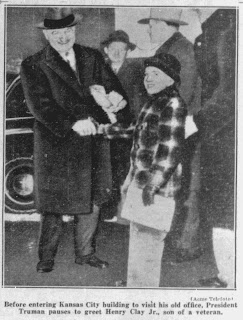 Washington—The White House confirmed yesterday that President Truman’s appearance before Congress next month to deliver his annual message will be televised for the first time in the nation’s history. NBC’s offices in Washington said the event will inaugurate the coaxial link between the Capital and New York, which is scheduled for next month. Not only NBC, but also CBS and DuMont will telecast the event.
While no date for the address has been set as yet, Congress will reconvene on Jan. 14 and Charles G. Ross, White House press secretary, confirmed reports that history’s first television broadcast of a presidential address at the Capitol would be held.
Webs are busy laying the ground-work for the broadcast, taking particular pains that the history-making event will be technically correct. (Radio Daily, Dec. 28).
Friday, December 28
WNBT Channel 1
8:00 “Friday Night Quarterback” with Lou Little.
8:30 “The World in Your Home” sponsored by RCA Victor.
8:45 Boxing at Madison Square Garden. Joe Baksi vs. Freddie Schott.
WCBW Channel 2
8:00 News with Tom O’Connor.
8:15 Film. 8:30-9:00 “Casey, Press Photographer.
Saturday, December 29
WNBT Channel 1
8:00 Pre-game activities.
8:15-11:30 Basketball: L.I.U. vs Bowling Green; St. John’s vs. Kentucky. Madison Square Garden.

Billy Eddy, WBKB director, is increasing his hours of programing for three reasons: (1) It's just part of the general pushing ahead of the station. (2) It's an attempt to approach closer to that goat of 28 hours a week minimum the FCC says video stations must telecast in the future. (3) It is an effort to assist the video set manufacturers in this area who have been using WBKB test patterns when they made special requests for the pattern telecasting in order to test sets they have been developing. Eddy feels it would be better to give these manufacturers program material for test purposes, and thus one reason for the program increase.
The new five hours will be aired Monday thru Friday from 4 to 5 p.m. In the near future Eddy expects to add five more hours to his program structure. These latter new hours will be earlier on weekday afternoons for educational shows, and on Saturday and Sunday.
Long Spot Commercials
A large portion of the now five hours starting January 2 will be used for the new type of long spot commercials WBKB is developing. As a result of a letter Eddy sent out last week asking all the agencies in Chi to put on experimental commercial spots, he has already received answers expressing interest on the part of four big agencies here. Other agencies have said they were referring Eddy's letter to their New York offices, where video policy to created.
The new five hours will also be devoted to other forms of video program experiment. Eddy intends to use them to develop some new shows with which the station staff has been working. By having these program ideas developed to a polished point he will have plenty of program material ready for any potential sponsor showing interest in putting on a commercial show at the station. (Billboard, Jan. 5)
Sunday, December 30
WNBT Channel 1
8:00 Newsreel; Tribute to Alfred E. Smith; “Little Women” by Louisa May Alcott with Margaret Hayes.
9:46 Hockey: Rangers vs. Chicago at Madison Square Garden.
"LITTLE WOMEN"
With Margaret Hayes, Dorothy Emery, Madeline Lee, Billie Lou Watt, Charles Thompson, Fran Lee, Ruth Masters, Tom Seidel, Peter Preses, Gene Blakely, Grania O'Malley, John Robb
Director: Ernest Colling
Tech. Director: Reid Davis
Sets: Bob Wade
70 Mins.; Sunday (29) [sic], 8:30 p.m.
Sustaining
WNBT-NBC. N. Y.
Ernie Colling is rapidly emerging as one of the most competent directors in television. Carrying the brunt of the directorial chores on WNBT's Sunday night full-length plays, Colling has probably elicited the most entertainment possible out of video at its present stage of development.
Presentation of "Little Women" Sunday (29), while not as lively as previous shows because of the outmoded script, measured up in technical detail to almost anything yet televised.
Show, faltering in spots, would have been aided by a tighter script adaptation and a better balance in length of the different acts. First act ran nearly half-an-hour, while the remainder of the show was broken down into four or five different scenes of varying length with a two-minute intermission between each, the whole effect tending to disrupt audience attention. Camera work was especially good, with the cameras sticking to long shots to take in the entire set while several people were on stage but coming in for closeups to catch the actors' facial expressions at the opportune times.
Cast of the play, action of which revolves around an American family of four daughters during the Civil War years, was well-chosen. Margaret Hayes as Jo, the role she is now playing in the City Center version of the play, at times sounded like Katharine Hepburn, who played the part on the screen, but this added to the effectiveness of her acting. Other sisters included Dorothy Emery, Madeline Lee and Billie Lou Watt, with Miss Lee's sister, Fran, portraying the mother. (Variety, Jan. 2)
Little Women
Reviewed Sunday (30), 8:20-9:20 p.m. Style—Drama. Sustaining over WNBT (NBC), New York.
Credit Ernest Collings with doing a top-drawer job of staging, cutting and camera reporting of Louisa M. Alcott's Little Women. He deserves credit, multiplied by some 100 per cent, since several of the cast came direct from the City Canter—Frank McCoy's presentation of the play, which smelled to theatrical heavens, as reported last week—and there wasn't a dull moment or a stupid performance in the entire NBC scanning. That's something to report—any time, any place. In fact, the show was good enough to have been an Ed Sobol job, and this reviewer knows no better way of saying "Great!" at this stage of video.
The camera handling was masterful, and what was stagy and unreal across last week's footlights was real, solid, spine-tingling stuff this evening, via the ike. You were there.
Innovations?
Zero.
But it didn't matter, because the job was so smooth, so real, that you forgot that you were seeing it via air pix and felt you were back in the 19th century with the March menage. Jo (Margaret Hayes) was right out of the Alcott pages—many times, better than in the theater—and she wasn't bad there. Meg (Dorothy Emery), not of the McCoy production, was real. As a matter of fact, everyone, as we said before, was swell. Laurie (Tom Seidel) was the Alcott lover. Professor Bhaer (Peter Freses) was right out of the old Vienna school, and Hannah (Grania O'Malley) might have been the cookhouse keeper in any household of the Civil War period.
If the elder Marches (Charles Thompson and Fran Lee) seemed a bit young at times to have those four grown daughters, it didn't really matter once the cameras and mikes got under way, for their performance made you forget their make-up.
This should be a yuletide regular, this Little Women, if they can get Collings and co- workers, Reid Davis and Bob Wade, to do it. The interior set by Wade was right out of the Victorian era.
We've never thought of Little Women as being ace theatrical fare at its best. We were wrong, it was just that on tele- vision this evening. Joe Koehler. (Billboard, Jan. 5)
Monday, December 31
 WNBT Channel 1
8:00 Tribute to 1945.
8:02 Feature Film: “On Approval” with Beatrice Lillie and Clive Brook (Gaumont, 1945).
9:18 Televue: Toronto Symphony.
9:30 Hockey: Rangers vs. Montreal at Madison Square Garden.
9:45 Times Square Pickup.
9:55 Hockey, Third Period.
10:30 Times Square revelry.
11:00 “Year End Varieties.”
11:50 Times Square at Midnight.