
 Of the three TV stations on the air in New York in March 1944, DuMont was the leader in programming. Thanks to a bit of help.
It already had a deal in place with ad agencies to use its airwaves on Wednesdays and WOR radio to fill time on Tuesdays. Now it inked a deal with WNEW radio to supply programmes to each other. It’s unclear how anyone could expect WNEW’s “Make-Believe Ballroom” to work on TV; the whole idea was to pretend the records being spun by Martin Block were the musicians and singers performing live (the show never made it onto TV).
WNBT was broadcasting a few live, on-location sports events that it offered to its two quasi-affiliates, but the majority of its programming in March 1944 was films. That’s all WCBW continued to air, two hours, two nights a week.
Of note in the reviews below is all the technical staff at WBKB in Chicago was female, understandable as men were off to war. A number of them continued in the television industry after the troops returned from overseas.
Below you’ll find the New York TV schedule, along with some reviews of programmes, including some from Chicago and other cities, and links to a few films. Unfortunately, the Herald Tribune and Times stopped being specific about short films the stations were airing.
There’s little from the West Coast. W6XAO was still live on the air every other Monday, alternating with films on opposite Mondays. The Los Angeles area’s other station, W6XYZ, had some live programming on Wednesdays. National Enterprise Association columnist Erskine Johnson was asked to appear on March 22 in connection with a preview of Diana Lynn's new movie and relates his experiences in a story published March 31.
Wednesday, March 1
W2XWV Channel 4
8:15 P.M Studio Varieties.
8:45 Film Short.
9:00 Face of the War, news and analysis by Sam Cuff.
9:30 Film Short.
9:45 Glorianne Lehr, Fashion Revue.
A Variety show with the Covered Wagon Girls and other acts will be televised by W6XYZ at 9. (Hollywood Citizen-News, March 1)
Thursday, March 2
WCBW Channel 2
8 to 10 p.m. Films.
Friday, March 3
WCBW Channel 2
8 to 10 p.m. Films.
Saturday, March 4
no programming.
NEW YORK, March 4.—A swap of time, convenient to the interest of both parties concerned, has been engineered by WNEW and W2XWV, the experimental television station operated by the Allen B. DuMont Laboratories.
The deal calls for selected WNEW features to be televised, in return. W2XWV will air informal forum discussions on post-war audio-visual work along with dramatizations of the history of tele vision on WNEW.
WNEW features to be televised include Paula Stone's Hollywood Digest; Martin Block's Make-Believe Ballroom; Spanish lessons and music, and several G. I. shows, the last named mainly with an eye toward recruiting. The telecasting is expected to begin soon after the completion of work on the new DuMont studios here in about four weeks. (Billboard, March 11)
NEW YORK, March 4.—W2XWV, the Allen B. DuMont Studios, is being equipped for 16mm. picture projection. At present only 35mm. film is used. (Billboard, Mar. 11)
Sunday, March 5
 W2XWV Channel 4
8:15 p.m. “Plays on Parade.”
8:30 Film: “A.B.C.D. of Health” (1942).
8:45 “Theatre House,” serial.
9:15 Film cartoon: “Singing Saps” (Van Beuren, 1930)
9:25 Bureau of Missing Persons
9:30 Lois Baker, songs
9:40 Doug Allan’s “Thrills and Chills.”
“THEATRE HOUSE”
With Gitz Rice, Irving Fisher, Jean Lewis, Joan Lloyd Jones, Freeman Hamond, Loretta Schere, Edith Huleck, Marie Kenny, Marion Moore, Marlon Newberry, Joan Lloyd
Writer-Director: Jay Strang
30 Mins; Sun., 9 p. m.
Sustaining
W2XWV-DuMont, N. Y.
Sixth chapter of "Theatre House," dramatic serial deviated from its accustomed line in favor of straight variety, running the gamut from a Swiss bell ringer (Diana Day) to a Met opera singer's (Edith Huleck) version of "Besame Mucho." Show was loosely woven, a factor not mitigated by program's impromptu nature, and camera work was blunted more often than not.
Talent acquitted itself generally well, exhibiting little of the self-consciousness manifested by most tele performers. From an entertainment standpoint, however, program was porous and lacking in sustaining interest.
Numbers included Marion Newberry's singing of "My Man" and "Je Vous Aime Beaucoup." and Loretta Schere's warbling of Cole Porter's "I Love You'' and "With All My Heart." Irving Fisher also intoned, and Gitz Rice, who arranged the music for the show, was the recipient of a “Happy Birthday” finale that did not run to schedule.
Program also included an excerpt from J. B. Priestley's play, "I Have Been Here Before." demonstrating a praiseworthy maturity of approach that radio might well copy. Although the metaphysical aspects of the play was touched on only lightly, it was a compelling episode despite its ultra conciseness and strained acting. It presages a wide vista for similar efforts through which tele might well find its level. Jona. (Variety, March 8)

Monday, March 6
WNBT Channel 1
8:00 P. M. Day in Venice; Wrestling: Freeman vs. Venable, also Matsudo vs. Reynolds; The War as It Happens.
8:35 Feature Film: Sign of the Wolf with Grace Bradley and Michael Whalen (Associated Artists, 1941).
9:45 Televues: Emanuel Feuermann, Cellist.
Thomas S. Lee’s Hollywood Television Station, W6XAO, as its bi-weekly offering, tonight at 8:00 to 9:30 will present a new program, “Illustration, Please,” designed by Fred G. Runyan. Aim is to translate the popular radio quiz-type show into a visual program in which experts will complete in developing ideas suggested by non-experts. Clifford McBride, creator of “Uncle Elby and Napoleon,” and illustrator Andrew Loomis will be among the entrants. (Hollywood Reporter, Mar. 6)
Tuesday, March 7
W2XWV Channel 4
8:15 P M. WOR’s “Here's Looking at You.”
8:40 Forum-Discussion.
8:50 Film Short.
9:00 WOR Television Revue.
B & K Television, Chicago
Reviewed Tuesday (March 7), 7:30 to 8:30 p.m. Contents—News, films, songs and drama. Sustaining on WBKB, Chicago.
After seeing this tele show one finds it hard to decide whether it's fortunate or unfortunate that there are only approximately 400 television receivers in the Chicago area. Some parts of the show were very good, and it was just too bad only a small audience could witness them. Some parts proved that television has many a hill to climb, and it was just as well that only a few people had a chance to judge the medium by present-day limited standards of telecasting.
The show led off with a newscast by Dan Cubberly. He was pictured in a make-believe newsroom, surrounded by reams of teletype copy. Even tho he merely read the copy, he did it in good video style punctuated with plenty of personality. Background settings were effective, giving the impression that Cubberly was getting the news hot off the wires.
Cubberly faded out and Wayne Van Dyne, tenor, faded in, introduced by clever screen title. Van Dyne was assisted by O'Del Hunter, both of whom were good. The camera work in this portion of the show was excellent—good fades from close-ups to distance shots, good camera composition. Here it was proved that Helen Carson, who produces those shows, has a competent staff of studio assistants—even tho all 10 are girls. They handled the camera okay and did good work on lights.
After that, oh, brother! The films which followed proved that tele will never get anywhere with productions made for the movie screen. Broken Earth, the first offering, might have been an okay pic, but it was never meant for television. Lighting was very poor, and some portions of the piece were hard to see. When characters were followed from afar as they climbed a hill, they were indistinct long before they got to the top. Second film, Getting Your Money's Worth, was so bad it had to be stopped after first few minutes.
The bad taste left in the mouths of the audience by the films was washed out by the drama that followed. Using an original radio script by Rae Zolun, Miss Carson adapted a forceful bit entitled Mercy in the Wilderness. Excellent settings and backgrounds were employed: even outdoor scenes were presented with an appearance of reality. Five hours of rehearsal were put in on the 25-minute dramatic piece, and it was worth it. The actors, George Cisar, Charles Goff, Fred Howard and Charles Eggleston did a job that proved they have a spot in future tele acting. The camera close-ups packed a punch, and with the smooth continuity helped to sustain interest. The entire piece proved that when it comes to dramatics, B & K's Chicago tele staff will not take a back seat for anybody in the business. It was this portion that saved the show. Cy Wagner. (Billboard, Mar. 25)
Wednesday, March 8
W2XWV Channel 4
8:15 “Man of Magic” varieties.
8:45 Film Short.
9:00 Face of the War, news and analysis by Sam Cuff.
9:30 Film Short.
9:45 Interesting People.
DuMont Television
 Reviewed Wednesday (March 8), 8:15-10:15 p.m. Style—Variety and films. Sustaining on W2XWV, New York.
These sponsored telecasts show some improvement in programing over three months ago. The producers of each portion of the show will undoubtedly agree that they are not yet turning out first-class entertainment. A definite form is beginning to evolve from the practice sessions that holds promise of better shows to come.
For one thing, timing is better than heretofore. The addition of DuMont's Dotty Wooten to the cast as announcer for the all-over production holds the parts together as a unit. Inferior pix still bore the audience, and an increased use of printed program announcement placards, reminiscent of early silent movies, detract.
It is apparent that more rehearsal and tighter scripts are needed. Camera and light technicians are still sometimes a little careless. But ideas worth remembering and using later are popping up with increased regularity, proving that practice will eventually mean perfection. At times, the, it appears that the goal is a long way off.
The mentalist, Felix Greenfield, clicked for Charles A. Storm Agency in a routine of fast patter and mental gymnastics. An assortment of individuals from the "studio audience" willingly stooged for Greenfield. A group of Conover models participated in one part of the Storm show. Improper lighting, bad make-up and lack of script for the girls made them appear inane and un-pretty.
Commercials for Tintex has [sic] remained static. Figure turning on a tiny platform in front of a sign bearing the product's name, with a fem voice plugging the dye over soft, recorded music has varied little with the passing weeks.
Best introduction of the evening was the revolving cans of Spry for Lever Bros. program. Sprightly radio trademarked tunes create the right atmosphere for the product's innocuous exploitation. Pat Murray, emcee, continued as the deft guide for talent and plugs thru an entertaining half hour.
Frank Forrest, vocalist of the Double or Nothing program on MBS, discussed the art of pastry making with Murray, while a demonstrator's hands carried thru from Spry to pie. During the time the pie was in the oven, Forrest sang Oh, What a Beautiful Morning. He registers vocally and visually as a tele natural.
Sam Cuff's Face of the War was dull. His geopolitics weren't up to par because of a dearth of factual news items. He usually has lively material that is interestingly presented.
Ruthrauff & Ryan deserve a bow for creating variations on the Spry show. They retain the original format and increase commercial plugs without loss of entertainment.
Interesting People, sponsored by Ben Pulitzer creations, produced by Irwin A. Shane and emseed by Dick Bradly, featured three personalities who told of their unusual experiences. Kay Sheen discussed her flight from a Jap-held Chinese port, sang two Chinese songs and plugged a Chinese fund. Carl Rock, civilian pilot, told of bringing his burning plane to safety for which he was awarded the air medal. Joyanne Loree, 10-year-old flamenco dancer, executed her dances with authority and poise.
The sponsor's ties were displayed and plugged by Bradly and Marie Howard, who doubled, as usual, as cravat sales lady and songstress. Wanda Marvin. (Billboard, Mar. 25)
NEW YORK. March 11.—Television took another step forward last week when the army and navy agreed to release film from the fighting fronts to NBC's television station, WNBT, simultaneously with newsreel theaters, Programs are being relayed to WBGB [sic], Schenectady, N. Y. In addition, the films are sent to WPTZ, Philco's television outlet in Philadelphia. (Billboard, Mar. 18)
Thursday, March 9
WCBW Channel 2
8 to 10 p.m. Films.
Friday, March 10
WCBW Channel 2
8 to 10 p.m. Films.
Saturday, March 11
WNBT Channel 1
8 to 10 p.m. Films.
Sunday, March 12
W2XWV Channel 4
8:15 p.m. Wide Horizons.
8:45 Film short.
9:00 Television Canteen.
9:30 Film short.
9:45 “Theatre House,” serial play.
Monday, March 13
WNBT Channel 1
8:00-10:00 P.M. Films: To be announced.
Tuesday, March 14
W2XWV Channel 4
8:15-9:15 P. M. WOR Variety Show
“WOR TELEVISION VARIETIES”
With Martha Deane, Bruce Elliot, Mrs. Emma Van Coutren, Walter Shaver, Thelma Sobel, Lee Wallace, Dick Ettlinger, Theresa Rillo, "Red River Dave," Sonia Stolin, WOR Cuties (4), Mel Heimer, Paul Killian, Bill Pause, "Lucky" Fields, Bernard Tunis, Phil Senna and Bob Emery
Producer-Director: Bob Emery
60 Mins., Tuesday, 8:15 p.m.
Sustaining
W2XWV-DuMont. New York
This program is an honest endeavour to corral talent for television when this medium really starts rolling in the post-war. As such it is commendable, but as entertainment, from which angle the entire setup must be judged, it is amateurish and unabsorbing.
It is hardly understandable how a producer or director of a television show can permit the muddling and out-of-focus performance which comprised "WOR Television Varieties" in the main. Possibly Bob Emery, who pilots the program and also m.c.s, did not have enough time to lead his actors on a run-through before the stanza went on, but whatever the reason, the performers, including Emery himself, at times moved out of range of the center of the video camera, resulting in elongated figures flashing on the screen too often for comfort.
Possibly DuMont and the other television moguls, should revamp the technical staff setups and bring in men from Hollywood familiar with the technical side of film-making who, in many observers’ opinion, are the lads who will have to take over the production end of television. A picture director or producer would not permit such slipshod programs to go on in any event, not before making a try at having some quality to the finished product.
Most of those who appeared before the camera during this stanza (14) were so self-conscious, those witnessing the program squirmed in their seats from embarrassment. Their chores suffered as a result. Martha Deane, veteran Mutual radio commentator, and announcer Bruce Elliot, who handles her commercial spiels, both had to be shown by Emery where to look in order to come into focus correctly. It would take little time for them, and the others as well, to learn at what angle the video cameras could catch them for best results.
Format of the program ranged from music by singers and musicians to an interesting demonstration by soundman Walter Shaver of how he produces sound effects with such everyday items as a nail file, a bureau drawer and a basketball bladder with pebbles inside. Sten. (Variety, Mar. 22)
WOR-DuMont Television
Reviewed Tuesday, 8:15-9:15 p.m. Style—Variety. Sustaining on W2XWV (New York).
With Bob Emery as producer and director, WOR's Video Varieties for the first time had a professional air about itself. The radio vet, he emseed the telecast, put on a show that smacked of advance preparation. Thus his cast, Martha Deane, Bruce Elliot, Emma Van Coutren, Paul Killiam, Lucky Field, Teresa Rillo and Sonia Stolin, pro and non-pro alike, worked with an air of assurance. There was little of the uncertainty that's evident when a performer doesn't know what is coming, where it is coming from and when.
Thus is it possible to fairly criticize entertainment values and abilities, which is where these programs are still in the experimental stage.

Another plus to Bob Emery's credit on this program was his sparing use of singers. Only two on this session, Bruce Elliot and Sonia Stolin. Elliot showed a good pair of pipes with You Are My Sunshine. But Miss Stolin, and Teresa Rillo, an accordionist, were both young enough to come from Rainbow House, the Bob Emery radio show of kids, and so were almost devoid of poise and personality. Sight plus sound is a tough hurdle for youngsters.
One glaring error was Emery's injection of a hymn-singing quartet. This is okay on Sunday mornings but on a variety show, such as this hopes to be, hymns are as enervating as wet blankets. Paul Killiam interviewed a reporter and a cartoonist; okay but not exceptional. About the best bets were Lucky Field, who did a routine of charades, based on book titles, that were genuinely funny, and the Red Cross appeal.
Latter used Mrs. Van Coutren, mother with 13 children in uniform, for a sob appeal; this was followed by a tableau of service men and women that was faded-on as she finished her talk. Another good stunt was a sketch about sound effects. The cast ran thru the piece, then the camera switched off-stage while the sound-effectsman demonstrated.
All and all tho, it was one of the better programs. In addition to his smooth handling of talent and situations, Bob Emery came up with Ginger Gray to handle make-up, and Bill Wirges, vet batoneer, for his musical backgrounds and accompaniment. They know the score. Wanda Marvin. (Billboard, Mar. 25)
Wednesday, March 15
W2XWV Channel 4
8:15 P.M. Studio Varieties.
8:45 Film Short.
9:00 Face of the War, news and analysis by Sam Cuff.
9:30 Film Short.
9:45 Fashion Revue.
WNBT Channel 1
8:00-11:00 P.M. Golden Gloves Boxing Bouts, Madison Square Garden.
GOLDEN GLOVES BOXING BOUTS
From Madison Square Garden, N. Y.
Wednesday (15), 8-11 p.m.
Sustaining
WNBT-New York
If Uncle Mike Jacobs, reigning czar among fistic promoters, o.o.'ed NBC's video version of the amateur bouts staged in Madison Square Garden last week (15), he must have made a mental note to huddle, but quick, with John Royal, Allen DuMont or anyone else who could set him straight on how to get in on the new-fangled “newsreels” and protect his business investments.
Series of simon pure finals came through excellently on both screen and speaker, with only noticeable flaw being occasional loss of clarity when boxers and referee operated on far side of ring and thus were backgrounded by rows of ringsiders. Dark clothing of latter, naturally, swallowed the principals temporarily, but never so completely that the action could not be seen.
Smallness of image did not allow facial characteristics of contestants to bloom in full flower, but contrasting styles of boxers, plus occasional identifying remarks by spotters Clem McCarthy and Bob Stanton, made it easy to follow tide of battle. Satisfying to the fight fan was the fact that power behind and damage done by punches were detected at once via video.
Crowd noises came in well, giving fireside spectator most of the flavour of actual attendance, with bell, buzzer, voice of Garden announcer and ringside rooting adding up to authentic arena atmosphere. Tele announcers used fine judgment in letting the screen tell the story, with explanatory chatter reserved for between rounds and in other spots when action lagged.
Tele technique for sports announcers, as exemplified in this presentation, seems certain to revolutionize the Stern-Husing tonsil tearing school and eliminate much of the confusion heretofore encountered by bewildered fans. Never again, after television arrives, will home listeners work themselves into a frenzy over a fight broadcast, only to learn in the a.m. papers that the "battle" was a stinkeroo; that ringsiders started flocking out as early as the fourth round, and even one of the judges dozed off during what the radio announcer described as a “couple of bulldogs locked in a thrilling toe-to-toe exchange—right-left-right-left-right-left—he almost went down; no-he's-up-what-a-fight, boy-oh-boy-what-a-fight!”
From that angle alone tele can't come soon enough. Dona.(Variety, Mar. 22)
Thursday, March 16
WCBW Channel 2
8 to 10 p.m. Films.
Friday, March 17
WCBW Channel 2
8 to 10 p.m. Films.
B & K Television, Chicago
Reviewed Friday, March 17. Contents—WAC recruiting. Sustaining on WBKB, Chicago.
First WAC recruiting telecast in these parts was nothing sensational albeit effective. Program really scored in the local papers, which gave plenty of print and photo space to stunt.
Conceived by Lieut. Paula Amrein and written by Lieut. Anne Hatfield, both of Sixth Service Command Public Relations, the show was a straight dramatic illustration of how a WAC can take over chores of servicemen. Theme hugged the title These Are the WACS, so had a simple yet potent appeal.
If there were enough video outlets this might be the solution to the female service enlistment problem. Cy Wagner. (Billboard, Mar. 25)
Saturday, March 18
no television programmes.
Sunday, March 19
W2XWV Channel 4
8:15 p.m. Wide Horizons.
8:45 Film short.
9:00 Television Playhouse.
9:34 Film short.
10:00 “Theatre House,” serial play.
Monday, March 20
WNBT Channel 1
8:00-10:00 P.M. Films: To be announced.
Elliot Paul, author of “Death of a Spanish Town” and “The Last Time I Saw Paris " will be interviewed by Howard Campbell, correspondent on Television Station W6XAO at 8. Blondes are “blizzard heads,” brunettes, “dark angels” and redheads “problem children” to television engineers. Redheads may absorb or reflect light. (Hollywood Citizen-News, March 20)
NEW applications received by Thursday of last week at the FCC request facilities for five new commercial television stations, seven new FM outlets, two standard stations and one non-commercial educational station. . . .
Applicants seeking new commercial television outlets are Havens & Martin, Richmond, Va. (licensee of WMBG), Channel 3, 3 kw aural, 4 kw peak visual; Bamberger Broadcasting Service Inc., Washington, D. C.; Channel 4, Philadelphia, Channel 7; Louis Wasmer Inc., Spokane (KGA-KHQ licensee), Channel 1; Allen B. duMont Labs., Washington, D. C., which has applied for a construction permit for reinstatement of W3XWT with 2 kw aural, 4 kw peak visual, and special and A 5 emission. (Broadcasting, Mar. 20)
Tuesday, March 21
W2XWV Channel 4
8:15-9:15 P. M. Variety Show
TELEVISION set owners, and radio listeners participated last Tuesday, March 21, in ceremonies attending the award of the Army-Navy "E" to the Allen B. DuMont Labs., New York. Presentation was filmed by Paramount News in Central Theatre, Passaic, N. J. at 3 p.m. and the reel telecast the same evening at 9:15 p.m. on W2XWV, DuMont's station in New York. A recording of the ceremonies was broadcast on WOR New York. Presentation was made to Allen B. DuMont, president, by Brig. Gen. G. L. Van Duesen, Commanding General, Eastern Signal Corps., Fort Monmouth, N. J., for "pioneering work in engineering expansion and production of cathode ray tubes, oscillographs, and electronic equipment." (Broadcasting, Mar. 27)
Rochester, N. Y. March 21—Stromberg-Carlson Co., owners of WHAM and FM station WHFM, has applied to the FCC for a commercial television license.
At the same time William Fay, v.p. in charge of broadcasting, said the company plans to build a Rochester version of Radio City after the war near its radio and telephone equipment manufacturing plant. The building would be designed to house staffs and facilities of both present broadcasting units and a large auditorium as well as the television station. Fay added that arrangements have been made to obtain television equipment as soon as possible after the war.
Potent television boost came yesterday (21) with applications by Westinghouse Radio Stations, Inc..,to the FCC for video licenses in Boston, Philly and Pittsburgh where the outfit already operates AM broadcasting outlets. Construction of new studios, transmitters and other facilities will follow granting of the licenses and WLB releases on necessary materials.
Westinghouse's Philly studios (KYW), built in 1938, contain partly completed television facilities, with space allotted for lights, cameras, booms, etc. KYW arrangements will allow for AM, FM and video shows to be produced and broadcast at the same time in the same quarters. (Variety, March 22)
Wednesday, March 22
W2XWV Channel 4
8:15 P.M. Televisual specialties.
8:45 Film Short.
9:00 Face of the War, news and analysis by Sam Cuff.
9:30 Film Short.
9:45 Interesting People.
DuMont Television
Reviewed Wednesday, 8:15-10:15 p.m. Style—Variety and films. Sustaining on W2XWV (New York).
A point-by-point reckoning of the programs of the three agencies participating in tonight's show puts Charles M. Stone first, Ruthrauff & Ryan second, with Joseph Reiss in third place. Frim [sic] an advertising slant, however, none came thru with a first-class commercial. Storm presented good entertainment but no product exploitation; R&R touched lightly on Lifebuoy plugs, while Reiss tediously talked ties in overlong commercial script.
The over-all entertainment picture was better than some recent Wednesday night shows. Storm pulled the score up with its carefully directed, nicely costumed Gay '90s. Singers, in solo and group numbers, contributed seven vocal acts. Show was a little heavy on the warbling side, but an excellent set, consisting of a painted backdrop and realistic props, helped considerably.
Ruthrauff & Ryan's Lever Bros. half hour completely changed its format with Paul Wing's Words On the Wing, a spelling bee. A team of WAVES competed with a trio of sailors in a rather dull program. Imaginative script and a more colorful emsee might make the idea worth repeating. By keeping his eyes glued to his script, Wing never missed a cue; neither did he make much of a tele appearance. Commercial plugs were limited to revolving boxes of Lifebuoy soap and a clarification of its spelling during the contest.
 Reies's Interesting People had a femme singer, a child actress, and Guy Kibbee. The last named did the 15-minute monolog he has been doing for servicemen. Directly wisely kept Kibbee in close-up most of the time to capitalize on his gestures and facial expression.
 The Ben Pulitzer tie commercials need revision. Dick Bradley and Marie Howard will have to have better material to keep the plugs from being unconvincing. Reflection from chrome tie-rack cut a swath of light across the screen. Fixtures should be dulled.
Four British shorts, interspersed between agency shows, dragged into an uninteresting half hour. Station spokesman promises that when W2XWV's 16mm. projection equipment is installed, pix will improve due to larger selection in this range. Wanda Marvin. (Billboard, Apr. 1)
First preview by television of an unreleased major picture will be undertaken tomorrow night by Television Productions, Inc., a Paramount subsidiary, when using still clips from the film, it will present Preston Sturges.
The Miracle of Morgan’s Creek, a Paramount pic, does not open locally within the range of TP’s station W6XYZ until the following day [22].
Arranged by Klaus Landsburg, TP’s director of television the broadcast of Miracle is experimental in the direction of telling the complete story of a motion picture with the intent of arousing interest in seeing the picture in a theatre and without giving away the entirety of what the audience should pay for. (Hwd Reporter, March 21).
PHILADELPHIA, March 22 (AP)—Westinghouse Radio Stations, Inc., announced today it had applied for licenses for three television broadcasting stations—at Pittsburgh, Philadelphia and Boston—to be built as soon as critical materials are available.
Lee B. Wailes, General Manager, said new transmitters, studios and other facilities would be added to the company’s three standard broadcasting stations—KYW Philadelphia; KDKA Pittsburgh and WBZ Boston.
Thursday, March 23
WCBW Channel 2
8 to 10 p.m. Films.
The Feagin School of Dramatic Art will do J. B. Priestley's three-act play, "Time and the Conways" on WRGB, the General Electric television station in Schenectady, Thursday night (23).
Students of Professor George-Wiliiam Smith's class in speech and dramatics at Russell Sage Women's College, Troy, recently presented "Alice in Wonderland" over same station. (Variety, March 22)
Friday, March 24
WCBW Channel 2
8 to 10 p.m. Films.
Saturday, March 25
WNBT Channel 1
8:10-11:00 Basketball at Madison Square Garden, Dartmouth and Ohio State for N.C.A.A. Eastern Regional title.
BOSTON, March 25.—Jumping on the post-war television planning boat, Westinghouse (WBZ here) has filed application with FCC for permission to construct and operate a television station in Boston. At the same time Westinghouse announces the filing of applications for Philadelphia, home office of the parent company, and for Pittsburgh. But it is very likely that Boston will be the first to begin operations. (Billboard, Apr. 1)
Sunday, March 26
W2XWV Channel 4
8:15 p.m. Wide Horizons.
8:45 Film short.
9:00 Television Canteen.
9:30 Film short.
9:45 Meg of the Megacycles.
9:50 Bureau of Missing Persons.
10:00 “Thrills and Chills” with Doug Allan.
Monday, March 27
WNBT Channel No. 1
7:15 P. M. Test Pattern: Time: Red Cross News Film. Etc.
7:35-11:00 Inter-City Finals, Golden Gloves Boxing Bouts, Madison Square Garden. Clem McCarthy and Bob Stanton announcing.
APPROVAL of arrangements whereby War Dept. motion pictures and newsreel releases will be made available for television broadcasting on a non-sponsored basis and for simultaneous release was disclosed last week, with the service immediately available to NBC.
Pool Suggested
Col. Curtis Mitchell, chief, Pictorial Branch, of the Army's Bureau of Public Relations, advised John F. Royal, NBC vice-president, that procedures had been approved working toward handling of future as well as present requirements for telecasting. Copies of the letter, responding to an inquiry from Mr. Royal, also were sent to Gilbert Seldes, CBS television director, and Edmund (Tiny) Ruffner, Mutual, who had made inquiries. The department requested that television broadcasters form a "television film pool" representing all broadcasters who want Army film, with which the Department could deal as a whole. This parallels arrangements made in other pictorial and news fields. The release date for television War Department film, it was specified, will not precede the date on which the same material is available to the American public. (Broadcasting, March 27)
FILING with the FCC last week of three new commercial television applications by Westinghouse Radio Stations Inc. to supplement existing AM stations in Boston, Philadelphia and Pittsburgh, and of a commercial television application by the Stromberg-Carlson Co. for Rochester, coincided with public statements from those companies reporting extensive future commercial video plans. (Broadcasting, Mar. 27)
Tuesday, March 28
W2XWV Channel 4
8:15 P. M. Play: If Men Played Cards as Women Do.
8:45 Film.
9:00 WOR Video Varieties.
WOR-DuMont Television
Reviewed Tuesday, 8:15-10;15 p.m. Style—Variety and films. Sustaining on W2XWV (New York).
WOR's Video Varieties got second billing tonight (28) shunted into the 8:45 slot for the newcomer, Proctor Electric Company's Proctor Playhouse. It also took a back seat in entertainment, the P. P. dramatic presentation was tough competition for any regular tele show to follow.
Rand Darnell directed the P. P's If Men Played Cards as Women Do, a condensation of the George S. Kaufman play. He missed an opportunity to fully experiment with a farce into which product plugs were inserted as part of the plot when he permitted the cast to burlesque them straight.
The men doing women's work, gurgling over a new iron, playing poker for prizes, ripping their friends in the back and showing themselves as a gang of prattle-snakes could have been top draw home au pix. They went sissy and out of the tube went the point. What is worth remembering, however, is that a product can become part of a play and by careless scripting can sell itself effectively.
Charles Stark announced and brought the actors, still in character, to the camera for a bow after the show—a nice touch. Kitchen set with running water in sink was realistic. Entire production showed the polish that only repeated rehearsals bring. Excellent lighting and good mike work added considerably to the 30-minute offering. Newell Emmett Agency produced.
Video Varieties suffered from emcee Bob Emery's balmy approach. It may have been the heavy lip make-up that threw him, but the Rainbow House program director was off the beam thruout the show. He gagged the program along too fast. He practically shoved entertainers out of camera range after they had served his purpose and was flippant to the point of making his televiewers downright uncomfortable.
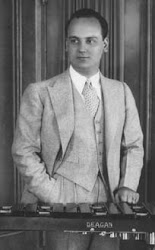 In the WOR talent line-up was Bill Kelly, sweet-potato player par excellence; Lorraine Sherwood, with a Red Cross appeal; Lenny and Ginger, radio jingle composers; the unfunny gagster, Joe Baltin [Bolton]; Sam Herman, on xylophone [photo to right], and Bill Wirges, at the piano in first-rate singles and duet; Bessie Beatty, with husband Bill and Dick Willard in an unimpressive appearance, and Paul Killiam with guest, Marine Lieut. Ruth Moss.
Killiam lost out in the verbal competition after one minute of interview. Miss Moss, an exremely [sic] capable talker, took over and told of her recruiting activities despite Killiam's unhappy interruptions.
If Emery is to add an iota to tele experimention he will have to work on the presentation of talent. He is just going to have to learn to focus attention on the entertainer instead of himself. The show needs a traffic manager to facilitate the graceful entrance and exit of acts. Emery was a cop who rode each car he signaled on its way. Wanda Marvin. (Billboard, Apr. 8)
ANOTHER SPONSOR ventured into the television field March 28 when Proctor Electric Co. Philadelphia, presented the first in a monthly series of one-act plays which were telecast over DuMont station W2XWV. The first program was based on George S. Kaufman's, If Men Played Cards as Women Do, adapted to highlight the Proctor "never lift" iron as an integral part of the play. Agency is Newell-Emmett Co. (Broadcasting, Apr. 17)
B&K Television, Chicago
Reviewed Tuesday, March 28. Contents—Commentary, films and variety. Sustaining on WBKB (Chicago). Who says it will cost a lot of money to put on an interest-holding evening of telecasting? Whosoever says that should have been at WBKB, Chicago, Tuesday night (28) to see an unelaborate series of tele shows during an hour and a half period that was so packed with interesting material this reviewer thought about a half hour had passed when the last scene faded away.
The cost of the show was practically nothing, because, of course, the people on the telecast were contributing their time. But even in the post-war period, when tele talent begins to receive professional wages, the cost of such a show will be small.
For example, Dan Cubberly put on an excellent newscast that would have been a good buy for any sponsor if quality of show and not size of audience were considered. Dan merely sat in a hypothetical newsroom and discussed copy hot off a teleprinter. He didn't merely read the news, as is the case so often in radio now, and he didn't give a pedantic analysis. He merely chatted about the stories, just as a visiting friend might do. He back-tracked often, just as is done in an informal discussion, but that helped to impress the more important stories upon the memories of the audience. And when he stopped for a moment to light his pipe the impression of informality was complete. Even if he had put on his house slippers it would have seemed natural. As he lighted his pipe he could have given with a commercial for a tobacco. And he would have sold. For he had the audience's interest; his informality—the informality of the whole scene—had their friendship. With interest and friendship you could sell fur coats on the equator.
After that Wayne Van Dyne and O'Del Hunter did some singing. This was by far the weakest part of the show. Songs, even when you see the singers, are not enough unless the singer is a Bing Crosby or a Lily Pons. And maybe if you could see Bing's bald head you wouldn't pay any attention to his voice. Things musical should be heard; the opportunity to see musical performers often takes away some of the enjoyment.
Now that B. & K. is able to preview its films, they have not been bad. Tuesday night the Mexican travelog and a comedy cartoon proved this. They were improvements over the films the station televised a few weeks ago, but there's no getting around the fact that films will not be top-notch entertainment until television receivers have a larger screen . . . or pix are shot especially for the air.
On the dramatic portion of the program members of Columbia (Mo.) Stephens College's Radio and Television Workshop put on a piece that again proved good television need not be expensive. Only six girls were in the show; only simple sets were used, and except for a few minor points it was good drama, the life of young women faced with wartime problems. One of the minor points on which someone slipped up is that the girls were not telegenic. Keep 'em good looking and you keep your audience.
Bill Vance finished the show with a gruesome discussion of a couple of history's most famed murder mysteries. Not expensive, again, but its contents and Bill's sardonic relish in his subject kept the eyes focused on the tele receiver. Cy Wagner. (Billboard, Apr. 8)
Wednesday, March 29
W2XWV Channel 4
8:15 P.M. Television specialties.
8:45 Film Short.
9:00 Face of the War, news and analysis by Sam Cuff.
9:30 Film Short.
9:45 Fashion Show.
"WHAT'S NEW WITH MADEMOISELLE"
With Toni Myles, Glendorra Donaldson, Dick Bradley, Fred Carter
Writers-Producers: Frances Hughes, Geri Trotta
Director: Miss Hughes
15 Mins.: Wed., 9:35 p.m.
STREET & SMITH
W2XWV-DuMont, N. Y.
 As might be expected, preem video performance on behalf of Mlle. reflected smart and intelligent approach to problem, but was short on showmanship. Two of the juve fashion mag's editors, the Misses Hughes and Trotta, did a nice condensing job, boiling down contents of the March issue into a 15-minute tele-show, but failed to provide sufficient punch to really sell the stuff.
Show opened with full-screen shot of Mlle.'s cover, and shifted to living room with two smart-looking gals giving their homework the swerve in favor of ooh-oohing over latest issue. Quick rundown of contents followed, with stopoffs for hairdressing and fashion demonstrations. Plugs for Best & Co., and Helena Rubinstein [photo to right] were inserted not very subtly. Modelling and lines were well handled by Toni Myles, striking blonde from the Mademoiselle-John Powers stable, and brunette Glendorra Donaldson, radio and tele actress with past experience in the GE video studio at Schenectady.
Opening chatter was too long, and failed to sell Mademoiselle right off the bat. But when the kids were into the fashion routine it made for smoother sailing. The blonde dressed up a new dress and underwent a hair transformation in a neat demonstration of what tele can mean fashion-wise in the future. Showing of hats however, was done too quickly from the femme viewpoint, so that no real idea of the style, etc., came through on the screen.
A protege of Harlem editor Dan Burleigh, Fred Carter, came on to video former's "Jive Othello" tune published in March issue of mag Strutting and cigar smoking by the dusky shuffler failed to get across Main reason was that camera range never extended to capture dancer's dogs, and his upper body contortions weren't enough to give illusion of stepping. Carter's costumes, supposedly a combo of Shakespeare and zoot suitings, also was lost in video. All music was recorded.
Despite shortcomings, however, Mlle's experimental shot on DuMont gave ample proof that by trial and error a socko format can be devised to sell mass, fashions, fiction, features, etc. on the television screen. Editors Hughes and Trotta definitely are on the right track—they just need a few more shows under their belts. Donn. (Variety, Apr. 5)
Hollywood slant stepped into the television production problem in New York last week [March 29] when “Mademoiselle” videoed a femme-slanted show over DuMont’s W2XWV and ran into make-up problems. After prelim tests on models under lights had them looking like zombies or Ubangis, the Helena Rubinstein organization was called in to devise rouge and powder recipes. After nearly 20 experiments, makeup base of blue and green rouges was adopted and came through okay on the tele screen. Fabric problem on model’s gowns, etc., also is being ironed out. On last week’s show a honey tricked out in a form-fitting pale blue sweater appeared in video to be wearing a shiny white blouse. She didn’t look bad either way, but hep editors think rightly that fabric reproduction must be conquered before tele can tell true story on fashion shows. (Variety, Apr. 5)
Thursday, March 30
WCBW Channel 2
8:00 P.M. Film: Dmitri Shostakovich.
Friday, March 31
WCBW Channel 2
8 to 10 p.m. Films.
Hollywood Column
By ERSKINE JOHNSON
HOLLYWOOD, March 31 (NEA)—Television, the man said, is ready. Why didn't we give it a try?
It was a challenge of things to come in this world of tomorrow everybody is talking about. So, with pad and pencil and wearing a nice blue suit, a silly grin and lips painted brown, we made our debut in television on channel 4—78-84Mc—station W6XYZ, Television Productions, Inc., Hollywood, Cal.
It was lot of fun too. Especially when the very trim legs of Preston Sturges’ cute little secretary, Jean La Veil, also made their debut in television—by mistake.
The program read: "8 p. m.—Test pattern, recorded music. 8:30 p. m.—Diana Lynn interviewed by Erskine Johnson. 8:43 p. m.—‘The Miracle of Morgan Creek,’ told by Preston Sturges with slides from the Paramount picture."
The proceedings were in charge of a very nice gent named Klaus Landsberg, a television technician for the last 10 years.
He supervised the make-up—three shades darker than film make-up—checked the brown lips (they had to be brown because of the lights), lined up the cameras, warned everybody to "keep it informal," rearranged the sets and the lights and the cameras.
There were two cameras. One for close-ups, another for long shots. There was a big green light on each camera to let us "actors" know we were on the air. "But don't look into the camera," Landsberg warned, "unless you're talking direct to the audience."
Keynote, Spontaneity

There would be no rehearsal, no script, Landsberg said. "Spontaneity and informality are the secret of television." The "test pattern" with the recorded music went on the air for a half hour. This test pattern gives the audience time to tune in and for the station to check the transmission. For this first half hour Landberg turned one of his cameras on a little card, giving the call letters of the station. It was then that the shapely legs of Preston Sturges' cute little secretary, Miss La Veil, made their debut.
Unaware that station W6XYZ was on the air, the young lady walked right between the camera, which was close to the floor, and that title card. Everybody went "Oh-h-h-h-h," and Landsberg gnashed his teeth. The young lady blushed and then almost knocked over a panel of lights in her confusion. If you were tuned in to W6XYZ that night that's the answer to the sudden appearance of the beautiful legs.
About this time a young lady pushed Diana and your reporter into those wing-backed chairs beside the fireplace, and the sound man gave us a cue.
Shucks, It Wuz Easy.
It was really nothing at all. We talked to Diana about her film career, which is going great at Paramount these days, trying the while to be informal. Then she played the piano. The whole thing took about 15 minutes. It was a very pleasant experience, due mostly to the complete lack of formality.
“We can screen picture now as big as those in film theaters," Landsberg said later. "After the war, you'll be seeing football and baseball game and news events while they happen." Landsberg started In Europe with television, then worked for the Dutch and British government and is now director of Television Productions, Inc., a Paramount subsidiary the only film studio with its own television company.


